
Erpodium glaucum
Common names
Moss
Biostatus
Native
Current conservation status
This is the first complete assessment of all known species of mosses found in the wild in Aotearoa New Zealand with a total of 560 species being assessed. The conservation status of mosses, published in the NZTCS database, replaces all previous assessments of mosses. Data supporting the 2025 NZTCS assessment of mosses has been published on the NZTCS database at https://nztcs.org.nz/reports/1155.
Source: NZTCS and licensed by DOC for reuse under the Creative Commons Attribution 4.0 International licence.
2025 | Threatened – Nationally Critical | Qualifiers: DPT, SO
Category
Non-vascular
Structural class
Mosses
Simplified description
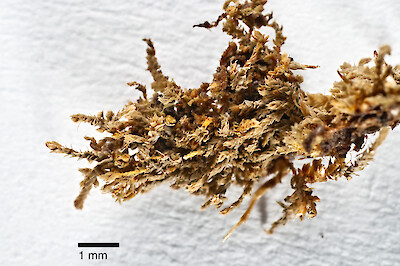
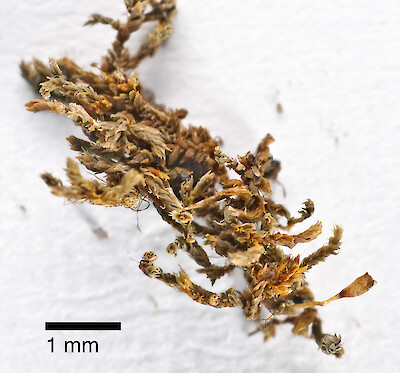
A minute moss distinguished by the blue-grey to grey-colour when fresh, acuminate to acute leaves which lack a nerve and by the distinctive sporophytes which (when present) are covered by a long sheathing calyptra
Detailed description
Corticolous, minute, pale glaucous-green, slender moss. Stems up to 10 mm long, densely matted together, soft and fragile. sparingly radiculose, irregularly or pinnate branched. Leaves c.0.5 mm long, appressed when dry, spreading when moist, the lateral leaves asymmetrical, ovate, acute or acuminate, the ventral leaves symmetrical, distinctly narrowly acuminate; lamina usually with a hyaline apiculus or short mucro, margins plane and entire. Nerve lacking. Cells throughout 12-13 microns long, rounded-hexagonal, thin-walled, multipapillose on both faces. Upper perichaetial bracts much longer than the foliage leaves, sheathing, ovate-acuminate, with longer rhomboid-hexagonal cells. Seta 0.7-0.8 mm long. Capsule up to 0.5 mm long, erect, symmetrical, ovate-globose, mouth truncate. Peristome lacking. Calyptra very long, covering the capsule and the upper part of the seta, plicate, split and twisted.
Distribution
Indigenous. New Zealand: North Island (Te Paki (Unuwhao Bush), Tuhua (Mayor Island), East Cape (Raukokore River)). Also Australia, South Africa, Sri Lanka
Habitat
Corticolous on the bark of trees such as puriri (Vitex lucens) and on the leaves of taraire (Beilschmiedia tarairi). Usually associated with other small foliose liverworts such as Frullania and Lejeunea spp.
Substrate details
Corticolous on bark in coastal forest
Threats
Known from very few collections. Highly threatened by habitat loss. Vulnerable to plant collectors.
Detailed taxonomy
Genus
Family
Synonyms
Aulacopilum glaucum Wilson
Ecology
Fruiting
Although fruit has been seen insufficient information exists to provide any details on the timing of fruiting
Other information
Previous conservation statuses
This is the first complete assessment of all known species of mosses found in the wild in Aotearoa New Zealand with a total of 560 species being assessed. The conservation status of mosses, published in the NZTCS database, replaces all previous assessments of mosses. Data supporting the 2025 NZTCS assessment of mosses has been published on the NZTCS database at https://nztcs.org.nz/reports/1155.
Source: NZTCS and licensed by DOC for reuse under the Creative Commons Attribution 4.0 International licence.
2014 | Threatened – Nationally Critical | Qualifiers: SO
2009 | Threatened – Nationally Critical | Qualifiers: DP, TO
2004 | Threatened – Nationally Critical
Referencing and citations
References and further reading
Sainsbury, G.O.K. 1955: A handbook of the New Zealand mosses. Royal Society of New Zealand Bulletin 5.
Attribution
Fact sheet prepared for NZPCN by P.J. de Lange 29 August 2011. Description adapted from Sainsbury (1955).