
Ficus pumila
Common names
creeping fig
Biostatus
Exotic
Conservation status
Not applicable
Category
Vascular
Structural class
Trees & Shrubs - Dicotyledons
Flower colours
Green
Detailed description
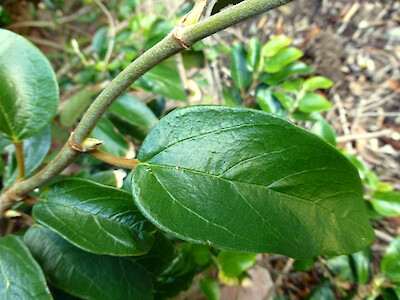
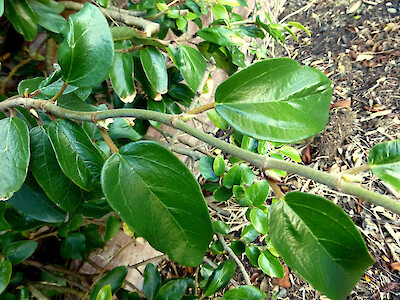
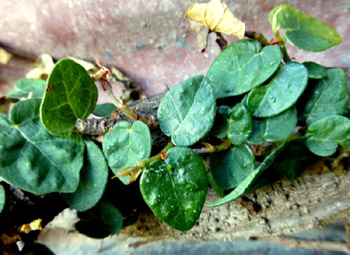
Evergreen, monoecious, scandent shrub becoming +/- erect at flowering. Young stems moderately to densely hairy, becoming glabrous. Leaves glabrous above, finely hairy below when young but becoming +/- glabrous, not lobed, entire, ovate to elliptic, cordate and often asymmetric at base, obtuse to acute, 1.5-3-(4) cm long on young scandent shoots, up to 12 cm long on the more erect flowering shoots; veins very prominently raised below; petiole< blade; stipules 2 per node, densely hairy, triangular, caducous. Inflorescence hairy, pyriform to subglobose, green, shortly pedunculate. Syncarp purplish pink, 2-8 cm long; achenes not seen. (Webb et al. 1988).
Habitat
Terrestrial. Moderate to full sun. Vicinity of old or abandoned gardens, climbing up buildings, walls, telegraph poles.
Detailed taxonomy
Genus
Family
Endemic family
No
Ecology
Year naturalised
1981
Origin
Japan, China
Reason for introduction
Ornamental
Life cycle and dispersal
Perennial. Can’t set seed but climbs and adheres to paintwork etc., resulting in some damage to walls not seen as a problem yet (Ewen Cameron 1996).
Other information
Etymology
ficus: The Latin name for fig tree, possibly derived from the Hebrew word fag
pumila: Small