
Fissidens oblongifolius
Common names
moss
Biostatus
Native
Current conservation status
This is the first complete assessment of all known species of mosses found in the wild in Aotearoa New Zealand with a total of 560 species being assessed. The conservation status of mosses, published in the NZTCS database, replaces all previous assessments of mosses. Data supporting the 2025 NZTCS assessment of mosses has been published on the NZTCS database at https://nztcs.org.nz/reports/1155.
Source: NZTCS and licensed by DOC for reuse under the Creative Commons Attribution 4.0 International licence.
2025 | At Risk – Uncommon | Qualifiers: Sp, DPR, DPS, DPT, SO
Category
Non-vascular
Structural class
Mosses
Detailed description
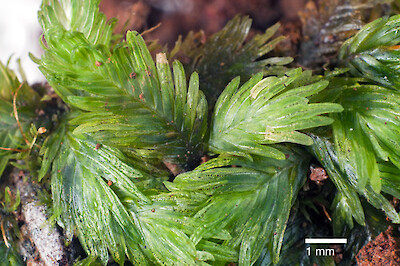
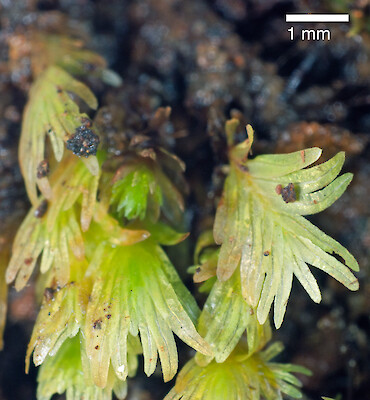
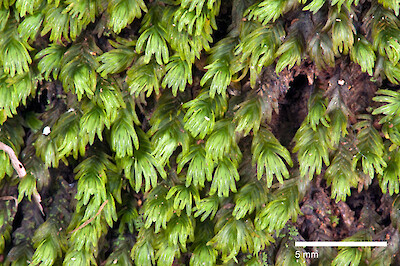
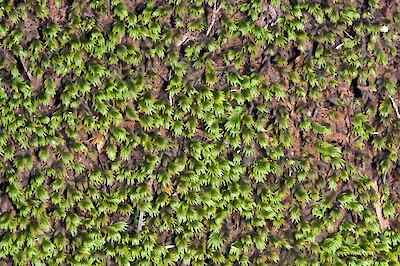
Plants 5-25 mm long, sometimes black below, loosely gregarious. Stems frequently branched by means of innovations below the terminal gametoecia, with rhizoids at the base only. Leaves in 15-30(-40) pairs, overlapping in mid-stem, patent, plane when moist, tips loosely and irregularly rolled up when dry, tending toward the substratum, lingulate, 1.7-3.0 x 0.2-0.35 mm; the apex acute to obtuse; laminae unistratose; the vaginant lamina up to 2/3 the leaf length, half-open to closed; margins serrulate-crenate on the apical, dorsal, and the vaginant laminae, with cells of the suprabasal vaginant lamina margins isodiametric to oblate; cells of the apical and dorsal laminae irregularly hexagonal, smooth, strongly bulging. Dorsal lamina tapered to base, often failing above the insertion; cells of the apical and dorsal laminae (6-)8-11(-15) x (6-)8-11(-15) µm. Costa failing below the leaf apex. Gonioautoicous. Perigonia axillary on the fruiting stems, bulbiform, conspicuous. Perichaetia terminal on main shoots and innovations, perichaetial leaves longer than the vegetative leaves. Setae 5-10 mm; capsules horizontal to inclined, moderately to strongly asymmetric, 5.0-1.0 mm. Calyptra and mature spores not seen in New Zealand material.
Similar taxa
Most often confused with Fissidens asplenioides from which it differs by its dark green rather than yellow-green colour and by the suprabasal region of the vaginant lamina which in F. asplenioides has marginal cells taller than wide, and the margin itself is entire (or nearly so), whereas in F. oblongifolius the marginal cells are wider than tall and the margin is distinctly serrulate (see Beever et al. 2002). From the two other allied members of the F. oblongifolius complex, F. oblongifolius is distinguished by a suite of characters than include the presence of bulbiform axillary perigonia; perichaetial leaves longer than the vegetative leaves; by the longer setae and absence of calyptra and mature spores (Beever et al. 2002). Fissidens oblongifolius is usually terricolous and seems more tolerant than F. capitatus and F. hyophilus of drought and exposed conditions.
Distribution
Indigenous. New Zealand: Kermadec Islands (Raoul Island), North Island (Te Paki, Ahipara, Bay of Islands and Rangitoto Island), Chatham Islands (Rekohu). Also Australia.
Habitat
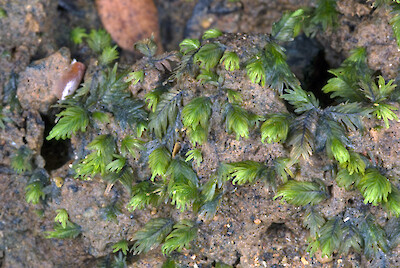
Terricolous and saxicolous. Coastal to lowland in open scrubland (especially on exposed clay pans or under a light shrub canopy) but also in stream beds, on water saturated banks, in seepages, around cave entrances, amongst rocks, in crevices and in dense forest.
Substrate details
Rock, saprolite, and clay.
Threats
Fissidens oblongifolius is now known to be a sparsely distributed, naturally uncommon species of mostly northern New Zealand. It is most common in Te Paki where it is the dominant Fissidens species of the exposed ferricrete clay pans and erosion gullies of North Cape (which is a fully protected area). Elsewhere in New Zealand it seems to be genuinely scarce and in some areas is only known from a handful of plants. Beyond habitat loss in some coastal areas through residential development there seem to be no major threats affecting this species.
Detailed taxonomy
Genus
Family
Synonyms
Fissidens oblongifolius Hook.f. et Wilson var. oblongifolius
Endemic taxon
No
Endemic genus
No
Endemic family
No
Ecology
Fruiting
Sporophytes although not common may be seen throughout the year
Other information
Etymology
fissidens: From the Latin fissio ‘fission’ and dens ‘tooth, prong’ meaning split tooth and referring to shape of the lamina.
NVS code
The National Vegetation Survey (NVS) Databank is a physical archive and electronic databank containing records of over 94,000 vegetation survey plots - including data from over 19,000 permanent plots. NVS maintains a standard set of species code abbreviations that correspond to standard scientific plant names from the Ngä Tipu o Aotearoa - New Zealand Plants database.
FISOBL
Previous conservation statuses
This is the first complete assessment of all known species of mosses found in the wild in Aotearoa New Zealand with a total of 560 species being assessed. The conservation status of mosses, published in the NZTCS database, replaces all previous assessments of mosses. Data supporting the 2025 NZTCS assessment of mosses has been published on the NZTCS database at https://nztcs.org.nz/reports/1155.
Source: NZTCS and licensed by DOC for reuse under the Creative Commons Attribution 4.0 International licence.
2014 | At Risk – Naturally Uncommon | Qualifiers: DP, SO, Sp
2010 | At Risk – Naturally Uncommon | Qualifiers: DP, SO, Sp
2005 | Data Deficient | Qualifiers: SO
Referencing and citations
References and further reading
Beever, J. Malcolm, B.; Malcolm, N. 2002: The moss genus Fissidens in New Zealand – an illustrated key. Nelson, Micro-Optics Press.
Attribution
Fact sheet prepared for NZPCN by P.J. de Lange August 2007. Description adapted from Beever et al. (2002).