
Fissidens rigidulus var. pseudostrictus
Common names
moss
Biostatus
Native – Endemic taxon
Current conservation status
This is the first complete assessment of all known species of mosses found in the wild in Aotearoa New Zealand with a total of 560 species being assessed. The conservation status of mosses, published in the NZTCS database, replaces all previous assessments of mosses. Data supporting the 2025 NZTCS assessment of mosses has been published on the NZTCS database at https://nztcs.org.nz/reports/1155.
Source: NZTCS and licensed by DOC for reuse under the Creative Commons Attribution 4.0 International licence.
2025 | Threatened – Nationally Vulnerable | Qualifiers: Sp, DPR, DPS, DPT, RR
Category
Non-vascular
Structural class
Mosses
Detailed description
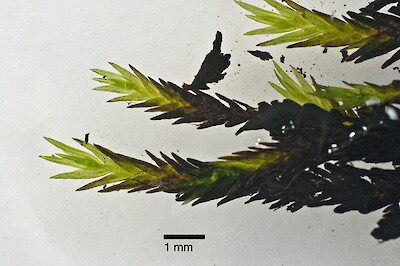
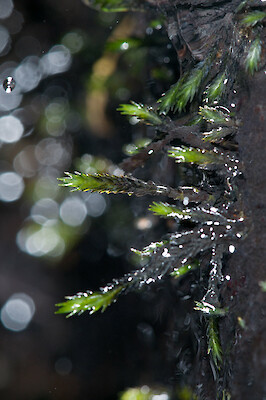
Plants medium-sized for the genus, saxicolous, aquatic, dark green to black, shoots 5.0–30.0 x 1.5–2.5 mm, branched ; shoot branches readily detached, rhizoids at base of shoot branches and well developed in axils of older leaves; leaves in 10–50 pairs, straight to falcate when moist, little altered when dry, broadly lanceolate, 1 .5–3 .0 x 0.30–0.75 mm, acute; vaginant lamina 2/3 of leaf length; extending across the lamina to a variable degree; dorsal lamina reaching to stem; costa failing about 4 cells before leaf apex, surface cells moderately broad-lumened, deuter cells exposed on the adaxial face; leaf margins entire to very weakly crenulate; border of prosenchymatous cells absent or variably developed on margin, or intramarginally, on vaginant laminae, extending in some cases onto apical and dorsal laminae ; apical, dorsal, and vaginant laminae variably bi- to pluristratose; lamina cells irregularly quadrate to hexagonal, medium thick-walled, 7.5–22 µm long, smooth, larger near the costa and often covering the costa in proximal part of the leaf. Apparently dioicous; male inflorescences terminal on main or axillary shoots; female inflorescences and sporophytes not seen.
Distribution
Endemic. New Zealand: North, South and Chatham Islands(from Te Paki south to about Taupo with one record from the Wairarapa, thence recorded once from Nenthorn Otago and once again from Rangiauria (Pitt Island) in the Chatham Islands group).
Habitat
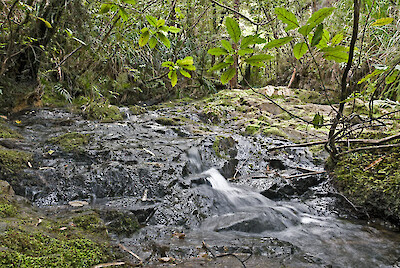
Saxicolous on base rich rocks such as basalt or chlorite schist with one record from ignimbrite. Lowland usually in densely forested areas. A rheophyte usually growing completely immersed in fast flowing streams (often under waterfalls and in similar steep sections of narrow streams). Often found growing sympatrically (most often syntopically) with Fissidens rigidulus var. rigidulus and F. waiensis.
Substrate details
Saxicolous - mostly on base rich rocks.
Threats
Fissidens rigidulus var. pseudostrictus is still relatively poorly known but opportunistic survey suggests that it is not very common (though it can be locally abundant in a very few locations), and rather sparsely distributed. It is seemingly absent from large parts of the country despite an abundance of suitable habitat. Currently no specific threats have been identified although it seems likely that this moss requires reasonably clean, fast flowing water, ideally within forested habitats - though it has been found in urban Auckland and also within a stream flowing through tussock grassland in Otago.
Detailed taxonomy
Genus
Family
Endemic taxon
Yes
Endemic genus
No
Endemic family
No
Ecology
Fruiting
Fruiting material has not yet been seen
Other information
Etymology
fissidens: From the Latin fissio ‘fission’ and dens ‘tooth, prong’ meaning split tooth and referring to shape of the lamina.
Previous conservation statuses
This is the first complete assessment of all known species of mosses found in the wild in Aotearoa New Zealand with a total of 560 species being assessed. The conservation status of mosses, published in the NZTCS database, replaces all previous assessments of mosses. Data supporting the 2025 NZTCS assessment of mosses has been published on the NZTCS database at https://nztcs.org.nz/reports/1155.
Source: NZTCS and licensed by DOC for reuse under the Creative Commons Attribution 4.0 International licence.
2014 | At Risk – Naturally Uncommon | Qualifiers: DP, RR, Sp
2010 | At Risk – Naturally Uncommon | Qualifiers: DP, RR, Sp
Referencing and citations
References and further reading
Beever, J.E.; I.G. Stone 1999: Studies of Fissidens (Bryophyta: Musci): new taxa and new records for New Zealand. New Zealand Journal of Botany 37: 643-657.
Attribution
Fact Sheet Prepared for NZPCN by: P.J. de Lange (11 October 2011). Description adapted from Beever & Stone (1999).