
Fissidens strictus
Common names
moss
Biostatus
Native
Current conservation status
This is the first complete assessment of all known species of mosses found in the wild in Aotearoa New Zealand with a total of 560 species being assessed. The conservation status of mosses, published in the NZTCS database, replaces all previous assessments of mosses. Data supporting the 2025 NZTCS assessment of mosses has been published on the NZTCS database at https://nztcs.org.nz/reports/1155.
Source: NZTCS and licensed by DOC for reuse under the Creative Commons Attribution 4.0 International licence.
2025 | Threatened – Nationally Endangered | Qualifiers: DPS, DPT, RR, TO
Category
Non-vascular
Structural class
Mosses
Detailed description
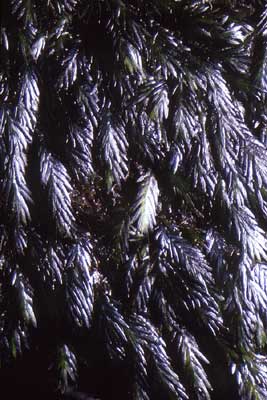
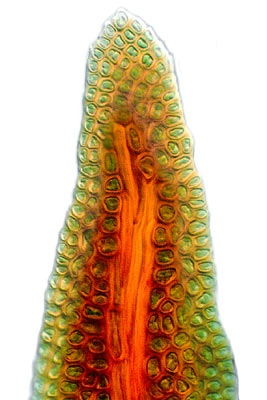
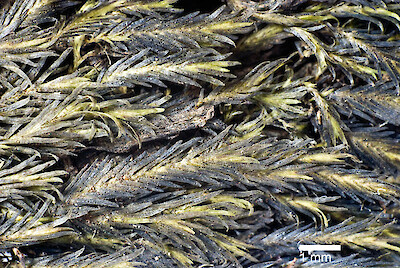
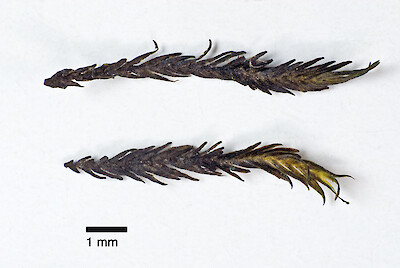
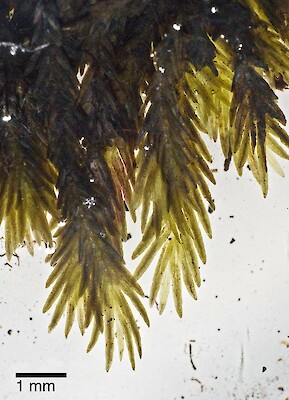
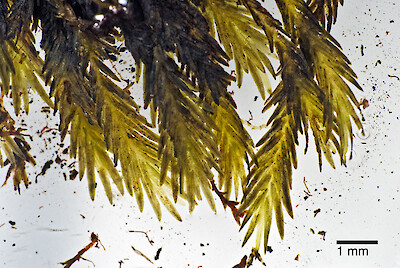
Plants medium sized for the genus, saxicolous, rheophytic, black except for green shoot tips; shoots rigid, forming dense, smooth mats or erect tufts, 6-15 mm long, 1-2 mm wide, occasionally branched; rhizoids dense at shoot base, rare elsewhere; stems without, or with very weak, central strand, axillary hyaline nodules weakly differentiated, uniseriate axillary hairs present; leaves in (15-)20-35(-40) pairs, all but youngest usually with tips eroded and surfaces heavily encrusted with epiphytes and detritus, erecto-patent, overlapping, rigid, unaltered when dry, linear, 1.25-2.0 mm long, 0.2-0.3 mm wide; leaf apex acute to obtuse, occasionally bent laterally; vaginant lamina 1/2 of leaf length, narrow throughout, joined to mid-way or more across lamina; dorsal lamina narrow, 8-10 cells wide opposite junction of vaginant lamina, shortly decurrent on stem; nerve white to yellow, often becoming dark red with age, distinct throughout leaf, straight below, often sinuous in apical lamina, failing (5-)6(-10) cells before leaf apex, 25-30 pin wide at junction of vaginant lamina, surface cells with very small lumina in cross-section, deuter cells exposed on the adaxial face; leaf margins crenulate, unbordered; apical and dorsal laminae bistratose to multistratose near the nerve, unistratose in several rows at the margin; vaginant laminae occasionally bistratose adjacent to the nerve; cells of apical and dorsal laminae irregular, strongly incrassate with evenly thickened walls, clear, smooth, gradually increasing in size from margin to nerve, (8-)ll-13(-15) microns long in mid-lamina. ?Dioicous. Perichaetia terminal on main stems or axillary branches, perichaetial leaves little modified, archegonia 250-450 microns long; calyptra smooth, mitriform; mature capsules not seen in New Zealand material. Perigonia terminal on main stems
Similar taxa
Fissidens strictus is mostly likely to be confused with Fissidens rigidulus var. pseudostrictus from which it differs by the white to yellow (becoming reddish with age) leaf nerve (costa) which is distinct rather than indistinct, and by the unistratose rather than multistratose vaginant laminae (see Beever et al. 2002)
Distribution
Indigenous. Australia and New Zealand. In New Zealand recorded from Northland (Puketi Forest and Kerikeri), the Waitakere Ranges west of Auckland, and from the Auckland Islands.
Substrate details
Saxicolous, aquatic moss confiend to well aerated streams flowing over basalt and andesite rock.
Threats
Extremely vulnerable to changes in water levels, aeration and quality. At least one Northland population is probably extinct due to changes in the surrounding river catchment, pollution, the effects of deforestation and aquatic and emergent weed growth. Recent surveys of a population in the Waitakere Ranges suggest that it has declined seriously for reasons which are not as yet clear. Given this data it is difficult to understand why this species has been assessed as Naturally Uncommon by Glenny et al. (2011). Nevertheless this species has a highly disjunct distribution which seems rather remarkable (see de Lange 2011) and so because it is easily overlooked it is possible that diligent searching may find additional populations in other parts of the country.
Detailed taxonomy
Genus
Family
Synonyms
None.
Endemic taxon
No
Endemic genus
No
Endemic family
No
Ecology
Fruiting
Fruiting specimens are very rarely seen.
Other information
Etymology
fissidens: From the Latin fissio ‘fission’ and dens ‘tooth, prong’ meaning split tooth and referring to shape of the lamina.
strictus: From the Latin strictus ‘upright, stiff’
NVS code
The National Vegetation Survey (NVS) Databank is a physical archive and electronic databank containing records of over 94,000 vegetation survey plots - including data from over 19,000 permanent plots. NVS maintains a standard set of species code abbreviations that correspond to standard scientific plant names from the Ngä Tipu o Aotearoa - New Zealand Plants database.
FISSTR
Previous conservation statuses
This is the first complete assessment of all known species of mosses found in the wild in Aotearoa New Zealand with a total of 560 species being assessed. The conservation status of mosses, published in the NZTCS database, replaces all previous assessments of mosses. Data supporting the 2025 NZTCS assessment of mosses has been published on the NZTCS database at https://nztcs.org.nz/reports/1155.
Source: NZTCS and licensed by DOC for reuse under the Creative Commons Attribution 4.0 International licence.
2014 | At Risk – Naturally Uncommon | Qualifiers: DP, RR, TO
2010 | At Risk – Naturally Uncommon | Qualifiers: DP, RR, TO
2005 | Threatened – Nationally Endangered | Qualifiers: S?O
Referencing and citations
References and further reading
Beever, J.E.; Stone, I.G. 1992: Studies of Fissidens (Bryophyta: Musci) in New Zealand: F. taxifolius Hedw. and F. integerrimus Mitt . New Zealand Journal of Botany 30: 237–246.
Beever, J. Malcolm, B.; Malcolm, N. 2002: The moss genus Fissidens in New Zealand – an illustrated key. Nelson, Micro-Optics Press.
de Lange, P.J. 2011: New location for endangered moss. Trilepidea 89: 6-8.
Glenny, D.; Fife, A.J.; Brownsey, P.J.; Renner, M.A.M.; Braggins, J.E.; Beever, J.E.; Hitchmough, R. 2011: Threatened and uncommon bryophytes of New Zealand (2010 Revision). New Zealand Journal of Botany 49: 305-327.
Attribution
Fact Sheet Prepared for NZPCN by: P.J. de Lange August 2007. Description adapted from Beever & Stone (1992).