
Hollia myrmecoa
Common names
moss
Biostatus
Native
Current conservation status
This is the first complete assessment of all known species of mosses found in the wild in Aotearoa New Zealand with a total of 560 species being assessed. The conservation status of mosses, published in the NZTCS database, replaces all previous assessments of mosses. Data supporting the 2025 NZTCS assessment of mosses has been published on the NZTCS database at https://nztcs.org.nz/reports/1155.
Source: NZTCS and licensed by DOC for reuse under the Creative Commons Attribution 4.0 International licence.
2025 | Data Deficient | Qualifiers: S?O
Category
Non-vascular
Structural class
Mosses
Detailed description
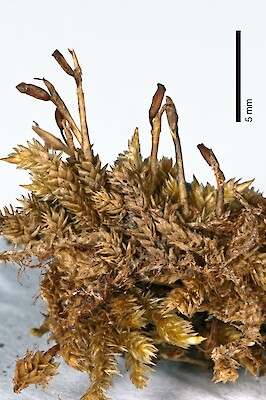
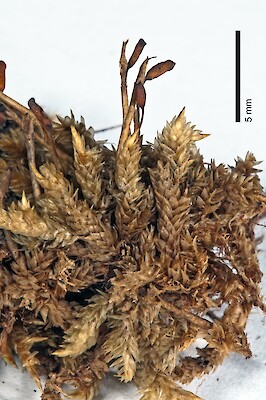
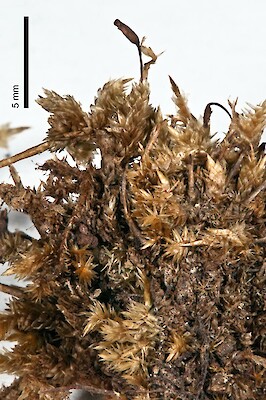
Corticolous, medium-sized, densely clustered, glossy, pale to medium green, drying pale grey-green or brownish with straw-like texture. Stems red-brown, thin, creeping, to 50 mm long; branches erect, robust, dense, to 15 mm long; apex tight with a conical appearance. Branch leaves whorled, imbricate to slightly spreading to patent when dry, spreading at 45 degrees when moist, 1.5–1.7 × 0.56–0.92 mm, ovate to lanceolate, concave, acute, ecostate; base cordate; margin incurved near apex, entire; laminal cells thick-walled, lacking papillae, rhomboidal to linear-rhomboidal; apical cells variable, c. 24–34 × 8 µm; medial cells sigmoid, 32–50 × 6–8 µm, unbordered; alar cells conspicuous, orange in a basal band, 5–8 cells high; cells variable, ± quadrate, c. 20 µm wide, more rectangular at margin, thick-walled; basal cells between alar cells rectangular, c. 50 × 6 µm, ± porose and sinuose, yellow-brown across base. Stem leaves sparse, ovate to oblong-lanceolate, 0.48–0.88 × 0.21–0.49 mm; alar cells not as well developed; laminal cells narrower, ± sigmoid. Rhizoids sparse but conspicuous on lower stems, wiry, reddish, smooth, to 3 mm long, c. 20 µm wide; branches short; cells to 90 µm long. Dioicous. Male plants perennial, either dwarf or large. Perigonial leaves narrowly ovate-lanceolate. Perichaetial leaves long-linear to oblong-lanceolate, c. 10.0 × 1.2 mm, obtuse to acute, ecostate; 2–4 conspicuously long perichaetial leaves at base of capsule sheathing seta, remainder shorter; base straight; margin entire; laminal cells linear, thick-walled; upper cells c.40 × 8 µm, slightly sigmoid; medial cells similar, less sigmoid; basal cells c. 100–160 µm long, porose, yellow-orange across base. Calyptra 4.0–4.5 mm long, cucullate, yellow to pale red-brown, smooth. Seta 5–12 mm long, terminal, reddish. Capsule 3.0 × 0.6 mm, solitary, red, erect or suberect (cylindrical or asymmetrical, respectively), smooth. Operculum to 1.6 mm long, slender, obliquely rostrate. Peristome single, reddish; teeth 16, 280–550 × 120 µm, broadly lanceolate, inserted below capsule mouth on short basal membrane, densely papillose on both sides; cells horizontally rectangular; medial lines straight. Spores large, 100–190 µm.
Distribution
Indigenous. New Zealand: Kermadec (Raoul Island) only. Also Australia, Norfolk Island and New Caledonia. As this species is known in Australia to range along the eastern side of that country to as far south as Victoria it possibly occurs elsewhere in New Zealand proper.
Habitat
Corticolous—a moss of the high forest canopy of Raoul Island. Gatherings have been made from both ‘dry’ and ‘wet’ forest types, and mostly from material strewn on the forest floor after big storms. The preferred host tree seems to be Kermadec pohutukawa (Metrosideros kermadecensis), and most gatherings have been made in association with the large foliose lichen Pseudocyphellaria argyracea.
Threats
Known in the New Zealand Botanical Region (see de Lange & Rolfe 2010) only from Raoul Island where three chance gatherings were made from fallen canopy branches in 2009 and 2010. Indications are that this species is probably locally common on Raoul however, until a proper survey is undertaken it seems wise to treat this species as Data Deficient.
Detailed taxonomy
Genus
Family
Synonyms
Eucamptodon muelleri Hampe et Müll.Hal
Endemic taxon
No
Endemic genus
No
Endemic family
No
Ecology
Fruiting
Fruiting material has been found in May gatherings.
Referencing and citations
References and further reading
de Lange PJ, Rolfe JR. 2010. New Zealand indigenous vascular plant checklist. New Zealand Plant Conservation Network, Wellington, NZ. 131 p.
Streimann H. 2002. The mosses of Norfolk Island. Flora of Australia Supplementary Series No. 16. Australian Biological Resources Library, Panther Printnet, Canberra. 178 p. https://www.publish.csiro.au/book/3535.
Attribution
Fact Sheet Prepared for NZPCN by: P.J. de Lange (23 November 2011). Description adapted from Streimann (2002)