
Houttuynia cordata


NPPA pest plant
Common names
houttuynia
Biostatus
Exotic
Conservation status
Not applicable
Category
Vascular
Structural class
Herbs - Dicotyledons other than Composites
Flower colours
White
Detailed description
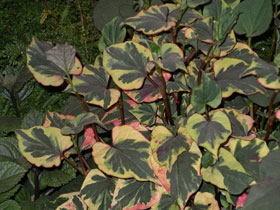
Dense, deciduous (semi-evergreen in warm areas) groundcover herb to 1m. Slender couch-like rhizomes. Stems creeping and semi-ascending. leaves heart-shaped, up to 7 cm long, usually variegated cream, bronze, scarlet and green, soon reverting to green. Peppery scent when crushed. Flowerhead a small spike with minute flowers and 4 white bracts (petals) at the base, Dec-Feb. Usually dies back to rootstock over winter.
Similar taxa
Ivy has similar leaves but woody stems. 3 coloured leaves (green, red, creamy ) inmost commonly cultivated form. Leaves are unpleasant-smelling.
Habitat
Terrestrial. Wetlands, gardens, freshwater margins, damp ground, forest, shrubland and fenland.
Detailed taxonomy
Genus
Family
Ecology
Flowering
December, January, February
Origin
Japan South to mountains of Nepal and Java.
Reason for introduction
Ornamental plant
Life cycle and dispersal
Reproduces by rhizome fragments or possibly seeds.
Other information
Etymology
houttuynia: Named for Dr Maarten Houttuyn (1720 – 1798), a Dutch botanist.
National Pest Plant Accord species
This plant is listed in the 2020 National Pest Plant Accord. The National Pest Plant Accord (NPPA) is an agreement to prevent the sale and/or distribution of specified pest plants where either formal or casual horticultural trade is the most significant way of spreading the plant in New Zealand. For up to date information and an electronic copy of the 2020 Pest Plant Accord manual (including plant information and images) visit the MPI website.
NVS code
The National Vegetation Survey (NVS) Databank is a physical archive and electronic databank containing records of over 94,000 vegetation survey plots - including data from over 19,000 permanent plots. NVS maintains a standard set of species code abbreviations that correspond to standard scientific plant names from the Ngä Tipu o Aotearoa - New Zealand Plants database.
HOUCOR
Referencing and citations
References and further reading
Johnson, A. T. and Smith, H. A (1986). Plant Names Simplified: Their pronunciation, derivation and meaning. Landsman Bookshop Ltd: Buckenhill, UK.