
Hygrophila angustifolia
Biostatus
Exotic
Conservation status
Not applicable
Category
Vascular
Structural class
Trees & Shrubs - Dicotyledons
Simplified description
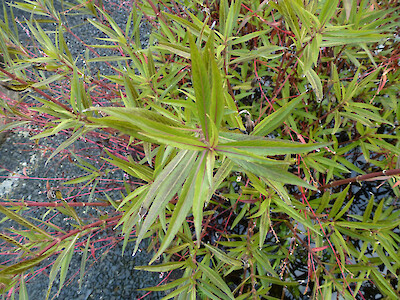
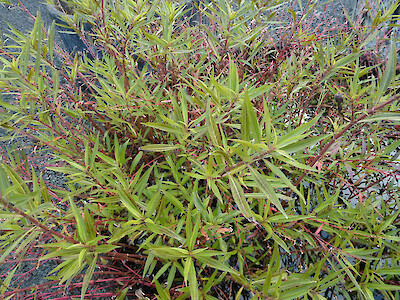
Upright, leafy perennial with long narrow leaves and blue flowers produced in the leaf bases.
Flower colours
Blue
Detailed description
Erect herb, decumbent with age, usually 50–100 cm high, mostly glabrous; branches 4-angled. Leaves linear to lanceolate, mostly 2.5–16 cm long, 2–8 mm wide, apex ± obtuse, base attenuate, margins entire and sometimes undulate, glabrous or sparsely hairy; ± sessile. Axillary clusters of 2–12-flowered; flowers sessile; bracts 2–7 mm long. Calyx 8–10 mm long. Corolla blue, mauve or more usually white with darker markings; tube 6–8 mm long; lobes 3–4 mm long.
Similar taxa
Superficially similar to willow weeds (Persicaria spp.) but leaves are opposite, not alternately arranged.
Distribution
Only known from one site at Western Springs, Auckland, but a common plant in the aquarium trade.
Habitat
Still and slow flowing shallow water bodies.
Detailed taxonomy
Genus
Family
Synonyms
Hygrophila salicifolia Nees
Endemic family
No
Ecology
Flowering
Late summer (March)
Year naturalised
2007
Origin
Northern Australia (W. Australia, Northern Territory, Queensland, New South Wales) and New Guinea
Reason for introduction
Ornamental aquarium and pond plant.
Control techniques
Can be controlled manually, mechanically or herbicidally depending on situation.
Life cycle and dispersal
Stem fragments in New Zealand
Other information
Etymology
angustifolia: From the Latin angustus ‘narrow, constricted’ and folius ‘leaf’, meaning narrow-leaved
Referencing and citations
References and further reading
New South Wales Flora Online (http://plantnet.rbgsyd.nsw.gov.au/)
Attribution
Factsheet prepared by Paul Champion and Deborah Hofstra (NIWA).