
Isolepis levynsiana

Common names
tiny flatsedge
Biostatus
Exotic
Conservation status
Not applicable
Category
Vascular
Structural class
Sedges
Simplified description
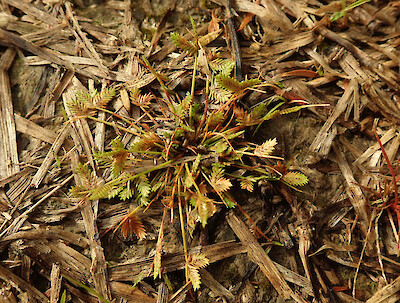
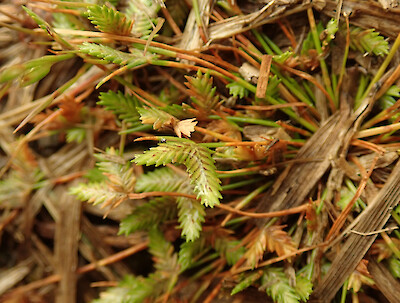
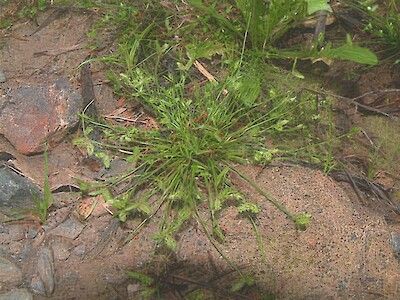
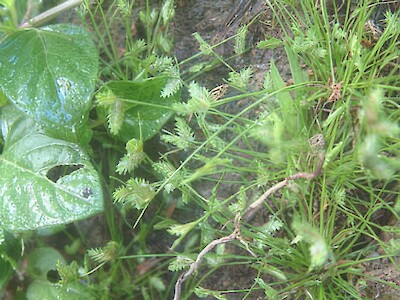
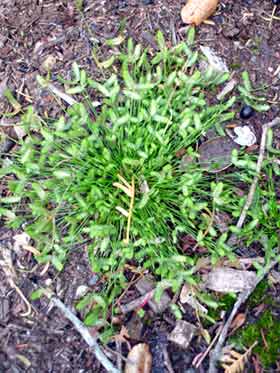
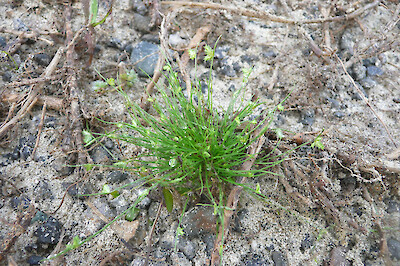
Tiny fine-leaved grass- or rush-like clump or mat forming plant, up to 10 cm tall, with flattened head heads, usually 2 per stem.
Flower colours
Green
Detailed description
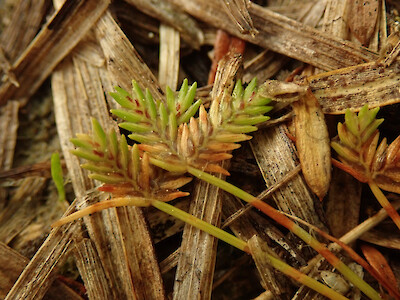
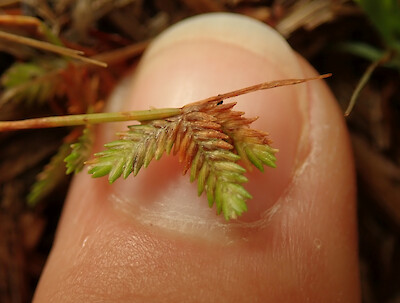
Small tufted annual, 2–10 cm high. Stems numerous, filiform. Leaves 1–2 basal, much > stems, setaceous; sheaths hyaline, mostly colourless but occasionally red-tinged at base. Inflorescence a solitary cluster of (1)–2–(5) comparatively large, digitate, very compressed spikelets varying from whitish-green to greenish-brown; lower subtending bract setaceous, < or > inflorescence, appearing as a continuation of the stem, occasionally a second setaceous bract or an upper spikelet with a short glume-like bract. Spikelets ± 3–8 × 2–3 mm, oblong to ovate-lanceolate. Glumes many, densely imbricate, ± 2 mm long, obtuse, distinctly nerved, margins occasionally brown-splotched, keel green, later brown, tip slightly spreading. Stamens 1 or 2. Style-branches 3. Nut slightly > ½ length of glume, ellipsoid, acutely triquetrous.
Similar taxa
Similar to many other Isolepis species and also young toad rush (Juncus bufonius), but none of these plants produce flattened spikelets.
Distribution
Scattered through the North Island and Nelson in the South Island, usually lowland.
Habitat
Margins of water bodies, wet roadsides.
Detailed taxonomy
Genus
Family
Synonyms
Cyperus tenellus L.f. Until recently known as Cyperus tenellus L.f. Isolepis tenellus (L.f.) Muasya et D.A.Simpson is illegitimate
Endemic genus
No
Endemic family
No
Ecology
Flowering
Throughout most of the year
Fruiting
Throughout most of the year
Year naturalised
1863
Origin
South Africa and Australia
Reason for introduction
Unknown, seed or soil contaminant.
Control techniques
Rarely controlled, but can be controlled manually, mechanically or herbicidally depending on situation.
Life cycle and dispersal
Seed dispersed by water or contaminated machinery.
Wetland plant indicator status rating
Information derived from the revised national wetland plant list prepared to assist councils in delineating and monitoring wetlands (Clarkson et al., 2021 Manaaki Whenua – Landcare Research Contract Report LC3975 for Hawke’s Bay Regional Council). The national plant list categorises plants by the extent to which they are found in wetlands and not ‘drylands’. The indicator status ratings are OBL (obligate wetland), FACW (facultative wetland), FAC (facultative), FACU (facultative upland), and UPL (obligate upland). If you have suggestions for the Wetland Indicator Status Rating, please contact: [Enable JavaScript to view protected content]
FAC: Facultative
Commonly occurs as either a hydrophyte or non-hydrophyte (non-wetlands).
Other information
Etymology
isolepis: From the Greek isos (equal) and lepis (scale)
NVS code
The National Vegetation Survey (NVS) Databank is a physical archive and electronic databank containing records of over 94,000 vegetation survey plots - including data from over 19,000 permanent plots. NVS maintains a standard set of species code abbreviations that correspond to standard scientific plant names from the Ngä Tipu o Aotearoa - New Zealand Plants database.
ISOLEV
Referencing and citations
References and further reading
Healy AJ, Edgar E. 1980. Flora of New Zealand, Volume III. Adventive Cyperaceous, Petalous and Spathaceous Monocotyledons. Government Printer, Wellington, NZ. 220 p.
Johnson AT, Smith HA. 1986. Plant Names Simplified: Their pronunciation, derivation and meaning. Landsman Bookshop Ltd, Buckenhill, UK.
Muasya AM, Simpson DA, Smets E. 2007. Isolepis levynsiana, a new name for Cyperus tenellus (Cyperaceae). Novon 17: 59.
Popay I, Champion P, James T. 2010. An illustrated guide to common weeds of New Zealand, 3rd edition. NZ Plant Protection Society Inc, Christchurch, NZ. 416 p.
Attribution
Factsheet prepared by Paul Champion and Deborah Hofstra (NIWA). Factsheet descriptions from Croasdale et al., (1994).