
Macromitrium longirostre var. ramsayae

Common names
moss
Biostatus
Native – Endemic taxon
Current conservation status
This is the first complete assessment of all known species of mosses found in the wild in Aotearoa New Zealand with a total of 560 species being assessed. The conservation status of mosses, published in the NZTCS database, replaces all previous assessments of mosses. Data supporting the 2025 NZTCS assessment of mosses has been published on the NZTCS database at https://nztcs.org.nz/reports/1155.
Source: NZTCS and licensed by DOC for reuse under the Creative Commons Attribution 4.0 International licence.
2025 | At Risk – Uncommon | Qualifiers: IE
Category
Non-vascular
Structural class
Mosses
Detailed description
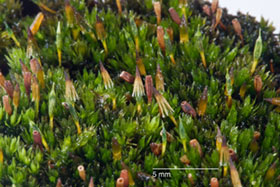
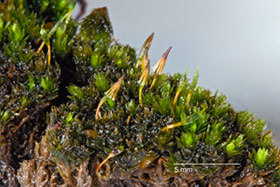
Plants dull, light olive-green to rich-green, darker below, without distinct yellow or chestnut tones, in dense, spreading mats. Stems creeping, with erect branches, usually up to 10 mm high, branches simple, or forked below perichaetia when fertile. Stem leaves spreading-curved to erect-flexuose, 1.0-1.5 mm long, ovate-lanceolate, gradually narrowed to an acuminate apex, costa very broad below, narrowed toward and ending in or just below the apex, upper cells 6-8 µm, wide, rounded-quadrate, rather thin-walled, chlorophyllose, somewhat bulging, smooth, elliptic, shortly rectangular to elongate, below thicker walled, smooth and slightly bulging. Branch leaves irregularly and loosely spirally-twisted around branch, the upper portion flexuose and irregularly twisted outward to erect-spreading when moist 1.6-2.5 mm long, narrowly oblong to broadly lanceolate-oblong, acute, shortly cuspidate, to broadly acuminate-apiculate, only rarely slenderly acuminate, strongly keeled below, becoming flattened near the apex, covered by rounded-quadrate (laminal) cells in upper ¼ to 1/5 of leaf, in transverse section with 3-4 abaxial rows of stereids, one (2) rows of guide cells and one (2) rows of adaxial stereids, semi-circular in shape; upper cells 5-8 µm wide, rounded-quadrate, occasionally some cells subquadrate or elliptic, plane to slightly bulging, smooth or nearly so, chlorophyllose, unistratose, cells at mid-leaf similar, 6-8 µm wide, subquadrate, rounded, quadrate, or rarely elliptic, in longitudinal rows, less chlorophyllose and with thicker-walls than upper cells; basal cells mostly c.9-11 µm wide, 9-15(-20) µm long, rounded-subquadrate, to mostly elliptic-shortly rectangular, occasional cells elongate, not much different from upper cells, bulging, with most cells lowly tuberculate or strongly papillose, walls mostly regularly and only moderately thick-walled, not nodose. Perichaetial leaves 1.3-1.8 mm long, shorter than vegetative leaves, ovate, shortly and stoutly acuminate to cuspidate, elongate basal cells continuing to almost mid-leaf. Dioicous. Setae 2.5-4.0 mm long, straight or curved, thick, smooth, scarcely twisted, if so then twisted right; capsules 1.2-2.3 mm long, narrowly ovate to fusiform-cylindric, indistinctly ribbed to almost smooth, erect or slightly curved and asymmetric when old, shortly exserted, exothecial cells 35-55 µm wide, very thick-walled, elongate-sinuose to elliptic, rounded to quadrate-elliptic near rim. Peristome double; exostome of 16, irregular, ± blunt, coarsely papillose teeth, very thick outwardly and ± smooth below, more finely papillose to base on inner surface, erect-recurved when dry, incurved when moist, the teeth often broken when old, with the lower portions remaining and forming a ± fused, low membrane; endostome an irregular, papillose membrane 1-3 cells high. Operculum c.1 mm long, conic, with along erect rostrum. Calyptrae deeply lacerate, mitrate, conic, moderately thin-walled.
Distribution
Endemic. New Zealand: Chatham Islands (Rekohu/Wharekauri (Chatham Island), Rangiuria (Pitt Island)). Also Australia
Substrate details
Corticolous on a wide variety of trees from the coast to the inland Tarahinau/Matipo/Poteriteri Forest
Threats
Not threatened. Listed because it is a narrow range endemic
Detailed taxonomy
Genus
Family
Synonyms
Macromitrium ramsayae Vitt
Endemic taxon
Yes
Endemic genus
No
Endemic family
No
Ecology
Fruiting
Fruits may be found throughout the year
Other information
Previous conservation statuses
This is the first complete assessment of all known species of mosses found in the wild in Aotearoa New Zealand with a total of 560 species being assessed. The conservation status of mosses, published in the NZTCS database, replaces all previous assessments of mosses. Data supporting the 2025 NZTCS assessment of mosses has been published on the NZTCS database at https://nztcs.org.nz/reports/1155.
Source: NZTCS and licensed by DOC for reuse under the Creative Commons Attribution 4.0 International licence.
2014 | At Risk – Naturally Uncommon | Qualifiers: IE
2010 | At Risk – Naturally Uncommon | Qualifiers: IE
2005 | Range Restricted | Qualifiers: S?O
Referencing and citations
References and further reading
Vitt, D.H. 1983: The New Zealand species of the pantropical genus Macromitrium (Orthotrichaceae: Musci) taxonomy, phylogeny and phytogeography. Journal of the Hattori Botanical Laboratory 54: 1-94
Attribution
Fact sheet prepared for NZPCN by P.J. de Lange (5 November 2007). Description adapted from Vitt (1983).