
Menyanthes trifoliata

NPPA pest plant
Common names
Bogbean
Biostatus
Exotic
Conservation status
Not applicable
Category
Vascular
Structural class
Herbs - Dicotyledons other than Composites
Simplified description
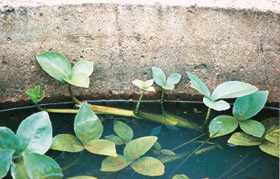
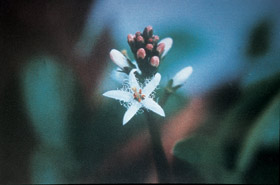
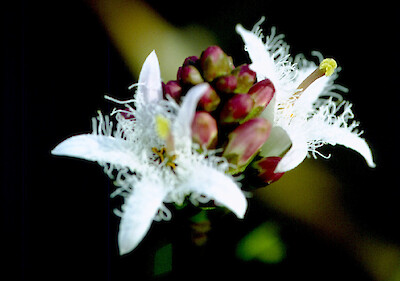
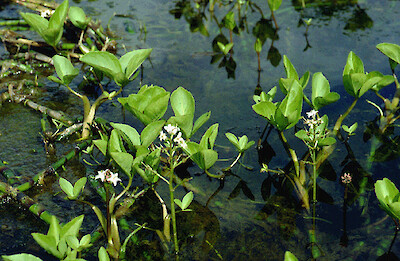
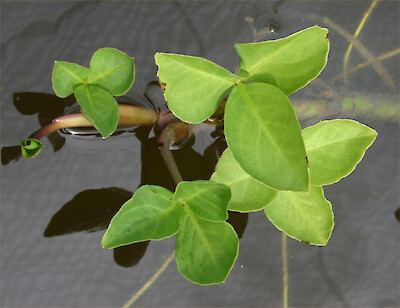
As the common name indicates the plant looks superficially similar to a broad bean, with three lobed leaves held above shallow water by long, fleshy stalks. In summer spikes of white (pinkish) flowers occur above the water
Flower colours
Red/Pink, White
Detailed description
Sprawling emergent perennial herb. Leaves of three leaflets (like the leaves of broad bean) at the end of stems. Leaflets are elliptical to obovate, 3-10 cm long, 1-5 cm wide, entire or sometimes coarsely toothed. Leaves are all basal, with the petiole bases arranged alternately on the creeping stem. Flowers have five petals, pinkish-white in colour, with long white hairs on the top surface. Flowers are about 2.5 cm across. The seed capsule contains shiny yellow-brown buoyant seeds.
Similar taxa
None.
Distribution
Nationally eradicated, only known from two sites, Racecourse Hill near Darfield, Canterbury and Queenstown, Otago.
Habitat
Only found in an ornamental pond and irrigation race in New Zealand, found in nutrient poor waters in native range.
Detailed taxonomy
Genus
Family
Endemic family
No
Ecology
Flowering
October - April
Fruiting
Autumn
Year naturalised
1976
Origin
Native to temperate Northern Hemisphere.
Reason for introduction
Ornamental pond plant
Control techniques
Notify the relevant regional council if found
Life cycle and dispersal
Spreads by seeds, stem extension, and fragmentation, Can establish rapidly from stem fragments. Seeds have not been seen in the field in New Zealand.
Wetland plant indicator status rating
Information derived from the revised national wetland plant list prepared to assist councils in delineating and monitoring wetlands (Clarkson et al., 2021 Manaaki Whenua – Landcare Research Contract Report LC3975 for Hawke’s Bay Regional Council). The national plant list categorises plants by the extent to which they are found in wetlands and not ‘drylands’. The indicator status ratings are OBL (obligate wetland), FACW (facultative wetland), FAC (facultative), FACU (facultative upland), and UPL (obligate upland). If you have suggestions for the Wetland Indicator Status Rating, please contact: [Enable JavaScript to view protected content]
OBL: Obligate Wetland
Almost always is a hydrophyte, rarely in uplands (non-wetlands).
Other information
National Pest Plant Accord species
This plant is listed in the 2020 National Pest Plant Accord. The National Pest Plant Accord (NPPA) is an agreement to prevent the sale and/or distribution of specified pest plants where either formal or casual horticultural trade is the most significant way of spreading the plant in New Zealand. For up to date information and an electronic copy of the 2020 Pest Plant Accord manual (including plant information and images) visit the MPI website.
Referencing and citations
References and further reading
Champion et al (2012). Freshwater Pests of New Zealand. NIWA publication.
WSDE (2001). An aquatic plant identification manual for Washington’s freshwater plants. Washington State Department of Ecology, 195pp.
Johnson PN, Brooke PA (1989). Wetland plants in New Zealand. DSIR Field Guide, DSIR Publishing, Wellington. 319pp.
Attribution
Factsheet prepared by Paul Champion and Deborah Hofstra (NIWA).