
Metus conglomeratus







Biostatus
Native
Current conservation status
2018 | Not Threatened | Qualifiers: SO
Category
Lichen
Structural class
Lichens - Crustose
Lichen substrate
Corticolous (bark, wood)
Detailed description
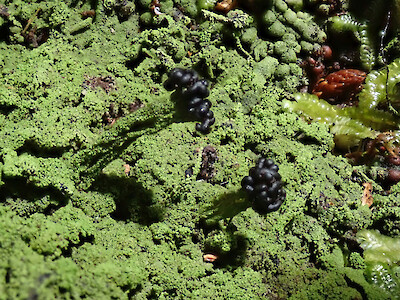
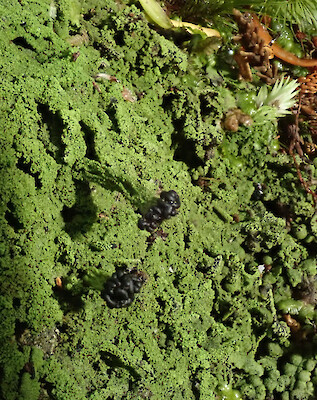
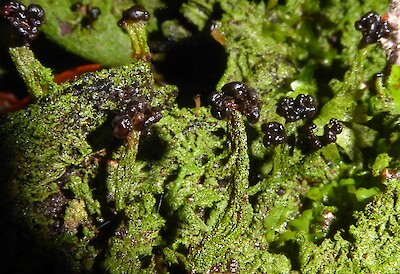
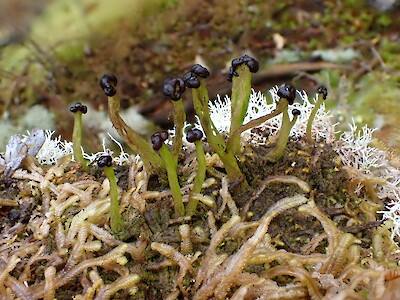
Thallus dimorphic Cladonia-like, primary thallus effuse, granular–crustose, glaucous-green to deep emerald-green on a thin to thick, pale to blackish prothallus. Podetia supporting ascomata without cups, erect to decumbent, to 1.5 cm tall and to 1–2 mm diam., hollow, terete or compressed, irregularly wrinkled or furrowed to longitudinally fissured or ±clathrate, simple, rarely furcate, subulate, covered with thalline granules to ±decorticate. Ascomata apothecia, terminal, hymenial discs brown to brown-black, ±globular and simple to clustered, convolute–conglomerate. Hymenium pale yellow-brown, 40–50 μm tall, I+ blue. Hamathecium of paraphyses, slender, simple, furcate or with interconnecting lateral anastomoses to 2 μm diam., slightly swollen (to 4 μm) at tips. Hypothecium deep red-brown, granular–opaque, K+ brownish, to 50 μm thick, I−. Asci cylindrical, tapering at foot, 35–40 × 5–8 μm; apical tholus prominent I+ dark-blue, 8-spored. Ascospores biseriate, simple, colourless, spindle-shaped or dacryoid, 8–10 (–14) × (2.5–)3–4(–4.5) μm. Conidiomata pycnidia, occasional to frequent, at apices of sterile, often decorticate podetia, or singly or clustered among thalline granules, minutely stalked, cylindrical, swollen or tapering at apices, mostly simple, rarely 2–3-branched, black or brown-black. Conidia colourless, falciform, 4–4.5 × 1 μm.
Chemistry: Caperatic acid ±atranorin (tr.). Australian populations contain protolichesterinic and lichesterinic acids and atranorin (tr.).
Substrate details
Corticolous
Detailed taxonomy
Genus
Family
Synonyms
Pilophoron cariosum, Pilophoron conglomeratum, Pilophorus conglomeratus
Endemic taxon
No
Endemic genus
No
Endemic family
No
Other information
Extra information
Metus is an austral genus of three species (Galloway & James 1987) included in the family Cladoniaceae (Eriksson et al. 2004; Pennycook & Galloway 2004; Eriksson 2005), with two species being known from southern Chile, and one from New Zealand and SE Australia. All three species have a similar ecology and thrive in moist, humid conditions prevailing in stands of mature, primary or occasionally secondary forest, in areas of moderate to high rainfall. All are characteristic of markedly shaded habitats and many specimens collected are from rotting stumps and the basal plates or buttresses of large forest trees in the forest interior, where few other lichens are able to tolerate either reduced illumination or competition from bryophytes. The granular vegetative thallus of Metus develops on a pale or dark, arachnoid prothallus, and spreads over rotting or sometimes burned stumps, or covers pteridophyte rhizomes and/or fronds, e.g. the brush of tree ferns such as *Alsophila, Dicksonia and *Sphaeropteris, bryophytes or litter, investing these substrata with a thick green crust.
Etymology
metus: Metus is Latin for “terror”. Named after H.M.S. Terror, one of the two ships of the Antarctic expedition of 1839–1843 commanded by Sir James Clark Ross, which visited New Zealand and Tasmania during the course of the expedition.
NVS code
The National Vegetation Survey (NVS) Databank is a physical archive and electronic databank containing records of over 94,000 vegetation survey plots - including data from over 19,000 permanent plots. NVS maintains a standard set of species code abbreviations that correspond to standard scientific plant names from the Ngä Tipu o Aotearoa - New Zealand Plants database.
METCON
Referencing and citations
References and further reading
Eriksson O.E. (Ed.) 2005: Outline of Ascomycota – 2005: Myconet 11: 1-113.
Eriksson O.E., Baral H.-O., Currah R.S., Hansen K., Kurtzman C.P., Rambold G. & Laessøe T. 2004: Outline of Ascomycota – 2004. Myconet 10: 1-99.
Galloway D.J. 2007: Flora of New Zealand: Lichens, including lichen-forming and lichenicolous fungi. 2nd edition. Lincoln, Manaaki Whenua Press. 2261 pp.
Galloway D.J. & James P.W. 1987: Metus, a new austral lichen genus and notes on an Australasian species of Pycnothelia. Notes from the Royal Botanic Garden Edinburgh 44: 561-579.
Pennycook S.R. & Galloway D.J. 2004: Checklist of New Zealand “Fungi”. In: McKenzie, E.H.C. (Ed.) Introduction to fungi of New Zealand. Fungi of New Zealand/Ngā Harore o Aoteroa Volume 1. Fungal Diversity Research Series 14: 401-488.
Attribution
Some of this factsheet information is derived from Biota of New Zealand and is used under a Creative Commons Attribution 4.0 International licence.