
Placopsis murrayi
Biostatus
Native – Endemic taxon
Current conservation status
2018 | At Risk – Naturally Uncommon | Qualifiers: RR
Category
Lichen
Structural class
Lichens - Placodioid
Lichen substrate
Saxicolous (rock)
Substrate details
Saxicolous
Detailed taxonomy
Genus
Family
Endemic taxon
Yes
Endemic genus
No
Endemic family
No
Other information
Extra information
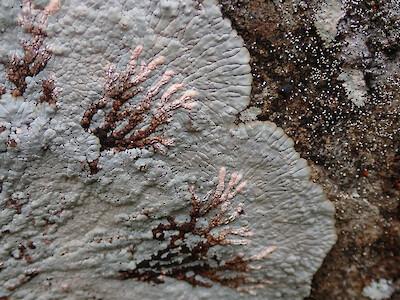
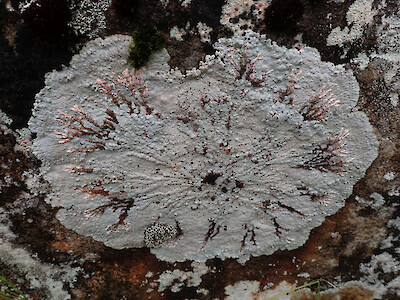
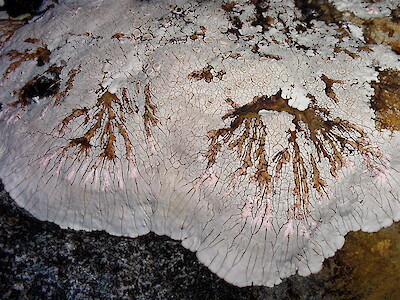
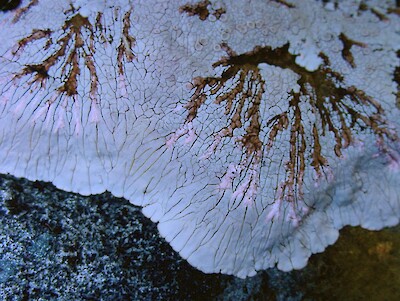
The development of branched, elongated, vein-like, immersed cephalodia in the New Zealand species P. murrayi and P. venosa is a remarkable advance on the more usual, orbicular, flattened-effigurate to hemispherical type of cephalodia found in all other species (Galloway 2013).
Etymology
murrayi: This species was first collected by the late James Murray (1923–1961), in February 1959, from rocks in subalpine grassland above treeline on Secretary Island in Fiordland. Murray noted on his collection that the species was rare in this locality, and he recorded it as “Placopsis (Aspiciliopsis) new sp.” (Murray 1963a: 230). It is named in his honour.
Referencing and citations
References and further reading
Galloway DJ. 2004. Placopsis hertelii (Agyriaceae, Ascomycota) endemic to New Zealand, with descriptions of four additional new species of Placopsis (Nyl.) Linds., from New Zealand. Bibliotheca Lichenologica 88: 147–161.
Galloway DJ. 2007. Flora of New Zealand Lichens. Revised 2nd edition including lichen-forming and lichenicolous fungi. In two volumes: vol. 1 pp 1–1006; vol. 2 pp 1007–2261). Manaaki Whenua Press, Lincoln, NZ. 2261 p.
Galloway DJ. 2013. The lichen genera Aspiciliopsis, and Placopsis (Trapeliales: Trapeliaceae: Ascomycota) in New Zealand. Phytotaxa 120(1): 1–194. https://doi.org/10.11646/phytotaxa.120.1.1.