
Pseudocyphellaria dissimilis
Biostatus
Native
Current conservation status
2018 | Not Threatened | Qualifiers: SO
Category
Lichen
Structural class
Lichens - Foliose
Lichen substrates
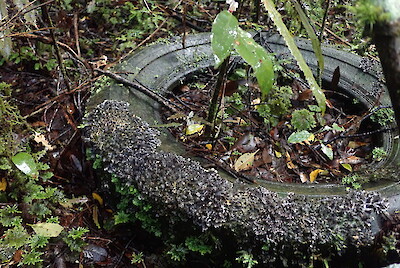
Corticolous (bark, wood), Terricolous (soil)
Detailed description
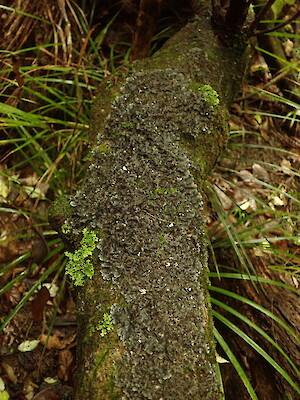
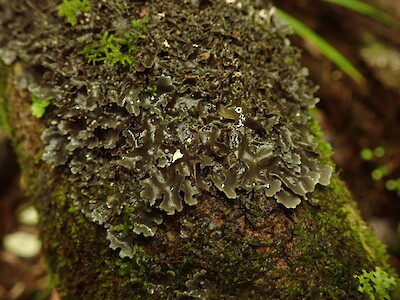
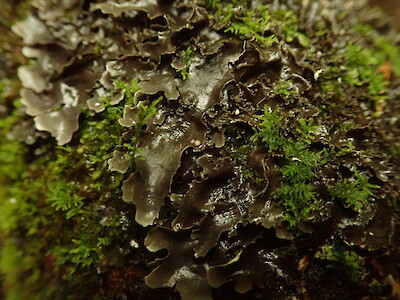
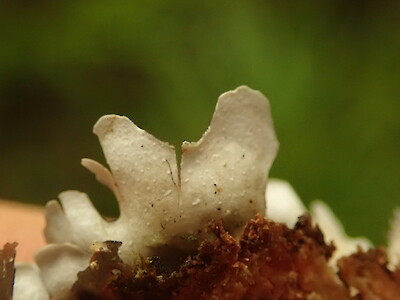
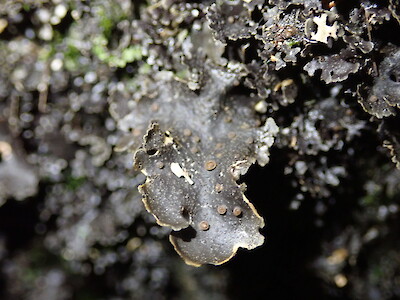
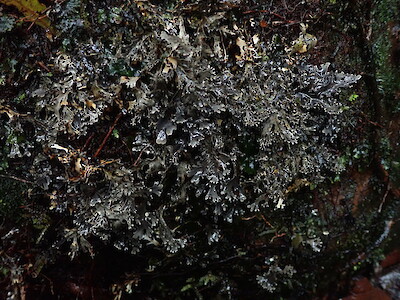
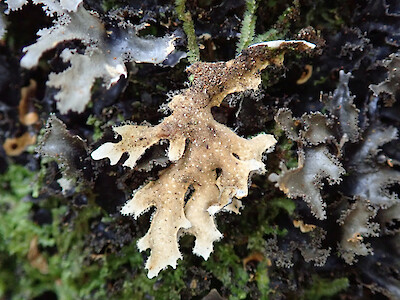
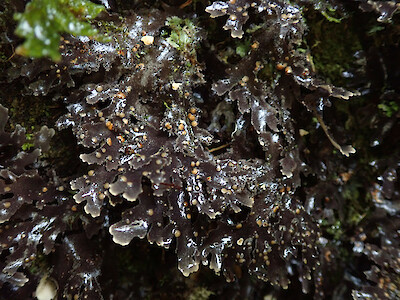
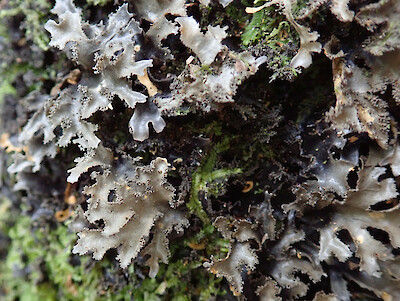
Thallus linear-laciniate, suborbicular to spreading, 5-10(-20) cm wide, loosely to closely attached. Lobes linear-elongate to shallowly rounded to ± dichotomously branching, thin and rather brittle, imbricate centrally, apices discrete, margins entire at apices or ± bifurcate, highly dissected in older parts, isidiate, often ± subcanaliculate, margins ± thickened. Upper surface dark leaden grey to bluish-black when wet, pale lilac-brown to grey-brown when dry, smooth, shining, not tomentose, without soredia, maculae or pseudocyphellae. Isidia mainly marginal, occasionally laminal, flattened, or terete, not tomentose, concolorous with thallus. Medulla white. Photobiont blue-green. Lower surface pale buff or white at margins, darker brown to ochre centrally, glabrous, slightly wrinkled at margins, tomentose centrally, glabrous in a narrow marginal zone, elsewhere tomentose, tomentum to margins in older lobes, short, regular, whitish, silky. Pseudocyphellae white, minute, fleck-like, 0.1-0.6 mm wide, rarely to 1 mm wide, rather sparse, flat, sunk in tomentum. Apothecia submarginal to scattered, 1.5-3.0 mm diam., disc red-brown, margins pale whitish, irregularly dentate-lacerate or crenulate, thalline exciple pale, corrugate-verrucose. Ascospores brown, oblong-fusiform, 1-3-septate, 24-42 × 8-11 µm. It may be parasitised by the lichenicolous fungi *Arthonia fuscopurpurea, *Plectocarpon gallowayi and *Pyrendium actinellum.
Chemistry: 7β-acetoxy-hopan-22-ol, hopane-15α,22-diol, ± gyrophoric acid.
Substrate details
Corticolous, terricolous
Detailed taxonomy
Genus
Family
Endemic taxon
No
Endemic genus
No
Endemic family
No
Other information
NVS code
The National Vegetation Survey (NVS) Databank is a physical archive and electronic databank containing records of over 94,000 vegetation survey plots - including data from over 19,000 permanent plots. NVS maintains a standard set of species code abbreviations that correspond to standard scientific plant names from the Ngä Tipu o Aotearoa - New Zealand Plants database.
PSCDIS
Referencing and citations
References and further reading
Galloway D.J. 1985: Flora of New Zealand: Lichens. Wellington, PD Hasselberg, Government Printer. 662 pp.
Galloway D.J. 2007: Flora of New Zealand: Lichens, including lichen-forming and lichenicolous fungi. 2nd edition. Lincoln, Manaaki Whenua Press. 2261 pp.
Attribution
Some of this factsheet information is derived from Biota of New Zealand and is used under a Creative Commons Attribution 4.0 International licence.