
Pseudocyphellaria maculata
Biostatus
Native
Current conservation status
2018 | Not Threatened | Qualifiers: SO
Category
Lichen
Structural class
Lichens - Foliose
Lichen substrate
Terricolous (soil)
Detailed description
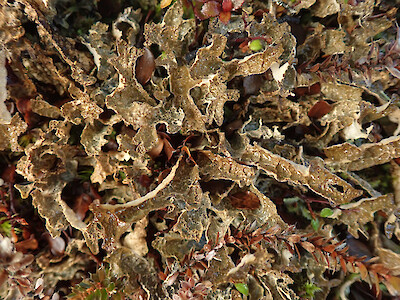
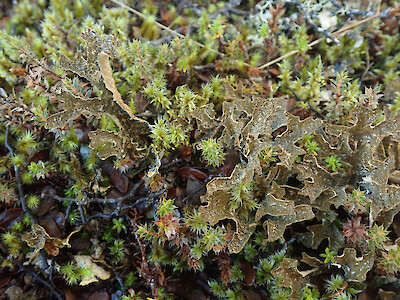
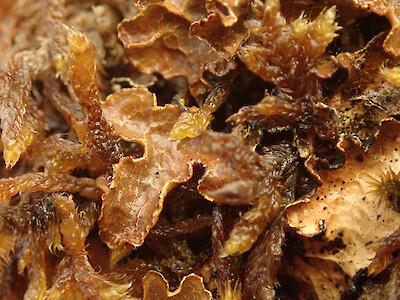
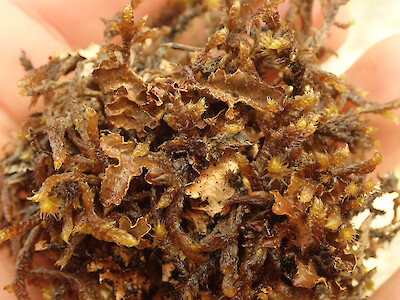
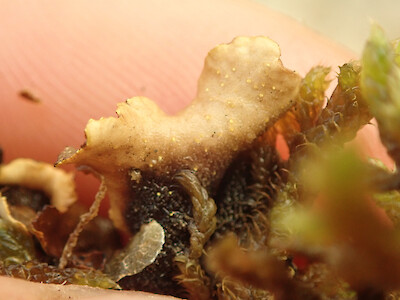
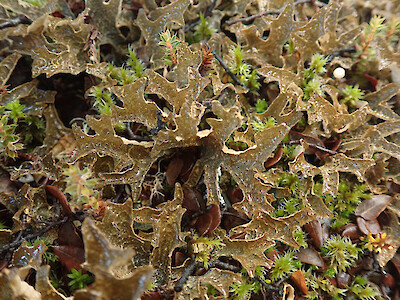
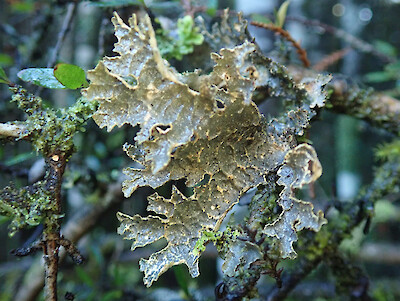
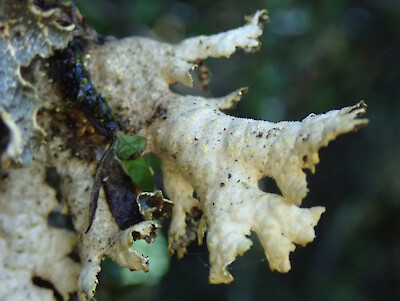
Thallus irregularly spreading, (2-)5-15 cm diam., loosely attached, corticolous. Lobes ± linear-elongate, subcanaliculate to plane, subdichotomously to irregularly or complexly branched, 1-10 mm wide and 0.5-5 cm long, margins entire, slightly thickened, occasionally ± ascending, rarely subdenticulate with raised, yellow pseudocyphellae. Upper surface shallowly to deeply faveolate, interconnecting ridges smoothly rounded or sharp, dark grey-blue when wet and conspicuously white-maculate in well-defined patterns (×10 lens), pale greyish or greenish-grey to greyish-buff when dry, sometimes suffused reddish- brown in parts, matt or slightly shining, often irregularly cracked, minutely scabrid-areolate in parts. Medulla white. Photobiont blue-green. Lower surface pale whitish-buff, distinctly wrinkled-bullate, ± evenly tomentose to margins, tomentum thin, silky, short, white or buff, thicker and darker (becoming brown) centrally. Pseudocyphellae minute, bright yellow, round, 0.05-0.3 mm diam., scattered, slightly raised above tomentum, decorticate area plane, margins not prominent. Apothecia marginal or submarginal, subpedicellate, 0.5-3.5 mm diam., plane to shallowly convex-undulate, disc in young stages obscured by margins, at maturity dark red-brown to black, matt, epruinose, margins denticulate, pale buff or flesh-coloured, often obscured by disc, exciple corrugate-scabrid, buff or pale flesh-coloured. Ascospores biseriate, brown, mainly polaribilocular, occasionally 3-septate, 20-30.6 × 8.3-10.2 µm. Pycnidia occasional to frequent, scattered, black, punctiform, minute.
Chemistry: Methyl evernate (tr.), tenuiorin, methyl lecanorate (tr.), methyl gyrophorate, evernic acid (tr.), gyrophoric acid (tr.), hopane-6α,7β,22-triol, norstictic (tr.), salazinic, consalazinic, galbinic acids, pulvinic acid, pulvinic dilactone and calycin.
Substrate details
Terricolous
Detailed taxonomy
Genus
Family
Endemic taxon
No
Endemic genus
No
Endemic family
No
Other information
Etymology
maculata: From Latin ‘macula’ blotch, meaning blotchy
NVS code
The National Vegetation Survey (NVS) Databank is a physical archive and electronic databank containing records of over 94,000 vegetation survey plots - including data from over 19,000 permanent plots. NVS maintains a standard set of species code abbreviations that correspond to standard scientific plant names from the Ngä Tipu o Aotearoa - New Zealand Plants database.
PSEMAL
Referencing and citations
References and further reading
Galloway D.J. 1985: Flora of New Zealand: Lichens. Wellington: PD Hasselberg, Government Printer. 662 pp.
Galloway D. J. 1992: Studies in Pseudocyphellaria (lichens) III. The South American species. Bibliotheca Lichenologica 46: 1-275.
Galloway D.J. 2007: Flora of New Zealand: Lichens, including lichen-forming and lichenicolous fungi. 2nd edition. Lincoln, Manaaki Whenua Press. 2261 pp.
Lücking R., Moncada B., McCune B., Farkas E., Goffinet B., Parker D., Chaves J.L., Lőkös L., Nelson P.R., Spribille T. and Stenroos S. 2017: Pseudocyphellaria crocata (Ascomycota: Lobariaceae) in the Americas is revealed to be thirteen species, and none of them is P. crocata. The Bryologist, 120(4): 441-500.
Attribution
Some of this factsheet information is derived from Biota of New Zealand and is used under a Creative Commons Attribution 4.0 International licence.