
Ranunculus trilobus
Common names
Three-lobed buttercup
Biostatus
Exotic
Conservation status
Not applicable
Category
Vascular
Structural class
Herbs - Dicotyledons other than Composites
Simplified description
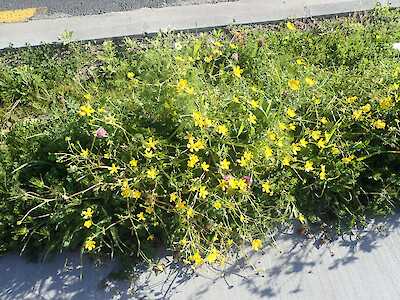
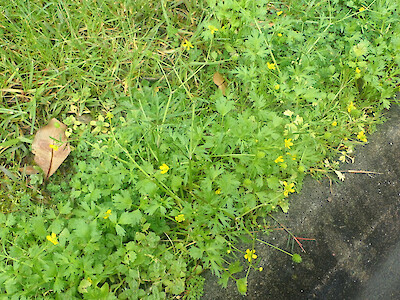
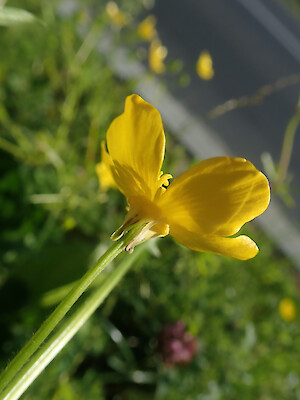
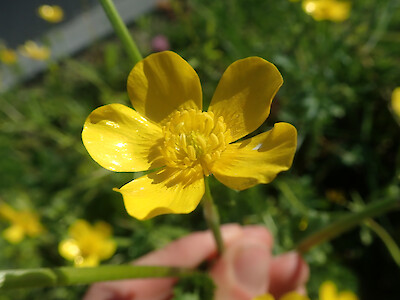
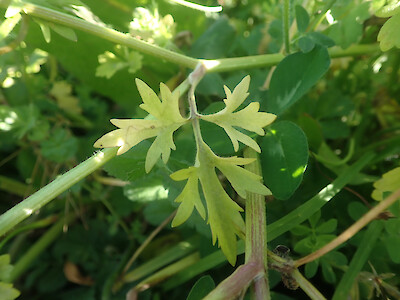
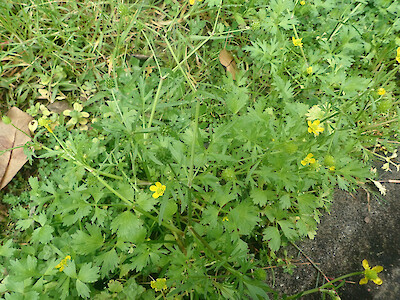
An erect, sparsely hairy annual buttercup, 10–49 cm tall. Its leaves are divided into three stalked, sharply angled leaflets. It has small yellow flowers 9–14 mm across with reflexed sepals. The flattened achenes are covered on their faces with short, blunt tubercles.
Flower colours
Yellow
Detailed description
Terrestrial herb, annual. Stem solitary or 2–3, erect, terete, branched, 10–49 cm high, 2.0–3.5 mm in diameter, hollow, continuously pubescent with long appressed or spreading trichomes. Basal leaves with petiole 3.5–14 cm long, sulcate along the upper side, continuously hairy with appressed trichomes; lamina cordate–ovate with cordate base, 4.5–9.5 × 4.0–9.0 cm, trifid, middle segment 3-partite or occasionally unequally 2-partite with 0.5–1.0 cm long petiolule, lateral segments 3-partite or irregularly lobed, lobule margins incised dentate, both surfaces pubescent, upper surface with scattered trichomes and lower surface with continuous trichomes, trichomes transparent, appressed; cauline leaves similar to basal ones, petioles shorter, 20–30 mm long. Flowers yellow, 9–14 mm across; pedicel 10–20 mm long, pubescent with appressed hairs. Sepals 5, ovate to obovate, reflexed, 3–3.75 × 1–15 mm, sparsely hairy on lower side. Petals 5, imbricate, ovate with rounded apex, 5–6 × 3–4 mm; nectary pit covered with 0.5–1 × 0.5–1 mm scale; claw 0.5–1 mm. Stamens 25–30, 3–4 mm long; filaments 1.75–2.5 mm; anthers adnate, 1.25–1.5 mm, latrorse. Carpels 25–35, 1–1.5 mm long, glabrous, minutely papillate in the ovary region. Achenes flattened, 25–40 per head, orbicular–obovate, 2.5–3 × 1.75–2.25 mm; faces covered with short blunt tubercules, distinctly marginate, margin smooth; beak small, 0.5–1 mm. Torus club-shaped, 4–5.5 × 1.5–2 mm, sparsely hairy, trichomes 0.5–1 mm.
Similar taxa
Ranunculus trilobus belongs to sect. Echinella, whose achenes have sculptured faces bearing tubercles, spines or recurved trichomes. This separates it from all native New Zealand Ranunculus. Several other naturalised members of the section have spiny or hooked achenes rather than blunt tubercles: R. arvensis, R. muricatus, R. parviflorus and R. sessiliflorus. R. parviflorus and R. sessiliflorus also have smaller flowers (< 6 mm diameter) and leaves lobed only to about halfway rather than divided into stalked leaflets. The most similar species is R. sardous, one of the most common buttercups in northern New Zealand. R. sardous has tubercles restricted to the achene margins rather than scattered across the faces, although these are not always obvious. It is also more or less hirsute, whereas R. trilobus has only a few scattered villous hairs, and its leaves are less lobed and more overlapping. R. bulbosus, which is uncommon here, has smooth achenes.
Vegetatively, R. trilobus resembles the three-lobed buttercups R. reflexus, R. urvilleanus and R. repens. Its young basal leaves are ovate–cordate, becoming trilobed as they mature. It is distinguished by its more sharply angled lobes with straight-edged margins, which lack the rounded serrations typical of the other species, and by its much sparser, pubescent hairs. R. repens also differs in its creeping habit and stems that root at the nodes.
Distribution
Native to the Mediterranean. It is naturalised in Australia, Europe, India, China, New Caledonia and North America. In New Zealand it was first collected in 1989 on a sandy roadside south of Houhora (Te Aupōuri, Te Tai Tokerau / Northland), but that population has not been relocated. Most records are from urban Tāmaki Makaurau / Auckland, including Waikumete Cemetery (1999), New Lynn, Blockhouse Bay and central Auckland. iNaturalist observations date from 2017. The species was formally reported as naturalised in 2025.
Habitat
An ephemeral annual of lightly mown lawns on clay or sandy soils, mesic to dryish, in habitats similar to those of R. sardous. It is found on urban road verges, in cemetery lawns and on sandy roadsides. It grows with other weeds such as Allium triquetrum, Bellis perennis, Cenchrus clandestinus, Cerastium glomeratum, Erodium moschatum, Hypochaeris radicata, Lysimachia arvensis, Plantago lanceolata, Trifolium repens, Veronica persica and Vulpia spp.
Detailed taxonomy
Genus
Family
Endemic genus
No
Endemic family
No
Ecology
Flowering
July–December
Fruiting
July–December
Life cycle and dispersal
Plants are highly fecund, producing on average about 475 seeds on 8–15 fruiting heads, with 85–94.5% germination. The tuberculate achenes can attach to the hair of cattle and sheep, and wind dispersal is also possible (Lone et al. 2014).
Other information
Etymology
ranunculus: From the Latin ‘rana’ frog, meaning little frog and probably refers to the plants typical marshy habit where frogs abound
Referencing and citations
References and further reading
Ford, M., Reinders, W.A., Lehnebach, C.A. (2025). Ranunculus trilobus Desf. (Ranunculaceae), a newly naturalised species in Aotearoa / New Zealand. Perspectives in Biosecurity 10: 10–21. https://doi.org/10.34074/pibs.01002
Garnock-Jones, P.J. (1988). Ranunculus. In: Webb, C.J., Sykes, W.R., Garnock-Jones, P.J. (Eds.), Flora of New Zealand, vol. IV. Christchurch: DSIR. pp. 1013–1039.
Lone, F.A., Dar, G.H., Wafai, B.A. (2014). Ranunculus trilobus Desfontaines (Ranunculaceae) – a new record for Northwest and Trans-Himalayas. Pleione 8: 171–177.
Attribution
Fact sheet prepared for NZPCN by M. Ford, October 2026, based on Ford, M., Reinders, W.A., Lehnebach, C.A. (2025). Ranunculus trilobus Desf. (Ranunculaceae), a newly naturalised species in Aotearoa / New Zealand. Perspectives in Biosecurity 10: 10–21. https://doi.org/10.34074/pibs.01002