
Sphagnum perichaetiale
Common names
moss
Biostatus
Native
Current conservation status
This is the first complete assessment of all known species of mosses found in the wild in Aotearoa New Zealand with a total of 560 species being assessed. The conservation status of mosses, published in the NZTCS database, replaces all previous assessments of mosses. Data supporting the 2025 NZTCS assessment of mosses has been published on the NZTCS database at https://nztcs.org.nz/reports/1155.
Source: NZTCS and licensed by DOC for reuse under the Creative Commons Attribution 4.0 International licence.
2025 | At Risk – Uncommon | Qualifiers: Sp, DPS, DPT, RR, SO
Category
Non-vascular
Structural class
Mosses
Detailed description
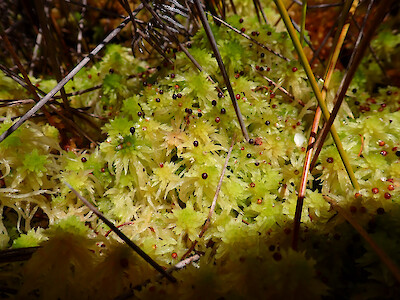
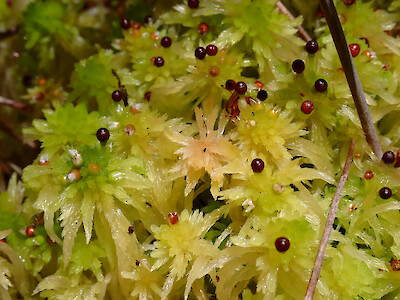
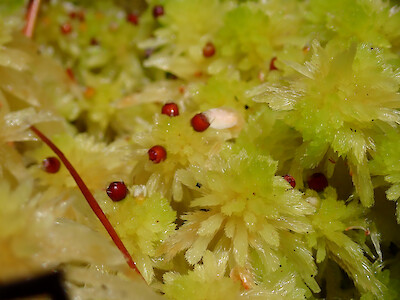
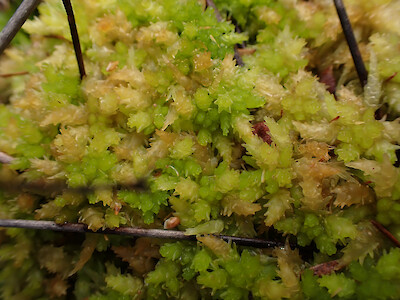
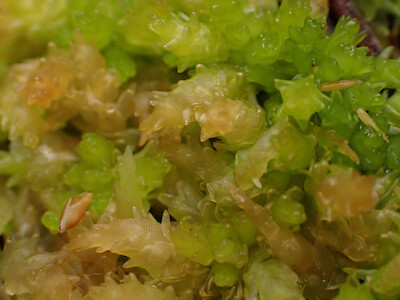
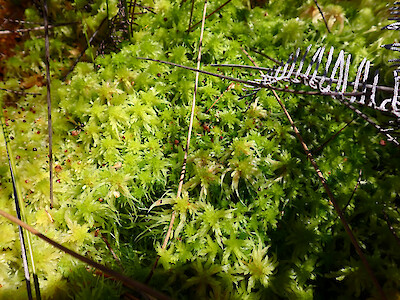
Plants usually robust, dirty yellowish or brownish-green, sometimes with a faint orange tinge, forming moist or water-logged cushions; capitulum not obscured by branches, with a small apical bud. Fascicles of 4 (rarely 2-3) branches, the spreading and pendent branches well differentiated. Stems less than 100 mm, partially obscured by pendent branches; cortical cells mostly in 3 layers, those of the outermost layer short (1-2:1), with 1 large pore at the upper end, and weakly developed fibrils, surrounding a woody, dark-brown to nearly black internal cylinder. Stem leaves erect or pendent, Ungulate and inrolled in upper third to half, c. 2 mm long, weakly bordered, hyaline cells not or sparsely divided, fibrillose, on abaxial surface with few (mostly 3-6) large, ringed pores which are often aggregated with those of adjacent cells to form pseudolacunae, and larger (owing to resorption) and more numerous in lower portion of leaf and near margins; on adaxial surface pores absent. Branches (spreading) c. 5-8 mm long; cortical cells in a single layer, fibrillose, ± uniform, eporose or singly pored. Branch leaves broadly ovate, concave with cucullate and rounded apices, c. 2.5 mm long (from middle of spreading branch), strongly roughened (cristate) at back near apex owing to cell wall resorption, serrulate above, bordered by a single row of narrow cells with a resorption furrow, with pores not clearly visible under stereoscope (x50). Hyaline cells ± sigmoid, mostly 150-180 x 36-45 microns (upper median), fibrillose, not divided, on abaxial surface with few (mostly 3-4) inconspicuous pores aggregated at adjacent corners in groups of 2-3, often forming pseudolacunae; on adaxial surface with a few (1-4) large, unringed pores scattered along commissures. Branch leaf cross-section with hyaline cells convex on both surfaces; green cells narrowly urceolate to elliptic, exposed equally on both surfaces; commissural walls smooth.
Distribution
Indigenous. Pantropical. In New Zealand known from the North Island (Ahipara, Lake Rotokawau, Pakawakatutu, Aranga, Kawerua and Netherby) and from the South Island (Collingwood, German Terrace and the Nile River).
Substrate details
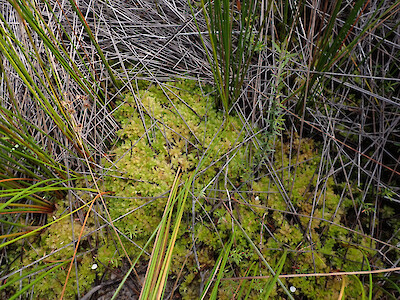
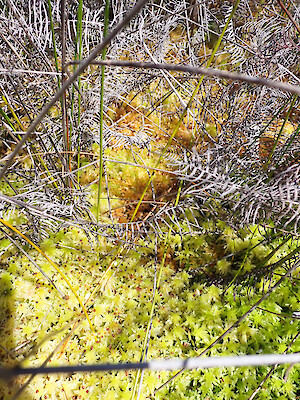
Tericolous in gumland scrub, in ditches, in seasonally wet depressions within poorly draining hard clays pans, and on acidic soils and peat.
Threats
This species is easily overlooked and can be mistaken for a stunted state of the more common S. cristatum. Karlin & Andrus (2006) suggested that it much more widespread than Fife (1996) had thought.
Detailed taxonomy
Genus
Family
Synonyms
None
Endemic genus
No
Endemic family
No
Ecology
Fruiting
Fruits apparently unknown in New Zealand material
Wetland plant indicator status rating
Information derived from the revised national wetland plant list prepared to assist councils in delineating and monitoring wetlands (Clarkson et al., 2021 Manaaki Whenua – Landcare Research Contract Report LC3975 for Hawke’s Bay Regional Council). The national plant list categorises plants by the extent to which they are found in wetlands and not ‘drylands’. The indicator status ratings are OBL (obligate wetland), FACW (facultative wetland), FAC (facultative), FACU (facultative upland), and UPL (obligate upland). If you have suggestions for the Wetland Indicator Status Rating, please contact: [Enable JavaScript to view protected content]
OBL: Obligate Wetland
Almost always is a hydrophyte, rarely in uplands (non-wetlands).
Other information
Previous conservation statuses
This is the first complete assessment of all known species of mosses found in the wild in Aotearoa New Zealand with a total of 560 species being assessed. The conservation status of mosses, published in the NZTCS database, replaces all previous assessments of mosses. Data supporting the 2025 NZTCS assessment of mosses has been published on the NZTCS database at https://nztcs.org.nz/reports/1155.
Source: NZTCS and licensed by DOC for reuse under the Creative Commons Attribution 4.0 International licence.
2014 | At Risk – Naturally Uncommon | Qualifiers: DP, RR, SO, Sp
2010 | At Risk – Naturally Uncommon | Qualifiers: DP, RR, SO, Sp
2005 | Range Restricted | Qualifiers: DP, SO