
Tussilago farfara

NPPA pest plant
Environmental Weed (2024)
Common names
coltsfoot
Biostatus
Exotic
Conservation status
Not applicable
Category
Vascular
Structural class
Herbs - Dicotyledonous composites
Flower colours
Yellow
Detailed description
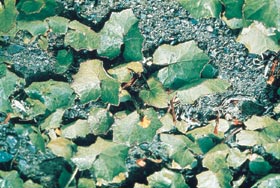
Herb with stout rootstock and rhizomes. Basal leaves glabrous on upper surface, moderately to densely lanate on lower; petiole hairy, > lamina, 3~35cm long; lamina reniform to suborbicular, cordate, acute, shallowly lobed and again denticulate, 3~20cm diam.; lobes with flat or concave sides. Infl. usu. appearing before leaves, erect, 5~30cm tall; cauline leaves > 10, ovate-triangular, entire, around 1cm long. Supplementary bracts 0~2. Involucral bracts approx. 20, linear- to ovate-oblong, 9~14mm long. Ray florets numerous, ligules yellow, linear, 3~5mm long. Achenes 3~5mm long. (- Webb et. al., 1988)
Similar taxa
A low growing perennial mat forming plant (Regional Councils n.d.). A herb with a stout rootstock and rhizomes (Webb et. al. 1988). A plant with yellow flower heads (Webb et. al. 1988; Regional Councils n.d.). The leaves of the upper aerial part of the plant are egg-shaped to triangular with shallow lobes (Webb et. al. 1988).
Habitat
Terrestrial.
Detailed taxonomy
Genus
Family
Endemic family
No
Ecology
Flowering
October
Year naturalised
1975
Origin
Europe, N Africa, N&W Asia
Reason for introduction
Agricultural
Life cycle and dispersal
Perennial
Other information
National Pest Plant Accord species
This plant is listed in the 2020 National Pest Plant Accord. The National Pest Plant Accord (NPPA) is an agreement to prevent the sale and/or distribution of specified pest plants where either formal or casual horticultural trade is the most significant way of spreading the plant in New Zealand. For up to date information and an electronic copy of the 2020 Pest Plant Accord manual (including plant information and images) visit the MPI website.
Environmental Weed (2024)
This plant is named in a list of 386 environmental weeds in New Zealand 2024 prepared by DOC. 759 candidate species were considered for inclusion on this new comprehensive list of environmental weeds in New Zealand. The species considered were drawn from published lists of weed species, lists of plants that must be reported or managed by law if observed, existing national and regional programmes and agreements for pest management, and species already managed by the Department of Conservation (DOC). Candidate species were then assessed to see if they were fully naturalised and whether they have more than minor impacts in natural ecosystems. Read the full report here.