
Utricularia livida

NPPA pest plant
Common names
bladderwort
Biostatus
Exotic
Conservation status
Not applicable
Category
Vascular
Structural class
Herbs - Dicotyledons other than Composites
Simplified description
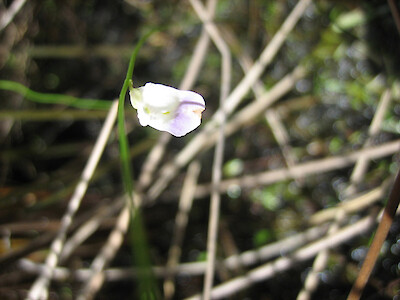
Minute herb with wedge-shaped leaves up to 7 mm long growing from underground parts, flower stalks much larger, usually around 10 cm long, with 2 to 8 oblong violet or white flowers up to 1.5 cm long.
Flower colours
Violet/Purple, White
Detailed description
Annual or perennial, terrestrial. Rhizoids few to many, capillary, simple. Stolons up to 5.0 cm long, few, apillary, much branched. Leaves few, usually one at peduncle base, others scattered on stolons; lamina 0.2-7.0 × 1.0-6.0 mm, narrowly cuneate or obovate to reniform, petiolate. Traps numerous on rhizoids, stolons, and leaves, 1-2 mm long, ovoid, stalked. Inflorescences 2-80 cm long, erect, solitary, simple or branched above; peduncle 0.5-2.0 mm diam., terete, glabrous. Bracts c. 1 mm long, basifixed, ovate to ovate-deltoid. Flowers 2-8, distant to congested; pedicels 1-3 mm long, terete, erect in flower, spreading or reflexed in fruit; calyx 2-5 mm long; corolla 5-15 mm long, violet, lower floral limb transversely wrinkled; filaments c. 1 mm long; ovary globose; style cylindrical, short. Capsule c. 2 mm long, globose, dehiscing by longitudinal slits. Apparently seed is not produced in naturalised populations.
Similar taxa
Other so-called ‘terrestrial’ Utricularia species have similar leaves, although the native U. dichotoma and U. delicatula do not have wedge-shaped leaves. Two other introduced species U. sandersonii and U. arenaria have a spur that extends well beyond the lower lip of the flower.
Distribution
Only known from two sites in Waitakere District, Auckland.
Habitat
Dune slack wetlands amongst oioi (Apodasmia similis).
Detailed taxonomy
Genus
Family
Endemic genus
No
Endemic family
No
Ecology
Flowering
Summer
Fruiting
n/a
Year naturalised
2001
Origin
Tropical and southern Africa, Madagascar and Mexico.
Reason for introduction
Ornamental plant
Control techniques
Manual removal.
Life cycle and dispersal
Deliberate planting and water borne dispersal of rhizome fragments
Other information
Etymology
utricularia: A small bladder
National Pest Plant Accord species
This plant is listed in the 2020 National Pest Plant Accord. The National Pest Plant Accord (NPPA) is an agreement to prevent the sale and/or distribution of specified pest plants where either formal or casual horticultural trade is the most significant way of spreading the plant in New Zealand. For up to date information and an electronic copy of the 2020 Pest Plant Accord manual (including plant information and images) visit the MPI website.
NVS code
The National Vegetation Survey (NVS) Databank is a physical archive and electronic databank containing records of over 94,000 vegetation survey plots - including data from over 19,000 permanent plots. NVS maintains a standard set of species code abbreviations that correspond to standard scientific plant names from the Ngä Tipu o Aotearoa - New Zealand Plants database.
UTRLIV
Referencing and citations
References and further reading
Heenan, P.B.; de Lange, P.J.; Cameron, E.K.; Ogle, C.C.; Champion, P.D. (2004). Checklist of dicotyledons, gymnosperms and pteridophytes naturalised or casual in New Zealand: additional records 2001-2003. New Zealand Journal of Botany 42: 797-814.
Attribution
Factsheet prepared by Paul Champion and Deborah Hofstra (NIWA).