
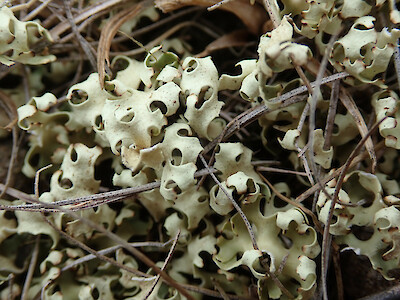
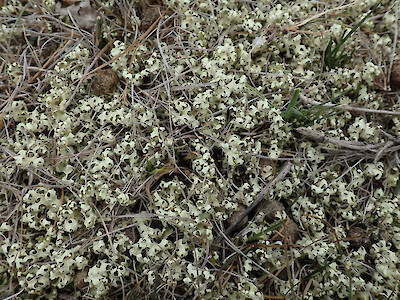
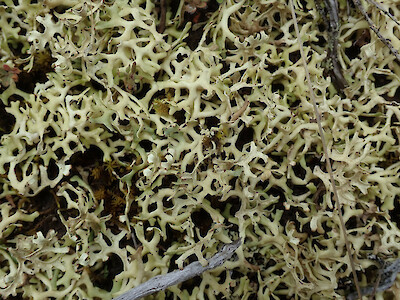
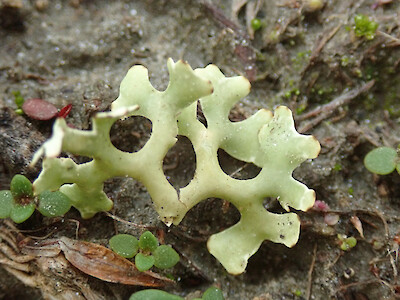
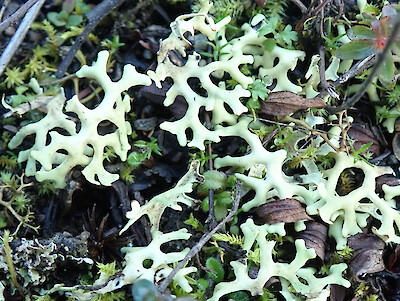
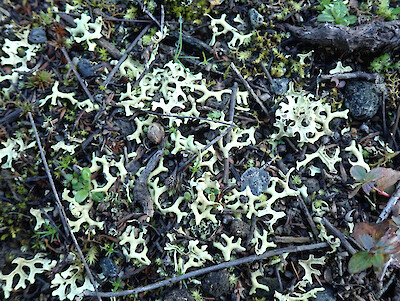
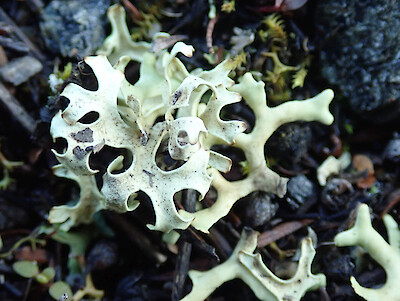
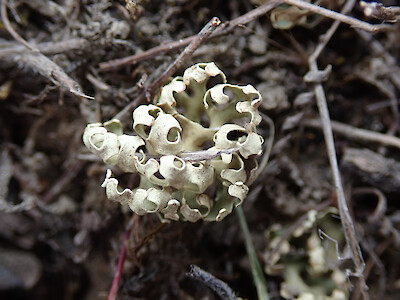
Xanthoparmelia semiviridis
Common names
Resurrection lichen
Biostatus
Native
Current conservation status
2018 | At Risk – Declining | Qualifiers: EF, SO
Category
Lichen
Structural class
Lichens - Foliose
Substrate details
Vagrant (unattached, on the ground)
Threats
Habitat loss and modification of the dryland habitats it occupies. Agricultural intensification (e.g. irrigation, fertilisation) and weed invasion.
Detailed taxonomy
Genus
Family
Synonyms
Chondropsis semiviridis, Parmeliopsis semiviridis
Endemic taxon
No
Endemic genus
No
Endemic family
No
Ecology
Life cycle and dispersal
In a recent study using a field-based wind tunnel Eldridge & Leys (1999) showed that continual bombardment of X. semiviridis thalli against both the soil surface and physical objects (fallen branches debris etc.) resulted in the breakdown of thalli into small, detached apical fragments that were easily moved by wind. They hypothesise that thallus fragments are likely to move with much higher frequencies than larger, intact thalli, and thereby provide a means of dispersal to new areas.
Other information
Etymology
semiviridis: From the Latin semi- ‘half’ or ‘partially’ and ‘viridis ‘green’
NVS code
The National Vegetation Survey (NVS) Databank is a physical archive and electronic databank containing records of over 94,000 vegetation survey plots - including data from over 19,000 permanent plots. NVS maintains a standard set of species code abbreviations that correspond to standard scientific plant names from the Ngä Tipu o Aotearoa - New Zealand Plants database.
XANSEM
Referencing and citations
References and further reading
Eldridge D.J. and Leys J.F. 1999: Wind dispersal of the vagant lichen Chondropsis semiviridis in semi-arid eastern Australia. Australian Journal of Botany 47: 157–164.
Galloway D.J. 2007: Flora of New Zealand: Lichens, including lichen-forming and lichenicolous fungi. 2nd edition. Lincoln, Manaaki Whenua Press. 2261 pp.