
Carpobrotus glaucescens
Common names
pig face
Biostatus
Native
Current conservation status
The conservation status of all known New Zealand vascular plant taxa at the rank of species and below were reassessed in 2022-2023 using the New Zealand Threat Classification System (NZTCS) – more information about this can be found on the NZTCS website. This report includes replaces all previous NZTCS lists for vascular plants. Previous assessments can be found here.
- Conservation status of vascular plants in Aotearoa New Zealand, 2023. 2024. Peter J. de Lange, Jane Gosden, Shannel P. Courtney, Alexander J. Fergus, John W. Barkla, Sarah M. Beadel, Paul D. Champion, Rowan Hindmarsh-Walls, Troy Makan and Pascale Michel Department of Conservation. Source: NZTCS and licensed by DOC for reuse under the Creative Commons Attribution 4.0 International licence.
2023 | Non-resident Native – Coloniser | Qualifiers: SO
Category
Vascular
Structural class
Herbs - Dicotyledons other than Composites
Flower colours
Red/Pink, White
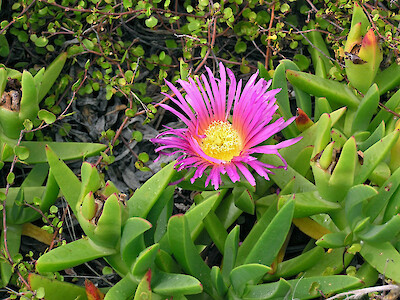
Detailed description
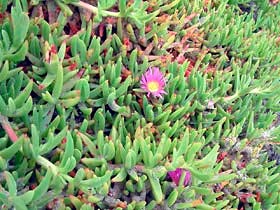
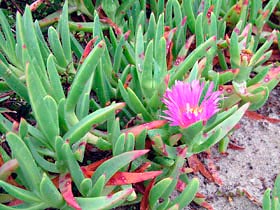
Succulent, glabrous perennial. Stems prostrate, widely spreading, rooting at nodes. Leaves opposite, triquetrous, very succulent, basally connate, ensheathing stem, 30-100 × 8-15 mm, light-green, faintly glaucous, adaxial and lateral faces flat, lamina becoming convex toward base; keel crenulate in upper portion, otherwise smooth. Flowers solitary, terminal, 40-60 mm diameter. Pedicels 10-30 mm long. Sepals 5 with 2 larger than the others, triquetrous and opposite, smaller 3 with membranous margins. Petals numerous, magenta, white at base. Stamens 300-400, 5-6-seriate. Styles 7-10. Fruit fleshy, indehiscent, ellipsoidal, 20-30 mm long, reddish, edible, tasting of strawberries.
Similar taxa
Differs from the other two naturalised species in New Zealand, C. chilensis and C. edulis by the glaucescent leaves, and smaller (40-60 mm diameter cf. 65-100 mm diameter) magenta rather than purple (C. chilensis) or yellow (C. edulis) flowers.
Distribution
Indigenous: New Zealand: North Island (Coromandel Peninsula, Otama). Present also in Australia, Lord Howe and Norfolk Islands.
Habitat
Mainly a strand line species of sandy beaches which occasionally colonises coastal headlands, or grows under coastal forest
Threats
Carpobrotus glaucescens has been controlled as a weed species within its only known New Zealand locations. At the time this was done it had not been considered that it might be a natural, self-introduction. It is not known if it now survives in the wild in New Zealand.
Detailed taxonomy
Genus
Family
Synonyms
Mesembryanthemum glaucescens Haw.
Endemic taxon
No
Endemic genus
No
Endemic family
No
Ecology
Flowering
Throughout the year
Fruiting
Throughout the year
Life cycle and dispersal
Fleshy capsules are dispersed by frugivory and possibly wind and water (Thorsen et al., 2009).
Propagation technique
Easily grown from rooted pieces, fruits and by the division of established plants.
Other information
Etymology
carpobrotus: From the Greek karpos ‘fruit’ and brotus ‘edible’, the fruits of some species being edible.
glaucescens: Becoming glaucous
NVS code
The National Vegetation Survey (NVS) Databank is a physical archive and electronic databank containing records of over 94,000 vegetation survey plots - including data from over 19,000 permanent plots. NVS maintains a standard set of species code abbreviations that correspond to standard scientific plant names from the Ngä Tipu o Aotearoa - New Zealand Plants database.
CARGLC
Previous conservation statuses
The conservation status of all known New Zealand vascular plant taxa at the rank of species and below were reassessed in 2022-2023 using the New Zealand Threat Classification System (NZTCS) – more information about this can be found on the NZTCS website. This report includes replaces all previous NZTCS lists for vascular plants. Previous assessments can be found here.
- Conservation status of vascular plants in Aotearoa New Zealand, 2023. 2024. Peter J. de Lange, Jane Gosden, Shannel P. Courtney, Alexander J. Fergus, John W. Barkla, Sarah M. Beadel, Paul D. Champion, Rowan Hindmarsh-Walls, Troy Makan and Pascale Michel Department of Conservation. Source: NZTCS and licensed by DOC for reuse under the Creative Commons Attribution 4.0 International licence.
2017 | Non-resident Native – Coloniser | Qualifiers: SO
2012 | Non-resident Native – Coloniser | Qualifiers: SO
2009 | Non-resident Native – Coloniser | Qualifiers: SO
2004 | Not Threatened
Referencing and citations
References and further reading
Green, P.S. 1994: Flora of Australia Volume 49, Oceanic Islands 1. Canberra, Australian Government Publishing Service
Thorsen, M. J.; Dickinson, K. J. M.; Seddon, P. J. 2009. Seed dispersal systems in the New Zealand flora. Perspectives in Plant Ecology, Evolution and Systematics 2009 Vol. 11 No. 4 pp. 285-309
Attribution
Fact sheet prepared for NZPCN by P.J. de Lange (12 December 2007). Description adapted from Green (1994) supplemented with observations made from live plants and herbarium specimens.
NZPCN Fact Sheet citation
Please cite as: de Lange, P.J. (Year at time of access): Carpobrotus glaucescens Fact Sheet (content continuously updated). New Zealand Plant Conservation Network. https://www.nzpcn.org.nz/flora/species/carpobrotus-glaucescens/ (Date website was queried)