
Convolvulus fractosaxosus
Common names
shingle convolvulus
Biostatus
Native – Endemic taxon
Current conservation status
The conservation status of all known New Zealand vascular plant taxa at the rank of species and below were reassessed in 2022-2023 using the New Zealand Threat Classification System (NZTCS) – more information about this can be found on the NZTCS website. This report includes replaces all previous NZTCS lists for vascular plants. Previous assessments can be found here.
- Conservation status of vascular plants in Aotearoa New Zealand, 2023. 2024. Peter J. de Lange, Jane Gosden, Shannel P. Courtney, Alexander J. Fergus, John W. Barkla, Sarah M. Beadel, Paul D. Champion, Rowan Hindmarsh-Walls, Troy Makan and Pascale Michel Department of Conservation. Source: NZTCS and licensed by DOC for reuse under the Creative Commons Attribution 4.0 International licence.
2023 | At Risk – Naturally Uncommon | Qualifiers: Sp, DPS, DPT
Category
Vascular
Structural class
Lianes & Related Trailing Plants - Dicotyledons
Flower colours
Red/Pink, White
Detailed description
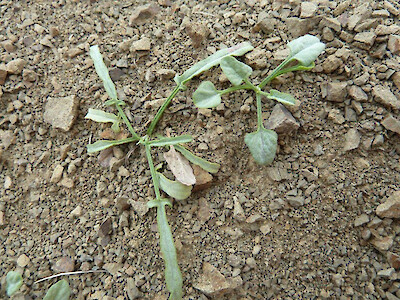
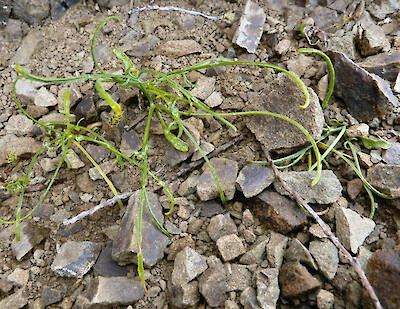
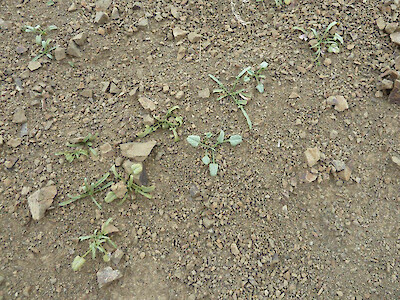
Rhizomatous, shortly creeping to lianoid, perennial herb arising from stout, fleshy, root stock. Stems slender up to 300 mm long. Petioles slender, 10-25 mm long, silky hairy. Leaves heterophyllous, 5-50 x 1-10 mm, green, yellow-green, grey-green, to silvery-grey; densely to sparsely silky hairy, deltoid, deltoid-ovate,broad-oblong, oblong to hastate some at least with filiform or linear terminal lobe and smaller basal lobes. Flowers axillary, solitary, peduncles filiform. Bracts paired, narrow linear. Sepals unequal, 5-7 mm, broad-ovate, covered with appressed hairs, apex obtuse. Corolla white or pink, 20 x 20 mm, when open, mid-petalline band pink. Capsule 7 mm diam., globose. Seeds black finely reticulate, reticulation made of short, narrow ridges.
Similar taxa
Convolvulus verecundus Allan and C. waitaha (Sykes) Heenan, Molloy et de Lange, from which C. fractosaxosus differs by its lianoid stems being up to 300 mm long, and by its heterophyllous foliage, with at least some lamina possessing a filiform or linear terminal lobes and smaller basal lobes.
Distribution
Endemic. Eastern South Island from Marlborough (upper Awatere) south to Central Otago (Kawerau Gorge)
Habitat
Montane in dry open, short-tussock grassland usually in or near rock outcrops, also on semi-stable scree and outcrops at the head of screes.
Threats
As far as is known not threatened but not common either. It appears to be a naturally uncommon, biologically sparse species.
Detailed taxonomy
Genus
Family
Synonyms
None
Endemic taxon
Yes
Endemic genus
No
Endemic family
No
Ecology
Flowering
November - February
Fruiting
January - March
Life cycle and dispersal
Seeds are wind dispersed (Thorsen et al., 2009).
Propagation technique
Has not been successfully cultivated.
Other information
Etymology
convolvulus: From Latin convolvere, which means to twine around
NVS code
The National Vegetation Survey (NVS) Databank is a physical archive and electronic databank containing records of over 94,000 vegetation survey plots - including data from over 19,000 permanent plots. NVS maintains a standard set of species code abbreviations that correspond to standard scientific plant names from the Ngä Tipu o Aotearoa - New Zealand Plants database.
CONFRA
Previous conservation statuses
The conservation status of all known New Zealand vascular plant taxa at the rank of species and below were reassessed in 2022-2023 using the New Zealand Threat Classification System (NZTCS) – more information about this can be found on the NZTCS website. This report includes replaces all previous NZTCS lists for vascular plants. Previous assessments can be found here.
- Conservation status of vascular plants in Aotearoa New Zealand, 2023. 2024. Peter J. de Lange, Jane Gosden, Shannel P. Courtney, Alexander J. Fergus, John W. Barkla, Sarah M. Beadel, Paul D. Champion, Rowan Hindmarsh-Walls, Troy Makan and Pascale Michel Department of Conservation. Source: NZTCS and licensed by DOC for reuse under the Creative Commons Attribution 4.0 International licence.
2017 | At Risk – Naturally Uncommon | Qualifiers: DP, Sp
2012 | At Risk – Naturally Uncommon | Qualifiers: Sp
2009 | At Risk – Naturally Uncommon
2004 | Sparse
Regional conservation statuses
Otago: 2025 | Regionally Data Deficient
Current regional threat status assessments prepared according to Crisp et al. (2025) are displayed when available. The Otago conservation status information is sourced from the “Conservation Status of Indigenous Vascular Plants in Otago, 2025” Jarvie S et al. (2025) report.
Referencing and citations
References and further reading
Thorsen, M. J.; Dickinson, K. J. M.; Seddon, P. J. 2009. Seed dispersal systems in the New Zealand flora. Perspectives in Plant Ecology, Evolution and Systematics 11: 285-309
Attribution
Fact sheet prepared by P.J. de Lange for NZPCN (1 June 2013)
NZPCN Fact Sheet citation
Please cite as: de Lange, P.J. (Year at time of access): Convolvulus fractosaxosus Fact Sheet (content continuously updated). New Zealand Plant Conservation Network. https://www.nzpcn.org.nz/flora/species/convolvulus-fractosaxosus/ (Date website was queried)