
Cyperus polystachyos
Common names
bunchy sedge
Biostatus
Exotic
Conservation status
Not applicable
Category
Vascular
Structural class
Sedges
Simplified description
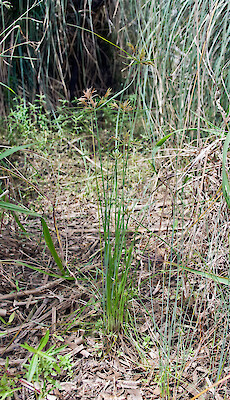
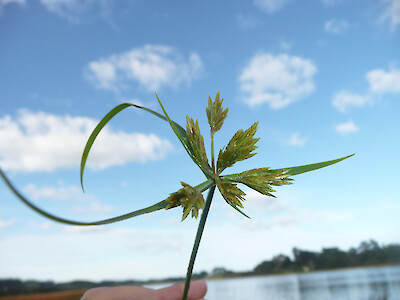
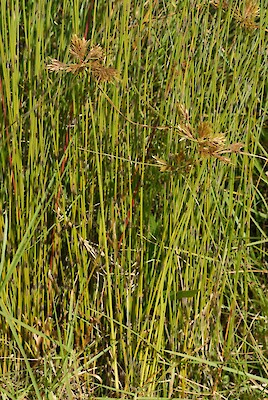
Tufted yellow-green leafy sedge, with triangular stems up to 50 cm tall, leaves arranged in threes, with up to 7 upright yellow-green to pale brown ragged flowerheads, each made up of narrow flattened flower spikes, with 3 to 6 long grass-like leaves immediately under this, at the end of flower stalk.
Flower colours
Brown, Green
Detailed description
Densely tufted annual to perennial. Stems to 50 cm tall, 3-angled, leafy at base. Leaves < stems, 2–3 mm wide, smooth; sheaths purple-brown, sometimes with a few transverse septa. Involucral bracts 3–6, leaf-like, > inflorescence. Inflorescence capitate or with rays to 4 cm long. Spikelets ± stiffly erect in rather dense clusters, narrow-linear, acute, ± 15 × 1.5 mm. Glumes ± 2 mm long, densely imbricate, membranous, subobtuse, chestnut or straw-coloured with green keel. Stamens 2. style-branches 2. Nut ± ½ length of glume, oblong, compressed-biconvex, brown.
Similar taxa
Similar to and often growing with Cyperus eragrostis and C. congestus, differring by the upright, close set inflorescence, the flowerheads are not globular.
Distribution
Restricted to Northland and Auckland where it is locally common.
Habitat
Wet pasture, margins of water bodies and drains.
Detailed taxonomy
Genus
Family
Synonyms
Pycreus polystachyos (Rottb.) Domin
Endemic genus
No
Endemic family
No
Ecology
Flowering
Summer to autumn
Fruiting
Summer to autumn
Year naturalised
1953
Origin
Pantropical and subtropical, also more temperate Australia
Reason for introduction
Unknown, possibly ornamental plant, seed or soil contaminant.
Control techniques
Not controlled in New Zealand.
Life cycle and dispersal
Seed dispersed by contaminated machinery.
Wetland plant indicator status rating
Information derived from the revised national wetland plant list prepared to assist councils in delineating and monitoring wetlands (Clarkson et al., 2021 Manaaki Whenua – Landcare Research Contract Report LC3975 for Hawke’s Bay Regional Council). The national plant list categorises plants by the extent to which they are found in wetlands and not ‘drylands’. The indicator status ratings are OBL (obligate wetland), FACW (facultative wetland), FAC (facultative), FACU (facultative upland), and UPL (obligate upland). If you have suggestions for the Wetland Indicator Status Rating, please contact: [Enable JavaScript to view protected content]
FACW: Facultative Wetland
Usually is a hydrophyte but occasionally found in uplands (non-wetlands).
Other information
Etymology
cyperus: From the ancient Greek name for sedge, kypeiros
NVS code
The National Vegetation Survey (NVS) Databank is a physical archive and electronic databank containing records of over 94,000 vegetation survey plots - including data from over 19,000 permanent plots. NVS maintains a standard set of species code abbreviations that correspond to standard scientific plant names from the Ngä Tipu o Aotearoa - New Zealand Plants database.
CYPPOL
Referencing and citations
References and further reading
Champion P. et al. 2020. Freshwater Invasive Species of New Zealand 2020. NIWA publication. https://docs.niwa.co.nz/library/public/FreInSpec.pdf
Healy AJ, Edgar E. 1980. Flora of New Zealand, Volume III. Adventive Cyperaceous, Petalous and Spathaceous Monocotyledons. Government Printer, Wellington, NZ. 220 p.
Johnson PN, Brooke PA. 1989. Wetland plants in New Zealand. DSIR Field Guide, DSIR Publishing, Wellington, NZ. 319 p.
Attribution
Factsheet prepared by Paul Champion and Deborah Hofstra (NIWA). Features description from Healy and Edgar (1980).
Some of this factsheet information is derived from Flora of New Zealand Online and is used under a Creative Commons Attribution 3.0 New Zealand licence.