
Ectropothecium sandwichense


Common names
moss
Biostatus
Native
Current conservation status
This is the first complete assessment of all known species of mosses found in the wild in Aotearoa New Zealand with a total of 560 species being assessed. The conservation status of mosses, published in the NZTCS database, replaces all previous assessments of mosses. Data supporting the 2025 NZTCS assessment of mosses has been published on the NZTCS database at https://nztcs.org.nz/reports/1155.
Source: NZTCS and licensed by DOC for reuse under the Creative Commons Attribution 4.0 International licence.
2025 | At Risk – Uncommon | Qualifiers: DPS, DPT, RR, SO
Category
Non-vascular
Structural class
Mosses
Detailed description
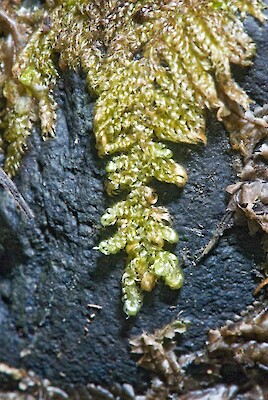
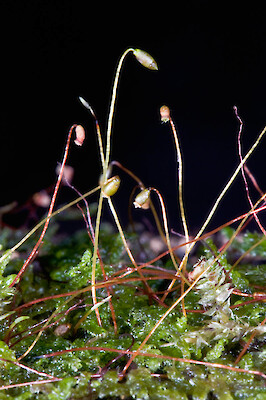
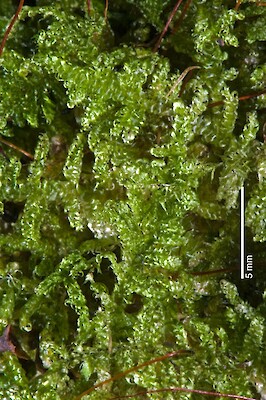
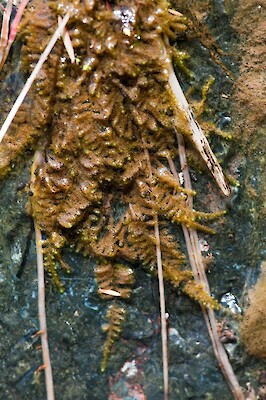
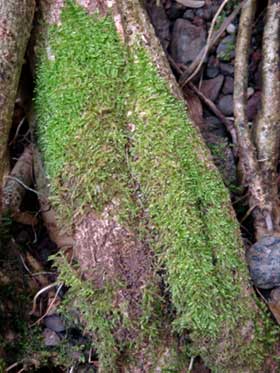
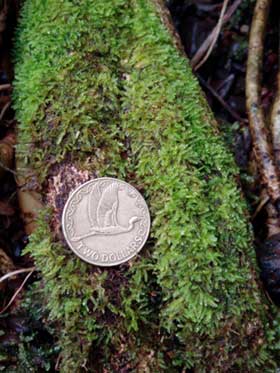
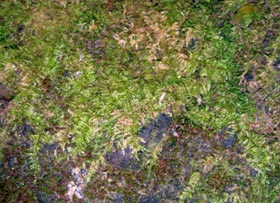
Autoicous. Saxicolous or corticolous, forming thin, pale green, glossy mats. Stems up to 40 mm long, prostrate, radiculose on the under side and closely attaching to substratum, branching irregular, more or less pinnate, short, complanate. Leaves laxly imbricating, widely spreading, complanate with falcate points, arising from a broad insertion, lamina narrowly ovate-lanceolate, apices finely acuminate, concave; margin erect, subentire toward base, serrulate above; nerve absent; leaf cells linear, dense, thin-walled, smooth or minutely papillose on the back by projecting ends, 3 or 4 microns wide and 15-20x as long, slightly wider and shorter in the point and toward the base, with a single row of enlarged, pellucid, oval cells across the insertion and 1-3 still larger, hyaline, very fragile cells at the extreme basal angles. Inner perichaetial leaves c.2.0-2.5 mm long, erect, from an oblong, laxly areolate base quickly narrowed to along slender flat serrulate apex. Seta of variable length mostly 16-20 mm long, reddish below, pale above; capsules pendulous or abruptly hooked, short oval or oblong, constricted under the mouth and more or less asymmetrical when dry; lid broadly convex, apiculate; calyptra usually sparsely hairy when young.
Distribution
Indigenous. New Zealand: Kermadec Islands (Raoul island), North Island (Te Paki - especially North Cape), Maungaraho Rock (near Dargaville), Chatham Islands. Also Australia and throughout the islands of the Pacific Basin.
Substrate details
Corticolous, terricolous and saxicolous on damp soil, rotting logs and rock in damp sites heavily shaded sites in dense forest or growing along stream banks. Sometimes partially or completely submerged.
Threats
Not Threatened. However, in New Zealand this species is known from only a few locations (most within reserves). It is abundant on Raoul Island
Detailed taxonomy
Genus
Family
Synonyms
Hypnum sandwichense Hook. et Arn.; Hypnum paucipilum Sullivan; Cupressina trachylocarpa C.Müll.
Endemic taxon
No
Endemic genus
No
Endemic family
No
Ecology
Fruiting
Although fruit has been seen insufficient information exists to provide any details on the timing of fruiting
Other information
Previous conservation statuses
This is the first complete assessment of all known species of mosses found in the wild in Aotearoa New Zealand with a total of 560 species being assessed. The conservation status of mosses, published in the NZTCS database, replaces all previous assessments of mosses. Data supporting the 2025 NZTCS assessment of mosses has been published on the NZTCS database at https://nztcs.org.nz/reports/1155.
Source: NZTCS and licensed by DOC for reuse under the Creative Commons Attribution 4.0 International licence.
2014 | At Risk – Naturally Uncommon | Qualifiers: RR, SO
2010 | At Risk – Naturally Uncommon | Qualifiers: RR, SO
2005 | Range Restricted | Qualifiers: SO
Referencing and citations
Attribution
Fact sheet prepared for NZPCN by P.J. de Lange 15 March 2007.
NZPCN Fact Sheet citation
Please cite as: de Lange, P.J. (Year at time of access): Ectropothecium sandwichense Fact Sheet (content continuously updated). New Zealand Plant Conservation Network. https://www.nzpcn.org.nz/flora/species/ectropothecium-sandwichense/ (Date website was queried)