
Goebelobryum vermiculare
Common names
Liverwort
Biostatus
Native
Current conservation status
The conservation status of the New Zealand hornwort and liverwort flora is reassessed using the New Zealand Threat Classification System (NZTCS). A full list is presented, along with a statistical summary and brief notes on the most important changes. This list replaces all previous NZTCS lists for New Zealand hornworts and liverworts which previously had been part of a generic bryophyte conservation status assessment that included mosses. Authors: P.J. de Lange, D. Glenny, K. Frogley, M.A.M. Renner, M. von Konrat, J.J. Engel, C. Reeb and J.R. Rolfe.
Source: NZTCS and licensed by DOC for reuse under the Creative Commons Attribution 4.0 International licence.
2020 | At Risk – Relict | Qualifiers: S?O
Category
Non-vascular
Structural class
Liverworts
Similar taxa
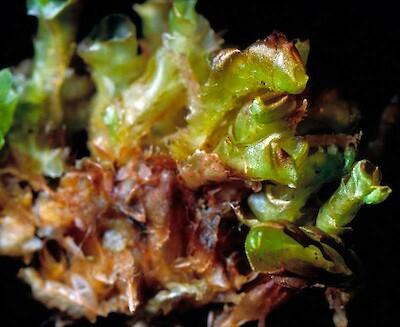
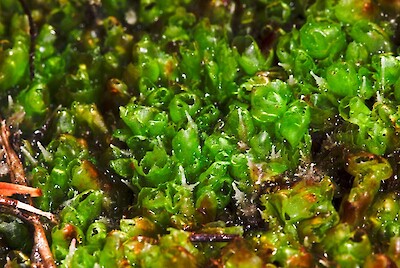
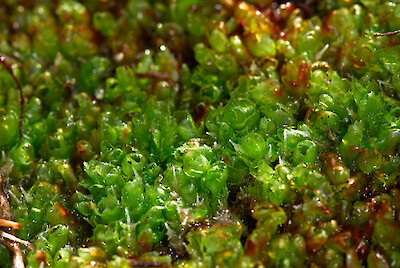
Goebelobryum unguiculatum from which G. vermiculare differs by ‘worm-like’ growth habit, with strongly dorsally assurgent, often darkly red-pigmented (magenta) leaves, whose apices are sparingly incised (or not). Goebelobryum unguiculatum has leaves which are weakly to moderately dorsally assurgent, yellow-green to golden sometimes faintly tinged rose or reddish (never magenta), and whose apices are prominently incised and lobulate
Distribution
Indigenous: New Zealand (North, South and Chatham Islands. Also Tasmania. In New Zealand mostly recorded from the Waikato, and north-western South Island. Scarce on the Chatham Islands.
Habitat
Terricolous. In New Zealand restricted to lowland acidic bogs - especially those dominated by the restiads Sporadanthus and Empodisima, and heathlands, or on poorly drained, podzolised soils.
Threats
Although widespread and mostly common within its chosen habitats, the wetlands this species prefers are now scarce due to past drainage, and in some cases the lack of fires to keep them open. This species, as Goebelobryum aff. unguiculatum (CHR 527492: Charleston) has been assessed as ‘At Risk / Relict’ by Glenny et al. (2011). This assessment is probably still appropriate.
Detailed taxonomy
Genus
Family
Synonyms
None - first described in 2012 (see Engel & Glenny 2012)
Endemic taxon
No
Endemic genus
No
Endemic family
No
Ecology
Flowering
Not applicable - produces sporophytes
Fruiting
Sporophytes may be seen throughout the year
Life cycle and dispersal
Hairy mericarps are dispersed by wind and possibly attachment (Thorsen et al., 2009).
Propagation technique
Difficult - should not be removed from the wild
Other information
Etymology
vermiculare: From the Latin vermiculus ‘little worm’ and -aris ‘resembling’, meaning worm-shaped, i.e. thick and almost cylindrical but bent in different places.
NVS code
The National Vegetation Survey (NVS) Databank is a physical archive and electronic databank containing records of over 94,000 vegetation survey plots - including data from over 19,000 permanent plots. NVS maintains a standard set of species code abbreviations that correspond to standard scientific plant names from the Ngä Tipu o Aotearoa - New Zealand Plants database.
GOEVER
Previous conservation status
The conservation status of the New Zealand hornwort and liverwort flora is reassessed using the New Zealand Threat Classification System (NZTCS). A full list is presented, along with a statistical summary and brief notes on the most important changes. This list replaces all previous NZTCS lists for New Zealand hornworts and liverworts which previously had been part of a generic bryophyte conservation status assessment that included mosses. Authors: P.J. de Lange, D. Glenny, K. Frogley, M.A.M. Renner, M. von Konrat, J.J. Engel, C. Reeb and J.R. Rolfe.
Source: NZTCS and licensed by DOC for reuse under the Creative Commons Attribution 4.0 International licence.
2012 | At Risk – Relict
Referencing and citations
References and further reading
Engel, J.J.; Glenny, D. 2012: Austral Hepaticae 48. Goebelobryum Grolle (Acrobolbaceae). Nova Hedwigia 95: 319-336.
Glenny, D.; Fife, A.J.; Brownsey, P.J.; Renner, M.A.M.; Braggins, J.E.; Beever, J.E.; Hitchmough, R. 2011: Threatened and uncommon bryophytes of New Zealand (2010 Revision). New Zealand Journal of Botany 49: 305-327.
Thorsen, M. J.; Dickinson, K. J. M.; Seddon, P. J. 2009. Seed dispersal systems in the New Zealand flora. Perspectives in Plant Ecology, Evolution and Systematics 11: 285-309
Attribution
Fact Sheet prepared by P.J. de Lange (1 June 2014).
NZPCN Fact Sheet citation
Please cite as: de Lange, P.J. (Year at time of access): Goebelobryum vermiculare Fact Sheet (content continuously updated). New Zealand Plant Conservation Network. https://www.nzpcn.org.nz/flora/species/goebelobryum-vermiculare/ (Date website was queried)