
Imperata cheesemanii
Common names
imperata, Cheeseman’s imperata
Biostatus
Native – Endemic taxon
Current conservation status
The conservation status of all known New Zealand vascular plant taxa at the rank of species and below were reassessed in 2022-2023 using the New Zealand Threat Classification System (NZTCS) – more information about this can be found on the NZTCS website. This report includes replaces all previous NZTCS lists for vascular plants. Previous assessments can be found here.
- Conservation status of vascular plants in Aotearoa New Zealand, 2023. 2024. Peter J. de Lange, Jane Gosden, Shannel P. Courtney, Alexander J. Fergus, John W. Barkla, Sarah M. Beadel, Paul D. Champion, Rowan Hindmarsh-Walls, Troy Makan and Pascale Michel Department of Conservation. Source: NZTCS and licensed by DOC for reuse under the Creative Commons Attribution 4.0 International licence.
2023 | At Risk – Naturally Uncommon | Qualifiers: IE
Category
Vascular
Structural class
Grasses
Flower colours
Violet/Purple
Detailed description
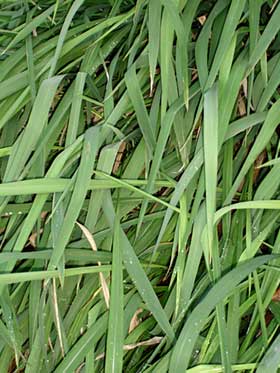
Widely spreading, rhizomatous, perennial forming dense, large mats or scattered clumps, to 800 mm; rhizomes 2–3 mm diameter, internodes covered by bracts; branching extravaginal. Leaf-sheath light cream to brown, glabrous. Ligule 1 mm, truncate, ciliolate. Leaf-blade 120–500 × 5–15 mm, glaucous-green to dark green, linear from pseudopetiolate base, glabrous apart from hairs on margins near ligule; margins sparsely scabrid above, tip acute, pungent. Culm 500–800 mm, nodes and internodes glabrous. Panicle 100–200 × 20–40 mm, narrow-lanceolate, gradually narrowed upwards to an acute point, initially dark purple to red-purple maturing greyish white with soft, dull hairs, c.6 mm, concealing spikelets; branches erect or the lower ± spreading, simple or branched again near base. Spikelets c. 3 mm, enveloped by hairs to 6 mm. Glumes = spikelet, purplish, with some scattered long hairs; lower 5-nerved, upper 3-nerved. Lemmas and palea < glumes, hyaline, nerveless, denticulate. Stamen 1; anther c. 2 mm. Stigmas purple. Seeds not described.
Similar taxa
No other grass species known from the Kermadec Islands group could be confused with this species. From the introduced I. cylindrica var. major (Hees) C.E.Hubb. (known only from northern North Island) it differs by the narrow-lanceolate rather than densely spiciform panicle, with the lower branches ± spreading rather than appressed; by the 1 rather than 2 stamens, and by the culm nodes ± glabrous rather than pubescent.
Distribution
Endemic to Raoul Island, Kermadec Islands group.
Habitat
Widespread in open ground, coastal and mid-elevation forest.
Threats
Abundant and not threatened on Raoul Island.
Detailed taxonomy
Genus
Family
Synonyms
None
Endemic taxon
Yes
Endemic genus
No
Endemic family
No
Ecology
Flowering
October–April
Fruiting
December–July
Life cycle and dispersal
Hairy florets are wind dispersed (Thorsen et al., 2009).
Propagation technique
Easy from fresh seed and rooted pieces. Inclined to be very aggressive and weedy, and has proved quite tolerant of mild frosts, from which it simply dies back, re-sprouting later.
Other information
Cultivation
Occasionally offered by specialist native plant nurseries.
Etymology
cheesemanii: Named after Thomas Frederick Cheeseman (1846 - 15 October 1923) who was a New Zealand botanist and naturalist who, in 1906, produced The Manual of the New Zealand Flora.
Manaaki Whenua Online Interactive Key
NVS code
The National Vegetation Survey (NVS) Databank is a physical archive and electronic databank containing records of over 94,000 vegetation survey plots - including data from over 19,000 permanent plots. NVS maintains a standard set of species code abbreviations that correspond to standard scientific plant names from the Ngä Tipu o Aotearoa - New Zealand Plants database.
IMPCHE
Chromosome number
2n = 20
Previous conservation statuses
The conservation status of all known New Zealand vascular plant taxa at the rank of species and below were reassessed in 2022-2023 using the New Zealand Threat Classification System (NZTCS) – more information about this can be found on the NZTCS website. This report includes replaces all previous NZTCS lists for vascular plants. Previous assessments can be found here.
- Conservation status of vascular plants in Aotearoa New Zealand, 2023. 2024. Peter J. de Lange, Jane Gosden, Shannel P. Courtney, Alexander J. Fergus, John W. Barkla, Sarah M. Beadel, Paul D. Champion, Rowan Hindmarsh-Walls, Troy Makan and Pascale Michel Department of Conservation. Source: NZTCS and licensed by DOC for reuse under the Creative Commons Attribution 4.0 International licence.
2017 | At Risk – Naturally Uncommon | Qualifiers: IE
2012 | At Risk – Naturally Uncommon | Qualifiers: IE, RR
2009 | At Risk – Naturally Uncommon | Qualifiers: OL, IE
2004 | Range Restricted
Referencing and citations
References and further reading
Edgar E, Connor HE. 2000. Flora of New Zealand. Vol. V. Grasses. Christchurch, Manaaki Whenua Press. 650 p.
Thorsen MJ, Dickinson KJM, Seddon PJ. 2009. Seed dispersal systems in the New Zealand flora. Perspectives in Plant Ecology, Evolution and Systematics 11: 285–309.
Attribution
Description modified from Edgar and Connor (2000).
Some of this factsheet information is derived from Flora of New Zealand Online and is used under a Creative Commons Attribution 3.0 New Zealand licence.