
Leucogenes tarahaoa

Past favourite plant finalist
Common names
Mount Peel edelweiss
Biostatus
Native – Endemic taxon
Current conservation status
The conservation status of all known New Zealand vascular plant taxa at the rank of species and below were reassessed in 2022-2023 using the New Zealand Threat Classification System (NZTCS) – more information about this can be found on the NZTCS website. This report includes replaces all previous NZTCS lists for vascular plants. Previous assessments can be found here.
- Conservation status of vascular plants in Aotearoa New Zealand, 2023. 2024. Peter J. de Lange, Jane Gosden, Shannel P. Courtney, Alexander J. Fergus, John W. Barkla, Sarah M. Beadel, Paul D. Champion, Rowan Hindmarsh-Walls, Troy Makan and Pascale Michel Department of Conservation. Source: NZTCS and licensed by DOC for reuse under the Creative Commons Attribution 4.0 International licence.
2023 | Threatened – Nationally Endangered | Qualifiers: OL
Category
Vascular
Structural class
Herbs - Dicotyledonous composites
Flower colours
Yellow
Detailed description
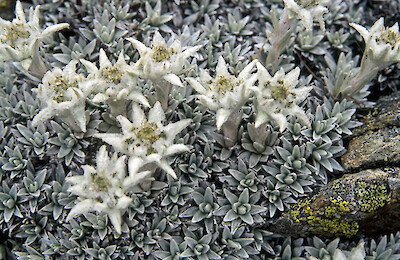
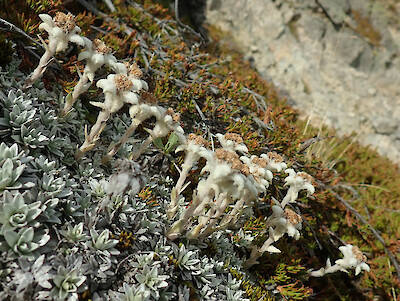
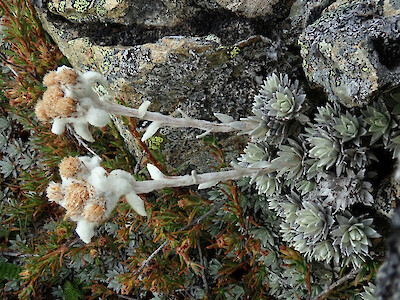
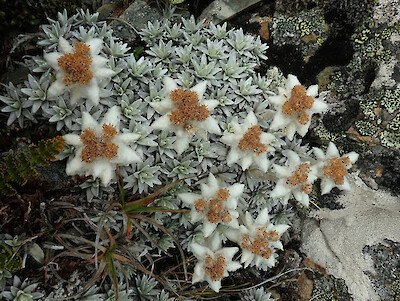
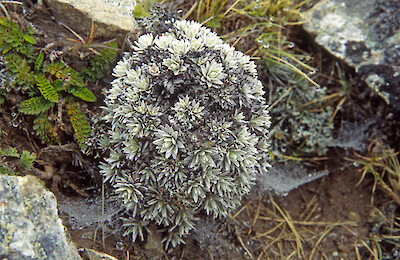
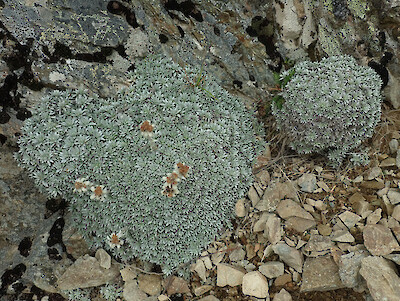
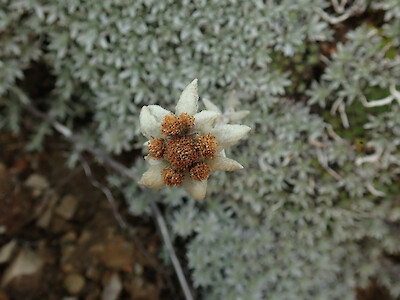
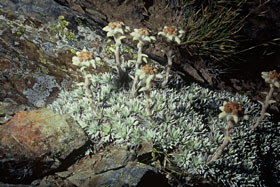
Perennial evergreen alpine subshrub forming dense, compact cushions. Leafy stems numerous, forming erect branched rosettes, 15 × 15 mm, including leaves. Leaves alternate, sessile, spreading, , 8–10 × 3–4 mm, lanceolate, apex acuminate; margin entire, smooth; clothed on both surfaces with thin shinning, silvery-white, tightly appressed tomentum. Peduncles distinct, terminal on leafy stems, 20-40 mm, clothed in dense woolly silvery-white tomentum. Inflorescence 10–25 mm diameter, consisting of 3–6 capitula arranged in a flat to convex, congested, corymbose cluster packed with woolly crimped tomentum and surrounded by 10–15 spreading, lanceolate, acuminate, woolly, crimped leafy bracts, c. 10 × 4 mm, forming a pseudo-ray. Involucral bracts 2 or 3-seriate, papery, linear-lanceolate, c. 6 mm long. Receptacle flat or convex, nude. Outer florets filiform, ♀, 6–16, in 1 series; corolla yellow, c. 4 mm long, dilated towards apex, 4-lobed. Inner florets tubular, hermaphrodite, 18–45; corolla yellow, c. 4 mm long, dilated towards apex, 5-lobed. Style arms long, curved, truncate, slightly papillose at apex. Anthers yellow, sagittate at base, with short tails. Pappus in 1 series, c. 4 mm long, slightly shorter in filiform florets, flattened at base, scabrid and shining, thickened at tips. Achene spindleshaped, c. 1.5 mm long, obscurely angled; hairs many, 0.1–0.6 mm long.
Similar taxa
A very distinctive species separated from the other three Leucogenes by the compact, cushion forming habit, silvery white leaves and octoploid chromosome number. A detailed account of this species and its relationships is provided by B.P.J. Molloy (NZ Journal Botany 33(1): 56-59 (1995)).
Distribution
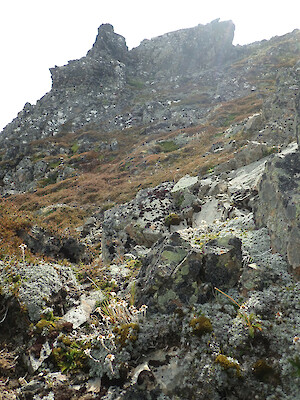
Endemic to Mt Peel near Geraldine, in the South Island.
Habitat
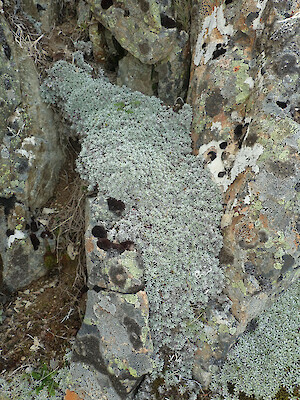
An alpine species growing in stable soils within shaded fell-field, on ledges, and within soil-filled crevices.
Threats
A very localised species confined to the fell field of the summits of Middle Mt Peel and the main ridge leading to Big Mt Peel. Recent field work suggests that these populations are declining although the exact cause is unclear. Browse by ungulates was evident on flowers in March 2022 (Melissa Hutchison, pers. obs.). The most significant losses have occurred on Middle Peel, where the Leucogenes was already considered to be very uncommon.
Detailed taxonomy
Genus
Family
Synonyms
None
Endemic taxon
Yes
Endemic genus
Yes
Endemic family
No
Ecology
Flowering
December to February
Fruiting
February to April
Life cycle and dispersal
Pappate cypselae are wind dispersed (Thorsen et al., 2009).
Propagation technique
Difficult. Should not be removed from the wild.
Other information
Cultivation
Not commercially available but plants are held by specialist growers.
Etymology
leucogenes: White genus
Chromosome number
2n = 112
Previous conservation statuses
The conservation status of all known New Zealand vascular plant taxa at the rank of species and below were reassessed in 2022-2023 using the New Zealand Threat Classification System (NZTCS) – more information about this can be found on the NZTCS website. This report includes replaces all previous NZTCS lists for vascular plants. Previous assessments can be found here.
- Conservation status of vascular plants in Aotearoa New Zealand, 2023. 2024. Peter J. de Lange, Jane Gosden, Shannel P. Courtney, Alexander J. Fergus, John W. Barkla, Sarah M. Beadel, Paul D. Champion, Rowan Hindmarsh-Walls, Troy Makan and Pascale Michel Department of Conservation. Source: NZTCS and licensed by DOC for reuse under the Creative Commons Attribution 4.0 International licence.
2017 | Threatened – Nationally Vulnerable | Qualifiers: DP, OL
2012 | Threatened – Nationally Vulnerable | Qualifiers: DP, OL
2009 | Threatened – Nationally Vulnerable | Qualifiers: DP, OL
2004 | Serious Decline
Referencing and citations
References and further reading
Molloy, B.P.J. 1995: Two new species of Leucogenes (Inuleae: Asteraceae) from New Zealand, and typification of L. grandiceps. New Zealand Journal of Botany 33(1): 53-63.
Thorsen, M.J.; Dickinson, K.J.M.; Seddon, P.J. 2009. Seed dispersal systems in the New Zealand flora. Perspectives in Plant Ecology, Evolution and Systematics 11: 285-309
Attribution
Fact Sheet by P.J. de Lange (25 July 2005). Description based on Molloy (1995).