
Muellerina celastroides

Common names
Muellerina
Biostatus
Native
Current conservation status
The conservation status of all known New Zealand vascular plant taxa at the rank of species and below were reassessed in 2022-2023 using the New Zealand Threat Classification System (NZTCS) – more information about this can be found on the NZTCS website. This report includes replaces all previous NZTCS lists for vascular plants. Previous assessments can be found here.
- Conservation status of vascular plants in Aotearoa New Zealand, 2023. 2024. Peter J. de Lange, Jane Gosden, Shannel P. Courtney, Alexander J. Fergus, John W. Barkla, Sarah M. Beadel, Paul D. Champion, Rowan Hindmarsh-Walls, Troy Makan and Pascale Michel Department of Conservation. Source: NZTCS and licensed by DOC for reuse under the Creative Commons Attribution 4.0 International licence.
2023 | Non-resident Native – Vagrant | Qualifiers: SO
Category
Vascular
Structural class
Trees & Shrubs - Dicotyledons
Simplified description
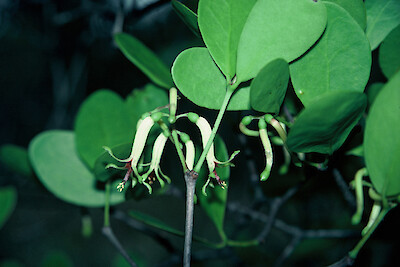
Green shrub growing on other plants known from one locality in pohutukawa forest in the Bay of Islands. No plants currently known in New Zealand. Leaves in pairs, rounded oval, 25-70mm long. Flowers tubular, drooping, pale green on outside, dark red on inside. Fruit 7-11mm long, pear-shaped.
Flower colours
Green, Yellow
Detailed description
Hemiparasite of outer host branches and rarely main trunk. Haustoris external, epicortical runners present. Growth habit erect or spreading, all parts glabrous except the minutely brown puberulent inflorescence axis. Leaves opposite, 25-70 x 15-25 mm, bright green, yellow-green to dark green, elliptic to oblong, round or obtuse, base attentuate with obscure3-8 mm long petiole; midrib indistinct, venation indistinct, pinnate. Inflorescence a terminal raceme of 1-3 pairs of triads, triad with central flower sessile and laterals pedicellate; axis 5-20 mm long; triad peduncles 5-7 mm long, pedicels of lateral flowers 3-6 mm long, bracts narrowly triangular, 1.5-2 mm long. Calyx 0.7-1 mm entire. Corolla 5-merous, curved in bud with mature buds 22-35 mm long, yellow-green to pale yellow at anthesis often fading to red or reddish-purple, petals free, distinctly decurved to pendulous. Stamens unequal; anthers 1.5 mm long, dorsifixed, versatile, yellow, free portion of filament 8-13 mm long, often dark red or pink. Fruit 7-11 mm, green grading to light red at ends, pear-shaped.
Similar taxa
None in New Zealand. The distinctive decurved, greenish-yellow flowers which fade to red or reddish-purple after anthesis, set in triads with the central flower sessile and the laterals pedicellate, and the distinctive pear-shaped fruits readily distinguish this species from the other loranthaceous taxa found in New Zealand.
Distribution
Indigenous. Reported in New Zealand once from the Bay of Islands. Present also in eastern Australia (Queensland and New South Wales) where it is abundant
Habitat
In New Zealand collected once from coastal Pohutukawa (Metrosideros excelsa Sol. ex Gaertn.) dominated forest. In Austraia more widespread but usually coastal on trees growing along waterways or in coastal forest.
Threats
Unknown.This species was collected once parasitic on pohutukawa and not seen again. In Australia the usual host of Banksia integrifolia L.f.. Possibly it became extinct in New Zealand due to the suboptimal host range available. Possums were not responsible as they had yet to be liberated in the country.
Detailed taxonomy
Genus
Family
Synonyms
Muellerina raouli Tiegh., Phrygilanthus raoulii (Tiegh.) Engl.
Taxonomic notes
Phrygilanthus tenuiflorus (Hook.f.) Engl. (Hookerella tenuiflorua Hook.f.) Tiegh and Loranthus tenuiflorus Hook.f. are names based on an early gathering of Peraxilla tetrapetala (L.f.) Tiegh.
Endemic taxon
No
Endemic genus
No
Endemic family
No
Ecology
Flowering
September - January
Fruiting
December - June
Propagation technique
Unknown.
Other information
Chromosome number
2n = 22
Previous conservation statuses
The conservation status of all known New Zealand vascular plant taxa at the rank of species and below were reassessed in 2022-2023 using the New Zealand Threat Classification System (NZTCS) – more information about this can be found on the NZTCS website. This report includes replaces all previous NZTCS lists for vascular plants. Previous assessments can be found here.
- Conservation status of vascular plants in Aotearoa New Zealand, 2023. 2024. Peter J. de Lange, Jane Gosden, Shannel P. Courtney, Alexander J. Fergus, John W. Barkla, Sarah M. Beadel, Paul D. Champion, Rowan Hindmarsh-Walls, Troy Makan and Pascale Michel Department of Conservation. Source: NZTCS and licensed by DOC for reuse under the Creative Commons Attribution 4.0 International licence.
2017 | Non-resident Native – Vagrant | Qualifiers: SO
2012 | Non-resident Native – Vagrant | Qualifiers: SO
2009 | Non-resident Native – Vagrant | Qualifiers: SO
2004 | Non-resident Native – Vagrant
Regional conservation statuses
Northland: 2026 | Regionally Extirpated
Current regional threat status assessments prepared according to Crisp et al. (2025) are displayed when available. The Northland conservation status information is sourced from the “Conservation status of indigenous vascular plants in Northland | Taitokerau” Ford et al. 2026 report.
Referencing and citations
Attribution
Fact sheet prepared by P.J. de Lange for NZPCN (1 June 2013)
NZPCN Fact Sheet citation
Please cite as: de Lange, P.J. (Year at time of access): Muellerina celastroides Fact Sheet (content continuously updated). New Zealand Plant Conservation Network. https://www.nzpcn.org.nz/flora/species/muellerina-celastroides/ (Date website was queried)