
Notothlaspi viretum
Common names
Red Hills penwiper
Biostatus
Native – Endemic taxon
Current conservation status
The conservation status of all known New Zealand vascular plant taxa at the rank of species and below were reassessed in 2022-2023 using the New Zealand Threat Classification System (NZTCS) – more information about this can be found on the NZTCS website. This report includes replaces all previous NZTCS lists for vascular plants. Previous assessments can be found here.
- Conservation status of vascular plants in Aotearoa New Zealand, 2023. 2024. Peter J. de Lange, Jane Gosden, Shannel P. Courtney, Alexander J. Fergus, John W. Barkla, Sarah M. Beadel, Paul D. Champion, Rowan Hindmarsh-Walls, Troy Makan and Pascale Michel Department of Conservation. Source: NZTCS and licensed by DOC for reuse under the Creative Commons Attribution 4.0 International licence.
2023 | Threatened – Nationally Critical | Qualifiers: OL
Category
Vascular
Structural class
Herbs - Dicotyledons other than Composites
Simplified description
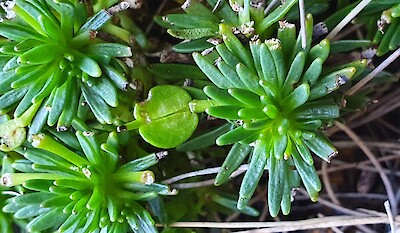
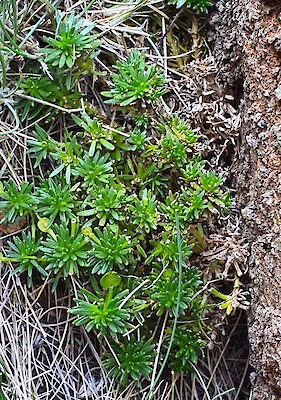
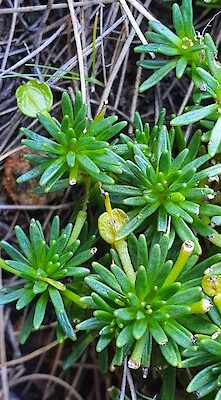
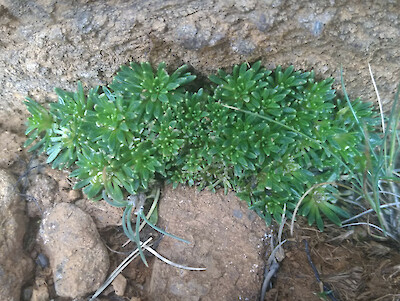
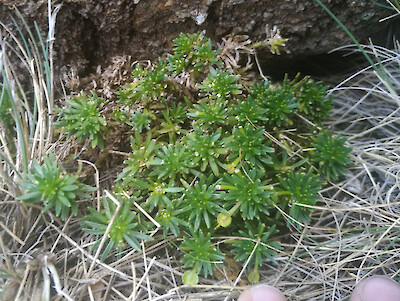
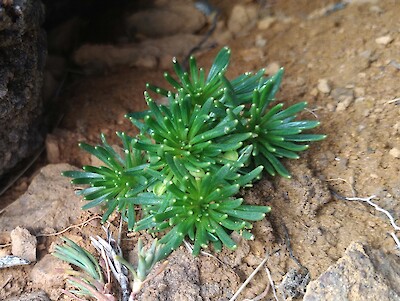
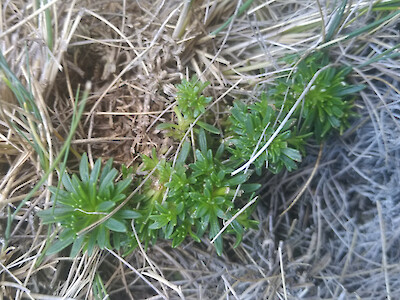
Alpine herb forming compact green cushions on ultramafic rocks. Cushions comprised of numerous closely placed rosettes. Leaves narrowly linear to lanceolate (when bruised smelling of cress), bright green. Flowers white. Fruit a green silicle.
Flower colours
White
Detailed description
Perennial herb, with short lateral stems, stems 1.0–1.7 mm diameter, usually forming compact cushions of few to numerous rosettes. Leaves 9.0–26.0 mm long, rosulate or spreading on stems; lamina 7.0–17.0 mm long, 0.7–2.4 mm wide, linear to linear-narrowly lanceolate, green, coriaceous, glabrous on abaxial and adaxial surfaces; margin usually entire, occasionally 1-pinnatafid; apex attenuate, tip obtuse with a prominent hydathode, base attenuate; petiole 2.0–10.0 mm long, often indistinct from lamina. Inflorescence axillary, flowers solitary; peduncle 7–10 mm long, 0.4–1.0 mm diameter, ascending, glabrous. Sepals 3.7–4.5 mm long, 1.2–1.5 mm wide, linear-lanceolate, green, glabrous, margin entire, apex subacute, base truncate. Petals 5.5–6.5 mm long, 1.6–2.4 mm wide, white, limb obovate to broadly elliptic, patent to reflexed; apex obtuse; base cuneate, tapering to a 2–3 mm long claw. Stamens 6; filaments linear, two 2.4–4.0 mm long, four 3.4–5.4 mm long; anthers 0.9–1.0 mm long, cream to pale yellow. Ovary 2.2–3.0 mm long, 1.2–1.8 mm wide, compressed, green, glabrous; ovules 5–8 per locule; style 2.0–2.1 mm long, terete; stigma capitate, 0.4–0.5 mm diameter. Silicle 4.3–5.2 mm long, 4.5–5.1 mm wide, green, glabrous, obcordate, angustiseptate; valves keeled, winged, wing c. 0.5 wide at base, up to 2.3 mm wide at apex, wing extended to form an apical notch to silicle; style persistent, up to 1.2 mm long. Seeds 0.8–1.1 mm long, 0.6–0.9 mm wide, orbicular-oblong, brown.
Similar taxa
An ultramafic endemic that is distinguished from Notothlaspi australe by the compact cushion growth habit with the plants producing numerous closely placed rosettes, and by the green, linear to linear-narrowly lanceolate leaves that are 7.0–17.0 mm long and 0.7–2.4 mm wide.
Distribution
Endemic. New Zealand: South Island (Richmond Range—Red Hills).
Habitat
Known from two sites only between 1540–1700 m a.s.l. where the species is confined to rocky outcrops, sparsely vegetated open stable to semi-stable scree, and on coarse sand and soil derived from ultramafic harzburgite rock.
Threats
As Notothlaspi (a) (CHR 363071; Red Hills), N. viretum was assessed as having a conservation status of Threatened – Nationally Critical by de Lange et al. (2018). This assessment considers that Notothlaspi viretum is confined to one location with an area of occupancy less than or equal to 1 hectare. Currently the sole known population is believed to be stable. Heenan (2019) suggest that hybridisation with N. australe may pose a long term threat as N. viretum is sympatric with N. australe and plants possibly representing hybrids were observed during a visit to the type locality in April 1997.
Detailed taxonomy
Genus
Family
Synonyms
None - first described in 2019. Previously known by the tag name “Notothlaspi (a) (CHR 363071; Red Hills)”
Endemic taxon
Yes
Endemic genus
Yes
Endemic family
No
Ecology
Flowering
December–January
Fruiting
Ferbuary–April
Propagation technique
Not known from cultivation.
Other information
Etymology
notothlaspi: Southern cress
viretum: Meaning ‘grass green’
Chromosome number
2n = 90-100
Previous conservation status
The conservation status of all known New Zealand vascular plant taxa at the rank of species and below were reassessed in 2022-2023 using the New Zealand Threat Classification System (NZTCS) – more information about this can be found on the NZTCS website. This report includes replaces all previous NZTCS lists for vascular plants. Previous assessments can be found here.
- Conservation status of vascular plants in Aotearoa New Zealand, 2023. 2024. Peter J. de Lange, Jane Gosden, Shannel P. Courtney, Alexander J. Fergus, John W. Barkla, Sarah M. Beadel, Paul D. Champion, Rowan Hindmarsh-Walls, Troy Makan and Pascale Michel Department of Conservation. Source: NZTCS and licensed by DOC for reuse under the Creative Commons Attribution 4.0 International licence.
2017 | Threatened – Nationally Critical | Qualifiers: DP, OL, St
Referencing and citations
References and further reading
Heenan PB. 2019. A taxonomic revision of Notothlaspi (Brassicaceae), a specialist alpine genus from New Zealand. Phytotaxa 399(3): 248–260. https://doi.org/10.11646/phytotaxa.399.3.7.
Attribution
Fact sheet prepared by P.J. de Lange (28 March 2019). Description from Heenan (2019).