
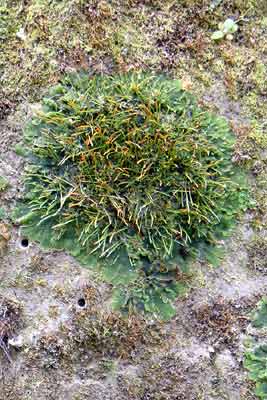
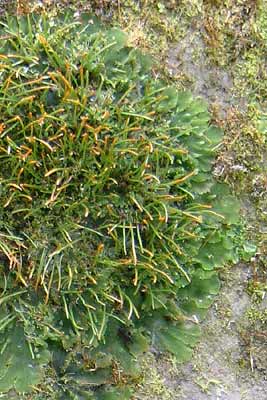
Paraphymatoceros hirticalyx
Common names
Hornwort
Biostatus
Native
Current conservation status
The conservation status of the New Zealand hornwort and liverwort flora is reassessed using the New Zealand Threat Classification System (NZTCS). A full list is presented, along with a statistical summary and brief notes on the most important changes. This list replaces all previous NZTCS lists for New Zealand hornworts and liverworts which previously had been part of a generic bryophyte conservation status assessment that included mosses. Authors: P.J. de Lange, D. Glenny, K. Frogley, M.A.M. Renner, M. von Konrat, J.J. Engel, C. Reeb and J.R. Rolfe.
Source: NZTCS and licensed by DOC for reuse under the Creative Commons Attribution 4.0 International licence.
2020 | At Risk – Naturally Uncommon | Qualifiers: DP
Category
Non-vascular
Structural class
Hornworts
Distribution
Indigenous. New Zealand: North and South Islands - recorded from Little Barrier (Hauturu) Island, Mt Ruapehu and from near Reefton
Habitat
Damp seepages on cliff faces, stream banks and collected also from alpine flushes
Threats
Unknown. At one stage believed to be highly threatened as the then only known populations occurred in highly vulnerable sites along roadsides.near Reefton. because the species was poorly understood it was re-assessed as “Data Deficient” “OL” [One Location] and “?SO” [Secure Overseas] (Glenny et al. 2011). Since then Paraphymatoceros hirticalyx has been recognised in the North Island from Little Barrier (Hauturu) Island and Mt Ruapehu suggesting that it is more overlooked than it is truly threatened. Further survey to clarify its true threat status in New Zealand would be useful.
Detailed taxonomy
Genus
Family
Synonyms
Phaeoceros hirticalyx (Steph.) Haseg.
Endemic taxon
No
Endemic genus
No
Endemic family
No
Ecology
Flowering
Not applicable - plants reproduce by spores
Other information
Previous conservation status
The conservation status of the New Zealand hornwort and liverwort flora is reassessed using the New Zealand Threat Classification System (NZTCS). A full list is presented, along with a statistical summary and brief notes on the most important changes. This list replaces all previous NZTCS lists for New Zealand hornworts and liverworts which previously had been part of a generic bryophyte conservation status assessment that included mosses. Authors: P.J. de Lange, D. Glenny, K. Frogley, M.A.M. Renner, M. von Konrat, J.J. Engel, C. Reeb and J.R. Rolfe.
Source: NZTCS and licensed by DOC for reuse under the Creative Commons Attribution 4.0 International licence.
2011 | Data Deficient | Qualifiers: OL, ?SO
Referencing and citations
References and further reading
Glenny, D.; Fife, A.J.; Brownsey, P.J.; Renner, M.A.M.; Braggins, J.E.; Beever, J.E.; Hitchmough, R. 2011: Threatened and uncommon bryophytes of New Zealand (2010 Revision). New Zealand Journal of Botany 49: 305-327.
Attribution
Fact sheet prepared for NZPCN by P.J. de Lange August 2009.
NZPCN Fact Sheet citation
Please cite as: de Lange, P.J. (Year at time of access): Paraphymatoceros hirticalyx Fact Sheet (content continuously updated). New Zealand Plant Conservation Network. https://www.nzpcn.org.nz/flora/species/paraphymatoceros-hirticalyx/ (Date website was queried)