
Pseudowintera insperata
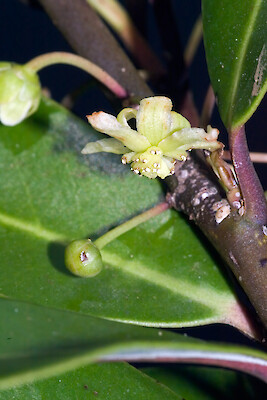

Past favourite plant winner
Common names
Northland horopito
Biostatus
Native – Endemic taxon
Current conservation status
The conservation status of all known New Zealand vascular plant taxa at the rank of species and below were reassessed in 2022-2023 using the New Zealand Threat Classification System (NZTCS) – more information about this can be found on the NZTCS website. This report includes replaces all previous NZTCS lists for vascular plants. Previous assessments can be found here.
- Conservation status of vascular plants in Aotearoa New Zealand, 2023. 2024. Peter J. de Lange, Jane Gosden, Shannel P. Courtney, Alexander J. Fergus, John W. Barkla, Sarah M. Beadel, Paul D. Champion, Rowan Hindmarsh-Walls, Troy Makan and Pascale Michel Department of Conservation. Source: NZTCS and licensed by DOC for reuse under the Creative Commons Attribution 4.0 International licence.
2023 | Threatened – Nationally Critical | Qualifiers: Sp
Category
Vascular
Structural class
Trees & Shrubs - Dicotyledons
Simplified description
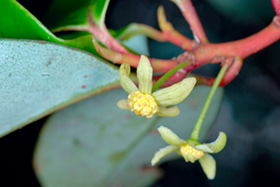
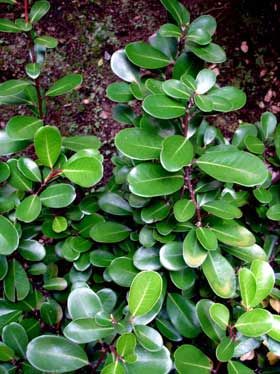
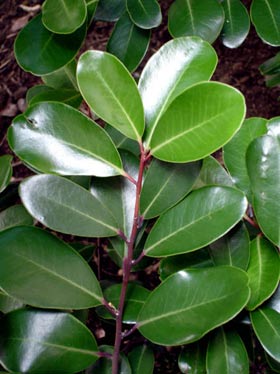
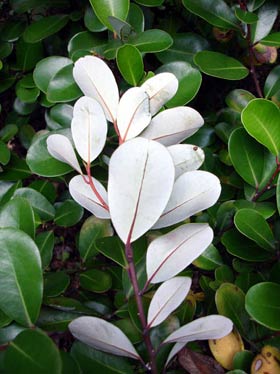
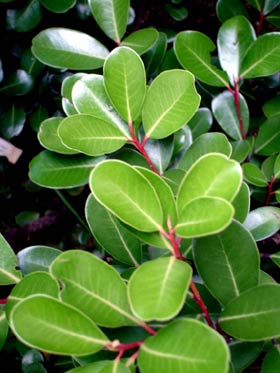
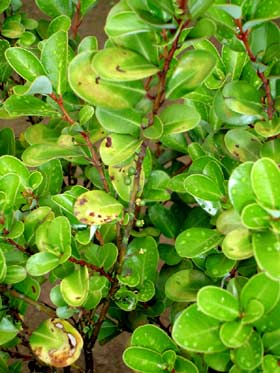
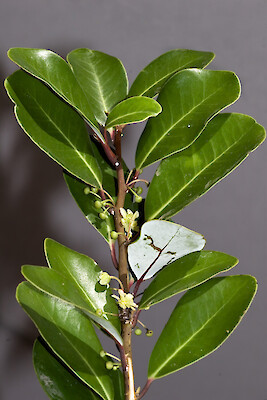
Small tree with dark trunks and reddish twigs bearing shiny oval leaves that are white underneath (excepting central vein) inhabiting sites in Northland. Leaves 35-110mm long by 18-45mm, central vein green above, red underneath. Flowers small, green. Fruit small and purple.
Flower colours
Cream, Yellow
Detailed description
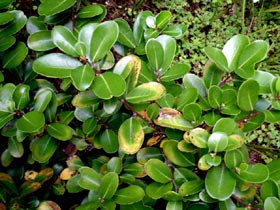
Shrub or small tree up to 7 m tall; trunks and branches upright. Branchlets red-brown to maroon-black, glabrous or hairy. Leaf buds and expanding leaves usually hairy on lamina margin, undersides and petiole. Petiole 4-11 x 1.4-2.4 mm, red-brown to maroon. Leaves 35-110 x 18-45 mm, upper surface glossy, dark green to yellow-green, without blemishes or blotches; midvein conspicuous, pale cream to yellow-green, glabrous or sparsely hairy; lamina broadly obovate, oblanceolate, elliptic, broadly elliptic to orbicular, coriaceous; undersides white; midvein red, sparsely hairy or glabrous. Inflorescences axillary, flowers bisexual, solitary or in fascicles of 2-3. Calyx cupule 2.8-2.9 mm diam., margins entire. Corolla comprised of 5-8 free petals, these 3.8-7.0 x 2.3-3.0 mm, broadly elliptic, cream, apex obtuse. Carpels 2-5, free, obovoid, stigma apical. Stamens 13-22, free. Fruit a 1-4-seeded berry, 6.4-9.8 x 4.9-1.8-2.3 mm, black, obovoid to obovoid-oblong.
Similar taxa
Distinguished from P. axillaris, P. colorata and P. traversii by its small tree habit, with an erect growth form, broadly obovate to broadly elliptic leaves that are glossy, without blemishes and blotches, and by the conspicuous pale cream to yellow-green midvein. The inflorescences have ciliate bracts, and an entire cupule, and the fruits are black.
Distribution
Endemic. North Island, formerly on all the northern Whangarei Harbour highpoints from Maungatapere to Bream Head, and also at Logues Bush near Wellsford. Now only known from Mt Manaia, Bream Head and Logues Bush.
Habitat
Coastal, lowland, and alluvial forest, and on exposed ridge tops within low windshorn scrub and forest overlying skeletal soils developed on igenous (andesitic and basaltic) rocks, talus and rock outcrops.
Threats
Herbarium specimens suggest there was once six discrete populations, three of these are now probably extinct. Of the remaining three, one plant survives at Logues Bush, and there are c.50 adult plants at the other two sites. Although recruitment is happening at the two main populations, all three populations occupy an area of < 1 ha. Although active threats are not evident, one population is potentially vulnerable to trampling. The plant at Logues Bush is in ill thrift. For all these reasons this species is regarded at seriously threatened. However, it is cryptic, and easily overlooked and current population estimates are probably inaccurate. For these reasons the threat ranking is qualified as Data Poor (DP)
Detailed taxonomy
Genus
Family
Synonyms
None
Taxonomic notes
Recognised as distinct in 2003. Prior to that these northerly plants had usually been referred to P. axillaris or as hybrids between P. axillaris and P. colorata.
Endemic taxon
Yes
Endemic genus
Yes
Endemic family
No
Ecology
Flowering
(October-) December - February
Fruiting
November - May
Propagation technique
Can be grown from semi-hardwood cuttings which, though slow strike readily. Fresh seed should germinate well, though it may take 1-2 years to germinate.
Other information
Plant of the Month
This plant has been featured as a Plant of the Month – see Trilepidea: NZPCN newsletter for January 2007 for the full story.
Etymology
pseudowintera: False Wintera (a related genus)
Chromosome number
2n = 84
Previous conservation statuses
The conservation status of all known New Zealand vascular plant taxa at the rank of species and below were reassessed in 2022-2023 using the New Zealand Threat Classification System (NZTCS) – more information about this can be found on the NZTCS website. This report includes replaces all previous NZTCS lists for vascular plants. Previous assessments can be found here.
- Conservation status of vascular plants in Aotearoa New Zealand, 2023. 2024. Peter J. de Lange, Jane Gosden, Shannel P. Courtney, Alexander J. Fergus, John W. Barkla, Sarah M. Beadel, Paul D. Champion, Rowan Hindmarsh-Walls, Troy Makan and Pascale Michel Department of Conservation. Source: NZTCS and licensed by DOC for reuse under the Creative Commons Attribution 4.0 International licence.
2017 | Threatened – Nationally Critical | Qualifiers: Sp
2012 | Threatened – Nationally Critical | Qualifiers: DP
2009 | Threatened – Nationally Critical | Qualifiers: DP
2004 | Not Threatened
Regional conservation statuses
Northland: 2026 | Regionally Threatened – Regionally Critical
Current regional threat status assessments prepared according to Crisp et al. (2025) are displayed when available. The Northland conservation status information is sourced from the “Conservation status of indigenous vascular plants in Northland | Taitokerau” Ford et al. 2026 report.
Referencing and citations
References and further reading
Heenan, P. B. and de Lange, P. J.2006: Pseudowintera insperata (Winteraceae), an overlooked and rare new species from northern New Zealand. New Zealand Journal of Botany 44: 89–98.
Attribution
Fact Sheet prepared for NZPCN by P.J. de Lange 12 December 2006: Description modified from Heenan & de Lange (2006).
NZPCN Fact Sheet citation
Please cite as: de Lange, P.J. (Year at time of access): Pseudowintera insperata Fact Sheet (content continuously updated). New Zealand Plant Conservation Network. https://www.nzpcn.org.nz/flora/species/pseudowintera-insperata/ (Date website was queried)