
Rorippa laciniata
Common names
cut-leaved bittercress
Biostatus
Native
Current conservation status
The conservation status of all known New Zealand vascular plant taxa at the rank of species and below were reassessed in 2022-2023 using the New Zealand Threat Classification System (NZTCS) – more information about this can be found on the NZTCS website. This report includes replaces all previous NZTCS lists for vascular plants. Previous assessments can be found here.
- Conservation status of vascular plants in Aotearoa New Zealand, 2023. 2024. Peter J. de Lange, Jane Gosden, Shannel P. Courtney, Alexander J. Fergus, John W. Barkla, Sarah M. Beadel, Paul D. Champion, Rowan Hindmarsh-Walls, Troy Makan and Pascale Michel Department of Conservation. Source: NZTCS and licensed by DOC for reuse under the Creative Commons Attribution 4.0 International licence.
2023 | Non-resident Native – Coloniser | Qualifiers: OL, SO
Category
Vascular
Structural class
Herbs - Dicotyledons other than Composites
Flower colours
White, Yellow
Detailed description
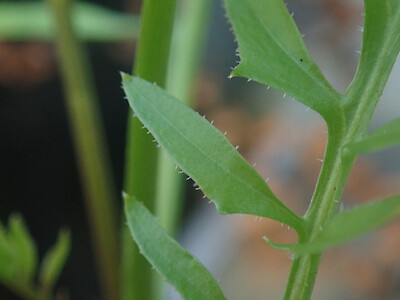
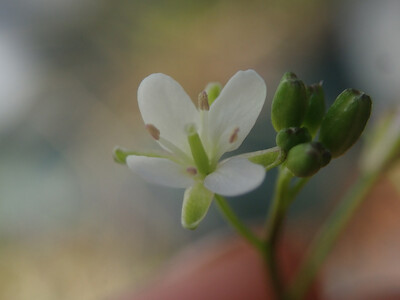
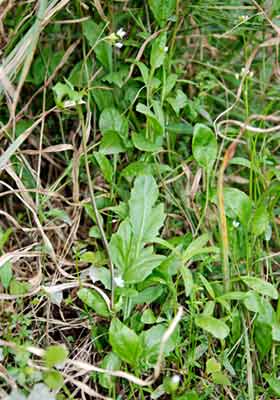
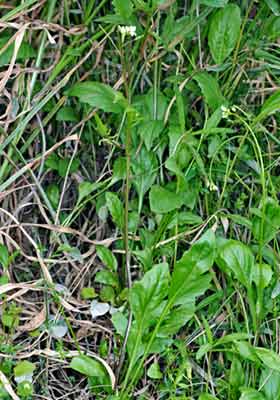
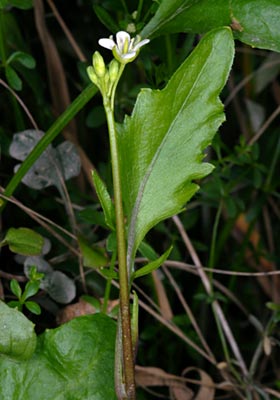
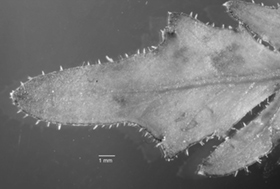
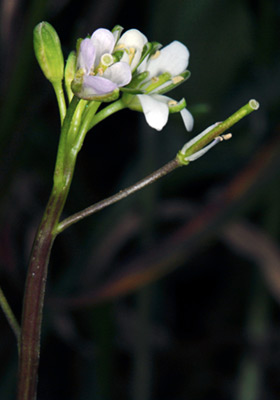
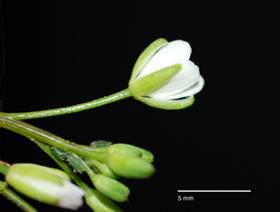
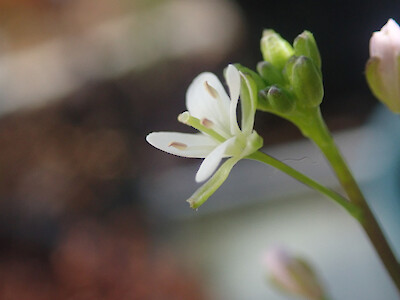
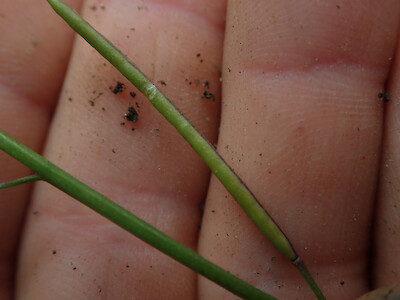
Perennial tap-rooted herb, root stock ± woody, suberect to erect, producing one or more leafy, somewhat flaccid rosettes. Leaves 20–150 × 30–50 mm, mostly basal, narrowly elliptic, elliptic to broadly elliptic or rhomboidal, entire or irregularly and sometimes deeply toothed or lobed, lyrate-pinnatifid, or lyrate-pinnatisect, segments broadly to narrowly linear, often deeply toothed, with a terminal lobe and 1–4 pairs of narrow lobes, adaxially dark green to reddish-green, abaxially similar but lighter, glabrous; margin hairy, hairs up to 0.3 mm long; petioles 50–100 mm long, plano-convex, glabrous, margin narrowly winged; cauline leaves absent or few, similar to basal leaves but smaller and narrower. Inflorescence 10–30 or more flowered, 200–800 mm long, dark green to reddish green, glabrous, sprawling to ascending, often flaccid and supported by surrounding vegetation; flowers protogynous, slightly fragrant, up to 5.7 × 3.6 mm. Pedicels 9.2–12.2 mm long, erecto-patent at flowering, spreading at fruiting. Sepals 4, (2.3–)3.8–4.5 × 1.2–1.3 mm, linear-lanceolate, ± subulate, adaxially dark green, yellow-green to reddish green, glabrous; margin entire, thin, white; apex saccate, obtuse. Petals 4, 3.6–5.5 × 1.9–2.3 mm, oblong, white, flushed lavender at senescence, slightly longer than sepals, base cuneate, apex obtuse, claw 0.8–1.2 mm long. Stamens 4; filaments 2.5–4.0 mm long, white; anthers 0.6–0.8 × c. 0.4 mm, yellow, pollen yellow. Ovary 1.8–4.0 mm long, terete, green; style c. 0.5 mm long; stigma c. 0.6 mm diam., capitate to weakly bilobed. Siliques 15–46 × 1.3–1.8 mm, erect to spreading, linear, straight, ± terete, green, dark green to reddish green; valves with inconspicuous midrib fading toward apex; style remnant 0.5–0.8 mm long; seeds in 1 row per locule. Seed 1.3–1.4 × c. 0.9 mm, light orange-brown, slightly winged, testa punctate, spongy when fresh, mucilaginous.
Similar taxa
Distinguished from Rorippa divaricata by the mostly basal, deeply cut leaves with distinctly hairy margins, few cauline leaves; petals > sepals, and coloured first white then flushing lavender at senescence, and by the seeds which are spongy when fresh, distinctly winged, with a punctuate rather than reticulate seed coat.
Distribution
Indigenous. North Island, Hikurangi Swamp. Also Australia (New South Wales and Victoria)
Habitat
Lowland alluvial swamp forest - along muddy river banks under Coprosma scrub. Usually in places where water is ponded over winter
Threats
About 100 plants are known so far from a single site that was discovered in January 2008. The only known population is within a reserve and there are no known threats.
Detailed taxonomy
Genus
Family
Synonyms
Cardamine laciniata F.Muell.; Nasturtium laciniatum (F.Muell.) O.E.Schulz
Endemic taxon
No
Endemic genus
No
Endemic family
No
Ecology
Flowering
October - January
Fruiting
November - February
Propagation technique
Easily grown from fresh seed. Leaves edible. Not a particularly attractive plant.
Other information
Etymology
rorippa: A latinized form of Rorippen, a Saxon vernacular name used by Euricius Cordus
Previous conservation statuses
The conservation status of all known New Zealand vascular plant taxa at the rank of species and below were reassessed in 2022-2023 using the New Zealand Threat Classification System (NZTCS) – more information about this can be found on the NZTCS website. This report includes replaces all previous NZTCS lists for vascular plants. Previous assessments can be found here.
- Conservation status of vascular plants in Aotearoa New Zealand, 2023. 2024. Peter J. de Lange, Jane Gosden, Shannel P. Courtney, Alexander J. Fergus, John W. Barkla, Sarah M. Beadel, Paul D. Champion, Rowan Hindmarsh-Walls, Troy Makan and Pascale Michel Department of Conservation. Source: NZTCS and licensed by DOC for reuse under the Creative Commons Attribution 4.0 International licence.
2017 | Non-resident Native – Coloniser | Qualifiers: OL, SO
2012 | Non-resident Native – Coloniser | Qualifiers: OL, SO
2009 | Non-resident Native – Coloniser | Qualifiers: DP
2004 | Not Threatened
Referencing and citations
References and further reading
Description from: de Lange, P.J.; Heenan, P.B.; Townsend, A.J. Rorippa laciniata (Brassicaceae), a new addition to the flora of New Zealand. New Zealand Journal of Botany 47: 133–137.
Attribution
Description from: de Lange et al. (2009).
NZPCN Fact Sheet citation
Please cite as: de Lange, P.J. (Year at time of access): Rorippa laciniata Fact Sheet (content continuously updated). New Zealand Plant Conservation Network. https://www.nzpcn.org.nz/flora/species/rorippa-laciniata/ (Date website was queried)