
Taraxacum pseudohamatum
Common names
Dandelion
Biostatus
Exotic
Conservation status
Not applicable
Category
Vascular
Structural class
Herbs - Dicotyledonous composites
Flower colours
Yellow
Detailed description
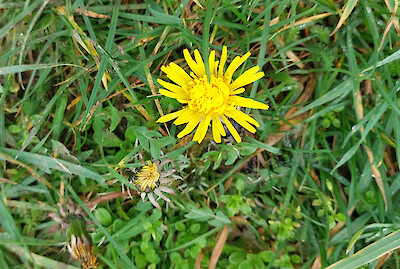
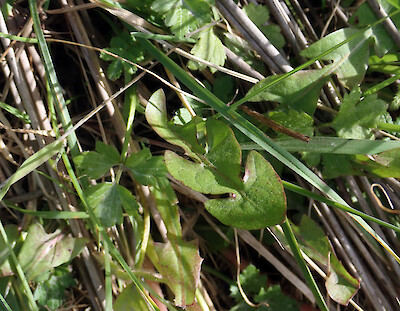
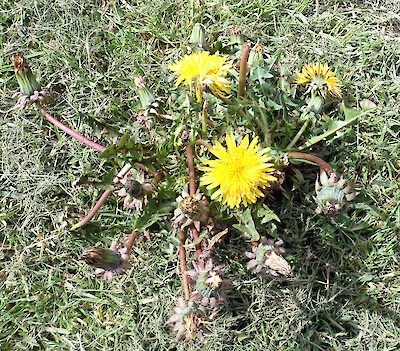
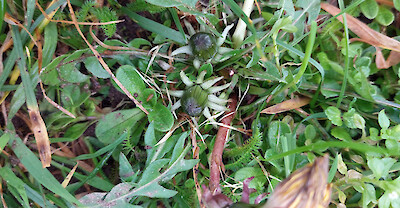
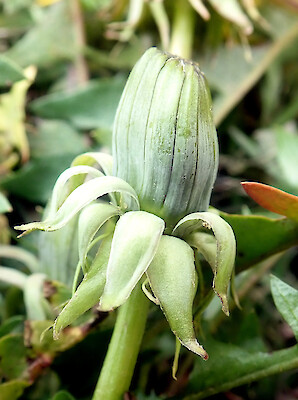
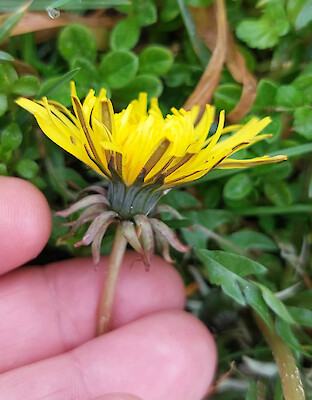
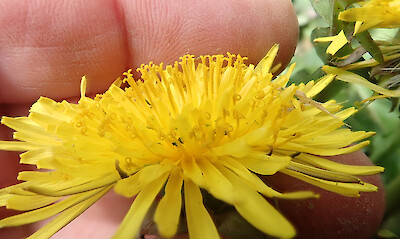
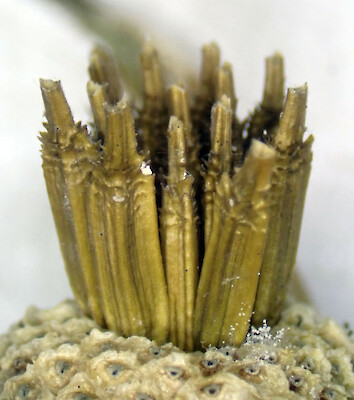
Stout, medium-sized to large plants bearing myriad suberect to erect leaves. Leaves not dimorphic, lanceolate, strongly hamate; adaxially usually glossy dark green, sometimes purple-green, or maroon when stressed or in exposed situations, abaxially slightly paler, interlobes sometimes darkly blotched, surfaces sparsely hairy or not, mid-rib pinkish with interwoven strands; petioles ± winged near base, white or purple (depending on exposure). Lateral leaf lobes 5−6(−8), alternate, recurved, broad, subacute to acute, convex on distal margin, proximal lobes filiform-dentate. Terminal leaf lobes deltoid to sagittate, ± entire, subobtuse. Scapes equalling leaves or slightly overtopping them, glabrous or sparsely hairy, hairs appressed. Involucre in bud 20−25 mm long, initially broadly ovoid, prior to anthesis distinctly barrel-shaped, dark green-brown to dark purple-green; involucral bracts in two whorls, outer involucral bracts 16−20, spreading, arcuate, usually reflexed at anthesis, 10−14 × 4.0−5.6 mm, broadly lanceolate, adaxially dark glaucous green, strongly pruinose, often suffused purple, abaxially dark green to purple-green, margins distinctly bordered; inner involucral bracts 12−18(−20), erect in bud, arcuate, apical ⅓−½ recurved at anthesis, abaxially dark brown-green, glaucescent to pruinose. Capitula 50−60 mm diameter, dark yellow. Ligules abaxially striped dark grey, or centrally grey with dark orange striping toward margins, inner florets sometimes finely tipped orange. Stigma dark-yellow, pollen plentiful. Achene 3.5−4.0 mm long, pale-yellow to yellow-brown; cone 0.4−0.6.
Similar taxa
Taraxacum pseudohamatum could only be confused with T. hamatum (known so far only from a single 1963 collection made from Hokorereoro / Rangatira / South-East Island in the Chathams group). From this species it is readily distinguished by the exterior bracts of the capitula which are bordered. Vegetative material, however, cannot be distinguished. From the other Taraxacum in New Zealand T. pseudohamatum is easily recognised by the hamate, lanceolate, usually darkly coloured leaves; dark green-brown to dark purple-green floral buds; and by the outer whorl of involucral bracts, which are adaxially dark glaucous green, strongly pruinose, often suffused purple, spreading and glabrous and distinctly bordered.
Distribution
Naturalised. Known with certainity from the Chatham Islands where it has been collected from Rēkohu / Wharekauri / Chatham Island
Habitat
A ruderal inhabiting dunefield, grasslands, verges, land banks and in urban wasteland, lawns and foot paths
Detailed taxonomy
Genus
Family
Endemic genus
No
Endemic family
No
Ecology
Flowering
February – September
Fruiting
February – October
Life cycle and dispersal
Perennial with wind-dispersed seeds.
Other information
Etymology
taraxacum: From the Greek ‘taraxos’ (disorder), and ‘akos’ (remedy), referring to medical qualities.
Chromosome number
2n = 24
Referencing and citations
References and further reading
Meijer, K., Aptroot, A., Tang, T., de Lange, P. (2024). Taraxacum pseudohamatum Dahlst. (Asteraceae, Cichorioideae) – a new naturalisation from the Chatham Islands, Aotearoa / New Zealand. Perspectives in Biodiversity, 2(1): 50–59. https://doi.org/10.34074/pibdiv.002106
NZPCN Fact Sheet citation
Please cite as: de Lange, P.J. (Year at time of access): Taraxacum pseudohamatum Fact Sheet (content continuously updated). New Zealand Plant Conservation Network. https://www.nzpcn.org.nz/flora/species/taraxacum-pseudohamatum/ (Date website was queried)