
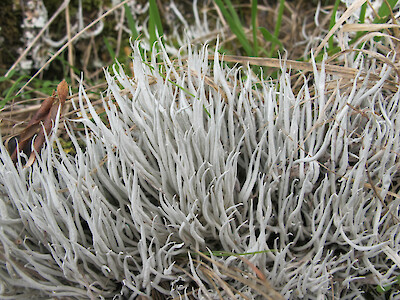
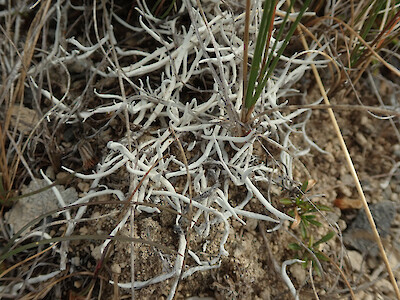
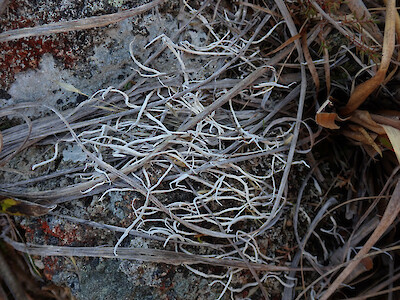
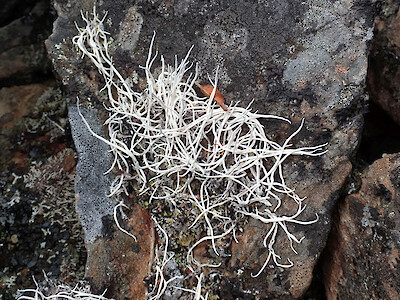
Thamnolia vermicularis var. vermicularis



Common names
Whiteworm lichen
Biostatus
Native
Current conservation status
2018 | Not Threatened | Qualifiers: SO
Category
Lichen
Structural class
Lichens - Fruticose
Lichen substrate
Terricolous (soil)
Substrate details
Terricolous
Detailed taxonomy
Genus
Family
Synonyms
Cerania vermicularis, Lichen subuliformis, Lichen vermicularis, Thamnolia subuliformis, Thamnolia vermicularis var. subuliformis
Endemic taxon
No
Endemic genus
No
Endemic family
No
Other information
Ecological notes
The UV− chemodeme is more common in the Southern Hemisphere than it is in the Northern Hemisphere (Satô 1965: 324). In New Zealand it has an altitudinal range from 287 m (Conroy’s Gully near Alexandra) to 3000 m (Mt Aspiring) and is most richly developed in the mountains of eastern South Island, from the Torlesse Range to the Blue Mountains. In this latter locality, exceptionally well-developed thalli occur reaching 12–15 cm in length. The UV+ chemodeme is much rarer in New Zealand (Satô 1965: 324) ranging from the St Arnaud Ranges to Mt Anglem on Stewart Island. This chemodeme is much more common in the Northern Hemisphere than it is in the Southern Hemisphere (Satô 1965), though in arctic North America both chemodemes appear to be equally distributed (Thomson 1984; Brodo et al. 2001).
Referencing and citations
References and further reading
Brodo I.M., Sharnoff S.D. & Sharnoff, S. 2001: Lichens of North America. New Haven & London,Yale University Press. 795 pp.
Galloway D.J. 1985: Flora of New Zealand: Lichens. Wellington: PD Hasselberg, Government Printer. 662 pp.
Galloway D.J. 2007: Flora of New Zealand: Lichens, including lichen-forming and lichenicolous fungi. 2nd edition. Lincoln, Manaaki Whenua Press. 2261 pp.
Satô M. 1965: Mixture ratio of the lichen genus Thamnolia in New Zealand. Bryologist 68: 320-324.
Thomson J.W. 1984: American Arctic lichens 1. The macrolichens. New York, Columbia University Press. 504 pp.