
Acaena saccaticupula

Common names
bidibid, piripiri
Biostatus
Native – Endemic taxon
Current conservation status
The conservation status of all known New Zealand vascular plant taxa at the rank of species and below were reassessed in 2022-2023 using the New Zealand Threat Classification System (NZTCS) – more information about this can be found on the NZTCS website. This report includes replaces all previous NZTCS lists for vascular plants. Previous assessments can be found here.
- Conservation status of vascular plants in Aotearoa New Zealand, 2023. 2024. Peter J. de Lange, Jane Gosden, Shannel P. Courtney, Alexander J. Fergus, John W. Barkla, Sarah M. Beadel, Paul D. Champion, Rowan Hindmarsh-Walls, Troy Makan and Pascale Michel Department of Conservation. Source: NZTCS and licensed by DOC for reuse under the Creative Commons Attribution 4.0 International licence.
2023 | Not Threatened
Category
Vascular
Structural class
Herbs - Dicotyledons other than Composites
Simplified description
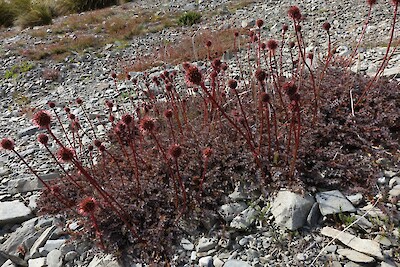
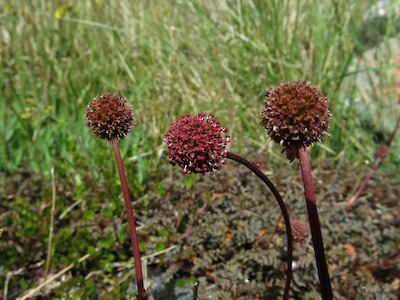
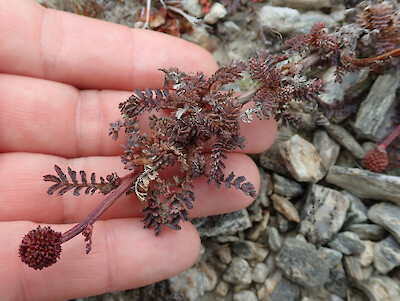
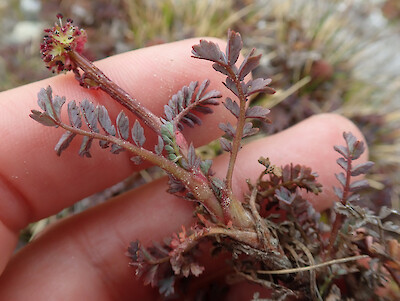
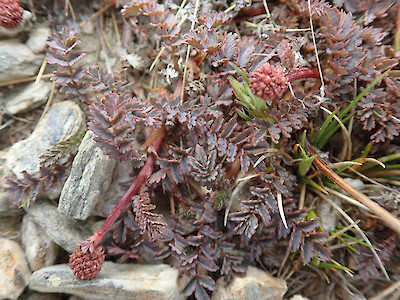
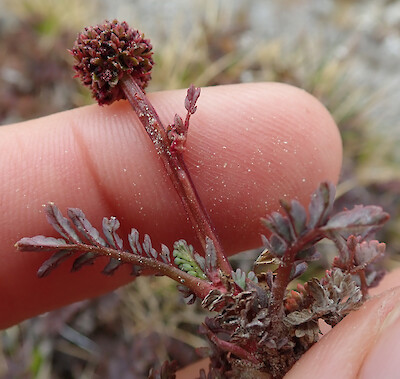
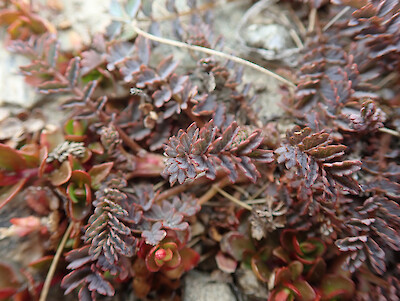
An attractive evergreen dull green to bluish green herb, which spreads up to a 1 metre across and about 5cm in height. The pinnate leaves are delicate and toothed, and may have a pinkish, contrasting coloured margin. The globe shaped flower balls are red on a robust red stem, and grow into a cluster of hooked spikes, which when ripe become light brown, become firm and may hook on to your socks or laces when brushed past in order to disperse.
Flower colours
Red/Pink
Detailed description
Stoloniferous, prostrate, trailing perennial herb, forming a dense mat up to 1 metre in diameter. Stems 1-1.7 mm diameter, up to 30 cm long, and/or 5 cm high, rooting at nodes; Stipules perfect, trifid to pentafid; Leaves odd-pinnate, between 9-130 mm long with 9-15 leaflets; Leaflets obovate or deltoid reducing in size from distal to proximal, serrated toothed margin, 5-8 blunt teeth lacking hair-tip, dull green to bluish green on both surfaces occasionally with pink tinged margin, upper surface keeled, glabrous or sparingly hairy on underside veins and margin; Inflorescence scape up to 100 mm, extending up to 300 mm when fruiting, stout, red, hairless; Capitulum of 80-100 florets, each floret has 4 sepals, 2 stamen, dark red anthers, 1 style, 1 achene, 6-9mm diameter in flower, when mature including spines less than 15mm diameter; Fruit roughly cone-shaped, each having 4 barb-tipped spines, 2-4 mm long, which mature dry, pale brown when ripe, enabling attachment to passing hairy/feathered surfaces as vector, and/or to aid wind dispersal, tiny spines occasionally occur in between foremost spines.
Similar taxa
Most similar to Acaena magellanica yet should not be confused as it can only be found on Macquarie Island, not mainland New Zealand.
Distribution
Endemic. South Island only, mainly East of the Alps, from Marlborough to Otago.
Habitat
Montane to alpine (900-1900 m.a.s.l.), prefers open sheltered sites, amongst snow-tussock grassland, fellfield, herbfield, and persistently snow-covered areas.
Detailed taxonomy
Genus
Family
Endemic taxon
Yes
Endemic genus
No
Endemic family
No
Ecology
Flowering
December-January.
Fruiting
January-March.
Life cycle and dispersal
Spiny hypanthia are dispersed by attaching to fur, feathers and clothing and possibly also dispersed by wind and granivory (Thorsen et al., 2009)
Wetland plant indicator status rating
Information derived from the revised national wetland plant list prepared to assist councils in delineating and monitoring wetlands (Clarkson et al., 2021 Manaaki Whenua – Landcare Research Contract Report LC3975 for Hawke’s Bay Regional Council). The national plant list categorises plants by the extent to which they are found in wetlands and not ‘drylands’. The indicator status ratings are OBL (obligate wetland), FACW (facultative wetland), FAC (facultative), FACU (facultative upland), and UPL (obligate upland). If you have suggestions for the Wetland Indicator Status Rating, please contact: [Enable JavaScript to view protected content]
FACU: Facultative Upland
Occasionally is a hydrophyte but usually occurs in uplands (non-wetlands).
Other information
Etymology
acaena: From the Greek ‘akanthos’ thorn, referring to the spiny calyx that many species have
saccaticupula: From the Latin saccata (bag) and cupula (cup-shaped)
NVS code
The National Vegetation Survey (NVS) Databank is a physical archive and electronic databank containing records of over 94,000 vegetation survey plots - including data from over 19,000 permanent plots. NVS maintains a standard set of species code abbreviations that correspond to standard scientific plant names from the Ngä Tipu o Aotearoa - New Zealand Plants database.
ACASAC
Chromosome number
2n = c.126
Previous conservation statuses
The conservation status of all known New Zealand vascular plant taxa at the rank of species and below were reassessed in 2022-2023 using the New Zealand Threat Classification System (NZTCS) – more information about this can be found on the NZTCS website. This report includes replaces all previous NZTCS lists for vascular plants. Previous assessments can be found here.
- Conservation status of vascular plants in Aotearoa New Zealand, 2023. 2024. Peter J. de Lange, Jane Gosden, Shannel P. Courtney, Alexander J. Fergus, John W. Barkla, Sarah M. Beadel, Paul D. Champion, Rowan Hindmarsh-Walls, Troy Makan and Pascale Michel Department of Conservation. Source: NZTCS and licensed by DOC for reuse under the Creative Commons Attribution 4.0 International licence.
2017 | Not Threatened
2012 | Not Threatened
2009 | Not Threatened
2004 | Not Threatened
Regional conservation statuses
Otago: 2025 | Regionally Not Threatened
Current regional threat status assessments prepared according to Crisp et al. (2025) are displayed when available. The Otago conservation status information is sourced from the “Conservation Status of Indigenous Vascular Plants in Otago, 2025” Jarvie S et al. (2025) report.
Referencing and citations
References and further reading
Lloyd K. 2001. A Key and notes for Acaena (Rosaceae) in New Zealand. Botanical Society of Otago Newsletter 25. Pgs.10-14.
Mark AF. 2012. Above the Treeline: A Nature Guide to Alpine New Zealand. Craig Potton Publishing, Nelson. pg. 112.
Thorsen MJ, Dickinson KJM, Seddon PJ. 2009. Seed dispersal systems in the New Zealand flora. Perspectives in Plant Ecology, Evolution and Systematics 11: 285–309. https://doi.org/10.1016/j.ppees.2009.06.001.
Webb CJ, Sykes WR, Garnock-Jones PJ. 1988. Flora of New Zealand, Volume IV. Naturalised Pteridophytes, Gymnosperms, Dicotyledons. Botany Division, Department of Scientific and Industrial Research, Christchurch, NZ. Pg. 1063-64.
Attribution
Fact sheet prepared for NZPCN by MD Ward (August 29th 2025). Description adapted from Mark (2012), Lloyd (2001), Webb et. al. (1988).
Some of this factsheet information is derived from Flora of New Zealand Online and is used under a Creative Commons Attribution 3.0 New Zealand licence.