
Anisotome aromatica



Common names
aromatic aniseed, kopoti, common aniseed
Biostatus
Native – Endemic taxon
Current conservation status
The conservation status of all known New Zealand vascular plant taxa at the rank of species and below were reassessed in 2022-2023 using the New Zealand Threat Classification System (NZTCS) – more information about this can be found on the NZTCS website. This report includes replaces all previous NZTCS lists for vascular plants. Previous assessments can be found here.
- Conservation status of vascular plants in Aotearoa New Zealand, 2023. 2024. Peter J. de Lange, Jane Gosden, Shannel P. Courtney, Alexander J. Fergus, John W. Barkla, Sarah M. Beadel, Paul D. Champion, Rowan Hindmarsh-Walls, Troy Makan and Pascale Michel Department of Conservation. Source: NZTCS and licensed by DOC for reuse under the Creative Commons Attribution 4.0 International licence.
2023 | Not Threatened | Qualifiers: DPT
Category
Vascular
Structural class
Herbs - Dicotyledons other than Composites
Simplified description
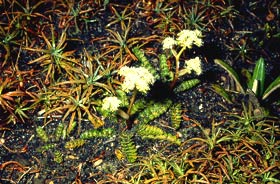
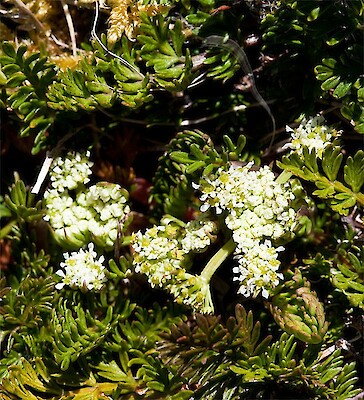
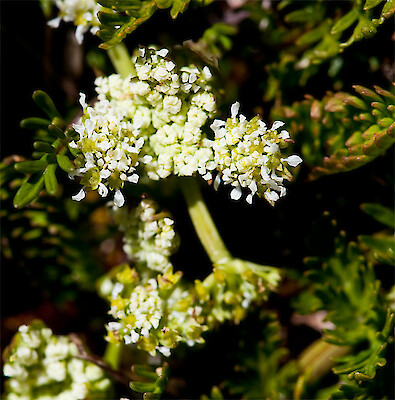
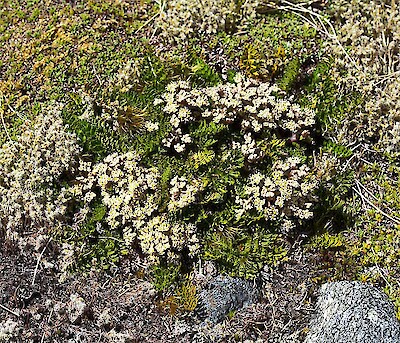
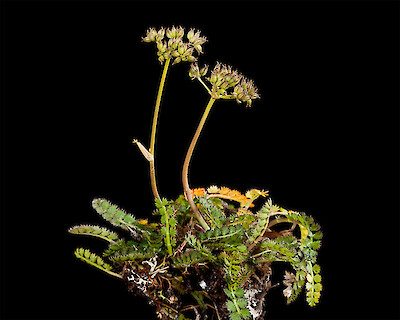
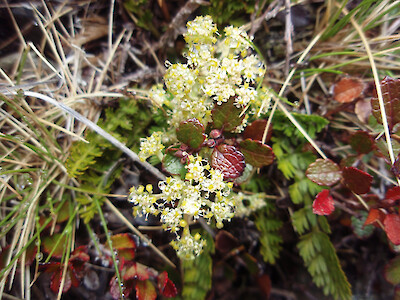
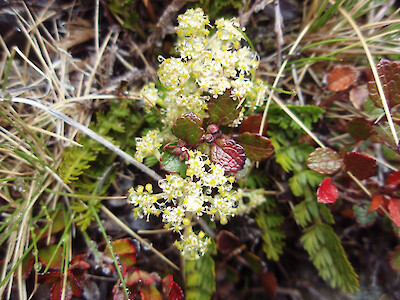
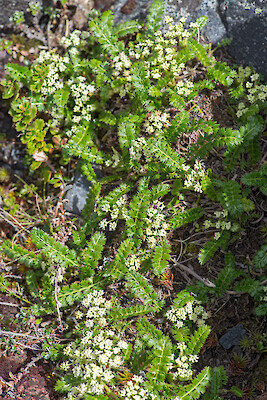
A small to medium sized perennial member of the carrot family which is a species complex. The rosettes range from 10-50 cm across and are found in coastal to alpine habitats. Leaves are one times pinnate, they may be yellow-green, green or dark green. Flowers are predominantly white and form umbrella-like shape above the plant.
Flower colours
White
Detailed description
Hooker gives a composite description based on various specimens from “Northern Island. East and south coasts, and interior, Banks and Solander, Colenso, etc. Middle (South) Island, Bidwill, Lyall, etc. The smallest species I know, 200-300 mm high. Leaves all radical, except one (no longer relevant as this is now A. lanuginosa, as described by Dawson 1961) at each fork of the stem, recurved. Petiole 100-150 mm long, stout, jointed, with eight pair of pinnae extending nearly to the base, 8-10 mm broad across the pinnae, which coriaceous, deeply veined, cuneate-orbicular, more or less deeply toothed, or cut into linear segments, each ending is a little bristle. Stems or scapes slender sparingly divided. Male umbels 35-55 mm across, many-flowered; flowers white, 2-3 mm across. Calyx lobes variable, sometimes obsolete. Female umbels much smaller, contracted, fewer-flowered. Involucral leaves partial and general, few, linear-subulate, shorter than the peduncles. Fruit shortly pedicellate. Mericarps linear, up to 4 mm long, equal, each with five winged ribs. Seeds deeply grooved.”
var. aromatica Leaves, stems slender, usually about 5-10 cm long; lamina 30-80 mm long, on petiole up to about 25-35 mm long; pinnae 4-8 pairs, close-set, sometimes slightly overlapping, submembranous, dark green, suborbicular-flabellate, rapidly cuneately narrowed to sessile or subsessile base, up to approximately 8 × 8 mm; irregularly, shallowly, sharply toothed; teeth with hair-process. Umbels small, compound, involucral bracts linear to filiform. Fruit 3-4 mm long.
var. flabellifolia Leaves, stems very slender, flexible, finely striate, up to 50 cm long; lamina narrow-oblong, up to 200 mm long, on petiole up to 70 mm. long; pinnae (5-)10(-20) pairs, distant, up to approximately 10 × 8 mm, rather abruptly cuneately narrowed to sessile or subsessile base, membranous; teeth sharp, fine, with short hair-process. Occasionally pinnae deeply, irregularly lobed. Umbels small, compound, on slender peduncles up to 40 mm long; primary rays almost filiform unequal, up to 25-35 mm long; involucral bracts narrow-linear, acuminate; secondary rays very short. Umbellules not more than 5 mm diameter in flower.
var. incisa Leaves, stems stout to rather slender, striate, up to 50 cm tall; lamina narrow-oblong in outline, up to 200 mm long, on petiole up to 100 mm long; pinnae 5-10 pairs, flabellate to rhomboid in outline, distant, submembranous, on petiolules up to 5 mm long, or subsessile. Lamina of pinnae 20 × 25 mm, very deeply irregularly 3-(5) lobed; lobes again deeply divided; final segs about oblong, rather abruptly narrowed to stiff hair-process. Umbel-bearing portion of stem very slender; bracts up to 20 mm long, including delicate sheath and small lamina. Umbels compound, on slender peduncles up to 80 mm long. Primary rays unequal, 5-10, very slender, up to 30 mm long; involucral bracts few, filiform, secondary rays very short, up to 15. Umbellules approximately 5-10 mm diameter in flower.
var. major Leaves, stems stout, finely grooved, up to 50 cm tall; lamina narrow-oblong, up to 120 mm long, on rather stout petiole up to 80 mm long; sheaths delicate up to 20 mm long, with short blunt ligule; pinnae 8-10 pairs, rather distant, submembranous, flabellate, 10-20 × 10-20 mm, sessile by broad base; teeth subacute, with hair-process. Bracts foliaceous, with open sheaths narrowed to lamina up to 40 mm long, with about 4 pairs of pinnae. Umbels axillary and terminal, compound, on peduncles up to 80 mm long. Primary rays up to 15, up to 30 mm long; involucral bracts linear, acuminate, up to 20 mm long; secondary rays short, up to 15. Fruit narrow-ovoid, about 5 mm long.
var. obtusa Leaves, stems generally 15–20(-30) cm tall, rather stout, strict; lamina 20–60 mm long, on petiole up to 20 mm long; pinnae 4–8 pairs, subcoriaceous, dark green, up to 6 × 5 mm, close-set, usually slightly overlapping; irregularly, shallowly, bluntly toothed; tips occasionally apiculate, but lacking hair-processes. Umbels compound, condensed up to 10 mm diameter. Primary rays very short; involucral bracts lanceolate. Fruit up to 2 mm long, styles slender; mericarps distinctly ribbed, more or less winged.
var. pinnatisecta Leaves, stems stiff, finely striate, up to 30 cm tall; lamina up to 80 mm long, on petiole 40–80 mm long including broad membranous sheath; pinnae up to 9 pairs, subcoriaceous, distant, up to 10 × 10 mm, sessile to shortly petiolulate, pinnately divided to midvein into 2–3 pairs of distant linear lobes (these sometimes again lobed) with obtuse to subacute minutely apiculate apex. Umbels compound or simple, up to 30 mm diameter in fruit, usually several on common peduncle up to 60 mm long; involucral bracts linear. Fruit ovate-oblong in outline; strongly compressed, 3–4 mm long; mericarps with acute to winged ridges.
Distribution
All varieties are Endemic.
var. aromatica – Te Ika-a-Māui | North Island, Te Waipounamu | South Island, Rakiura | Stewart Island, Raukumara Range to Central plateau South to Stewart Island.
var. flabellifolia – Te Waipounamu | South Island, Rakiura | Stewart Island, Mt Hutt Inland Canterbury, to Mt Anglem.
var. incisa – Te Waipounamu | South Island, Canterbury.
var. major – Te Ika-a-Māui | North Island, Raukumara Range, Central plateau, Mt Taranaki, Rangiwahia; Te Waipounamu | South Island, East of the divide.
var. obtusa - Te Ika-a-Māui | North Island, Te Waipounamu | South Island,
var. pinnatisecta – Te Waipounamu | South Island, North-west Nelson to South Westland.
Habitat
var. aromatica – Coastal to montane (0 – 1700 m.a.s.l.), wide range of habitats including grassland and open ground.
var. flabellifolia – Lowland to alpine (20-1700 m.a.s.l.), grassland, cushionfield to scree-field.
var. incisa – Montane (400-900 m.a.s.l.), occasional in grassland and rocky places, particularly limestone.
var. major – Montane (400-900 m.a.s.l.), grassland and open places.
var. obtusa – Montane (400-900 m.a.s.l.), grassland herbfield and rocky places.
var. pinnatisecta – Montane to subalpine (400-1500 m.a.s.l.), grassland, herbfield
Detailed taxonomy
Genus
Family
Taxonomic notes
Noted in Allan (1961), Hooker describes this entity as a composite with 8 varietals, var. aromatica, var. dissecta, var. flabellifolia, var. incisa, var. lanuginosa, var. major, var. obtusa and var. pinnatisecta, 2 of which are subsequently recognised by Dawson (1961) at species rank. Mark (2012) notes that the distinction between the 3 alpine varieties (var. aromatica, var. major, and var. obtusa) remains problematic.
Dawson (1961) suggested the variation of form may be due to habitat producing environmental modification. He then dismissed this idea when growing specimens from various locations of both the North and South Island’s in Wellington finding that the morphological traits remained in new growth.
Endemic taxon
Yes
Endemic genus
No
Endemic family
No
Ecology
Flowering
October – February.
Fruiting
November – April.
Life cycle and dispersal
Winged mericarps are dispersed by wind (Thorsen et al., 2009).
Wetland plant indicator status rating
Information derived from the revised national wetland plant list prepared to assist councils in delineating and monitoring wetlands (Clarkson et al., 2021 Manaaki Whenua – Landcare Research Contract Report LC3975 for Hawke’s Bay Regional Council). The national plant list categorises plants by the extent to which they are found in wetlands and not ‘drylands’. The indicator status ratings are OBL (obligate wetland), FACW (facultative wetland), FAC (facultative), FACU (facultative upland), and UPL (obligate upland). If you have suggestions for the Wetland Indicator Status Rating, please contact: [Enable JavaScript to view protected content]
FACU: Facultative Upland
Occasionally is a hydrophyte but usually occurs in uplands (non-wetlands).
Other information
Etymology
anisotome: Unequal sided
aromatica: Aromatic
NVS code
The National Vegetation Survey (NVS) Databank is a physical archive and electronic databank containing records of over 94,000 vegetation survey plots - including data from over 19,000 permanent plots. NVS maintains a standard set of species code abbreviations that correspond to standard scientific plant names from the Ngä Tipu o Aotearoa - New Zealand Plants database.
ANIARO
Chromosome number
2n = 22
Previous conservation statuses
The conservation status of all known New Zealand vascular plant taxa at the rank of species and below were reassessed in 2022-2023 using the New Zealand Threat Classification System (NZTCS) – more information about this can be found on the NZTCS website. This report includes replaces all previous NZTCS lists for vascular plants. Previous assessments can be found here.
- Conservation status of vascular plants in Aotearoa New Zealand, 2023. 2024. Peter J. de Lange, Jane Gosden, Shannel P. Courtney, Alexander J. Fergus, John W. Barkla, Sarah M. Beadel, Paul D. Champion, Rowan Hindmarsh-Walls, Troy Makan and Pascale Michel Department of Conservation. Source: NZTCS and licensed by DOC for reuse under the Creative Commons Attribution 4.0 International licence.
2017 | Not Threatened
2012 | Not Threatened
2009 | Not Threatened
2004 | Not Threatened
Regional conservation statuses
Otago: 2025 | Regionally Not Threatened | Qualifiers: TL
Current regional threat status assessments prepared according to Crisp et al. (2025) are displayed when available. The Otago conservation status information is sourced from the “Conservation Status of Indigenous Vascular Plants in Otago, 2025” Jarvie S et al. (2025) report.
Wellington: 2025 | Regionally At Risk – Regionally Naturally Uncommon
Current regional threat status assessments prepared according to Crisp et al. (2025) are displayed when available. The Wellington conservation status information is sourced from the “Conservation status of indigenous vascular plants in the Wellington region” Enright P et al. 2025 report.
Referencing and citations
References and further reading
Allan HH. 1961. Flora of New Zealand, Volume I. Indigenous Tracheophyta: Psilopsida, Lycopsida, Filicopsida, Gymnospermae, Dicotyledones. Government Printer, Wellington, NZ. Pg. 489-490.
Atlas of Living Australia website at http://www.ala.org.au. Accessed 26th December 2025; 29th January 2026.
Dawson JD. 1961. A Revision of the Genus Anisotome (Umbelliferae). Vol. 33, No 1, pp 1-98. University of California Press, Berkeley and Los Angeles.
Mark AF. 2012. Above the Treeline: A Nature Guide to Alpine New Zealand. Craig Potton Publishing, Nelson. pgs. 128-129.
Thorsen MJ, Dickinson KJM, Seddon PJ. 2009. Seed dispersal systems in the New Zealand flora. Perspectives in Plant Ecology, Evolution and Systematics 11: 285–309. https://doi.org/10.1016/j.ppees.2009.06.001.
Attribution
Fact sheet prepared for NZPCN by MD Ward (January 29th 2026). Description adapted from Allan (1961) & Mark (2012). Distribution confirmed using herbarium records ALA (2025, 2026).
Some of this factsheet information is derived from Flora of New Zealand Online and is used under a Creative Commons Attribution 3.0 New Zealand licence.