
Callitriche antarctica
Biostatus
Native – Endemic taxon
Current conservation status
The conservation status of all known New Zealand vascular plant taxa at the rank of species and below were reassessed in 2022-2023 using the New Zealand Threat Classification System (NZTCS) – more information about this can be found on the NZTCS website. This report includes replaces all previous NZTCS lists for vascular plants. Previous assessments can be found here.
- Conservation status of vascular plants in Aotearoa New Zealand, 2023. 2024. Peter J. de Lange, Jane Gosden, Shannel P. Courtney, Alexander J. Fergus, John W. Barkla, Sarah M. Beadel, Paul D. Champion, Rowan Hindmarsh-Walls, Troy Makan and Pascale Michel Department of Conservation. Source: NZTCS and licensed by DOC for reuse under the Creative Commons Attribution 4.0 International licence.
2023 | At Risk – Naturally Uncommon | Qualifiers: DPR, DPS, DPT, RR, SO
Category
Vascular
Structural class
Herbs - Dicotyledons other than Composites
Detailed description
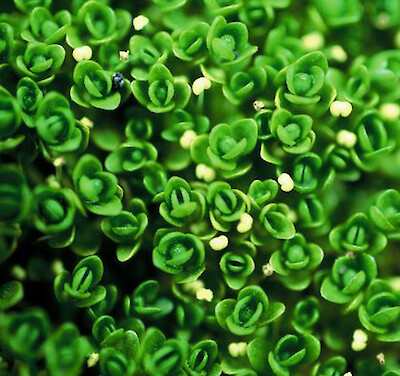
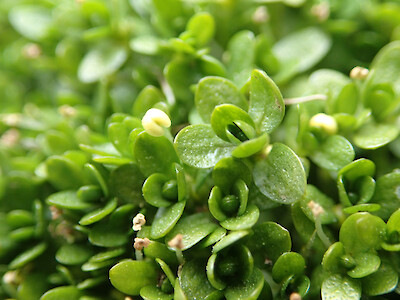
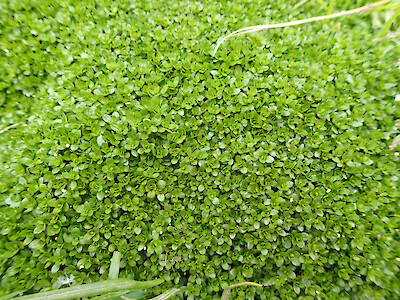
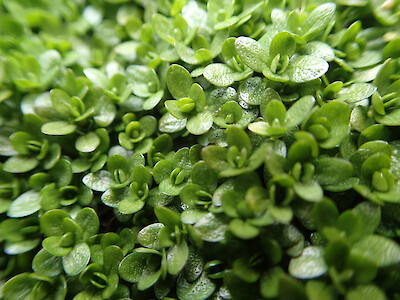
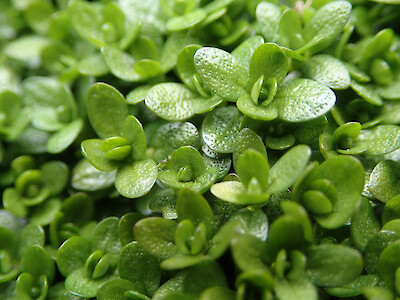
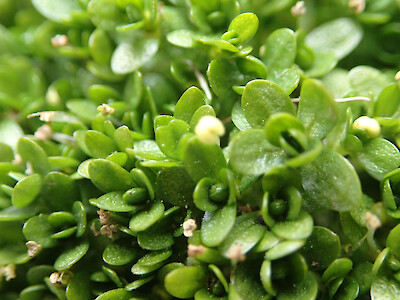
Tufted to spreading, much branched, succulent perennial herb forming dense bright to dark green patches on mud. Branches thick, creeping below with ascending branches up to 100 mm long. Leaves on stout petioles 2-3 mm long, lamina succulent, 2.5-10 x 1.5-4.8 mm, dark green to light green, spathulate to oblong-spathulate, 3-nerved, sometimes with free veins, apex rounded, base scarious. Flowers solitary, males in upper and femal lower axils, ebracteate or with bracts shedding early. Filaments to 13 mm, tapering from broad base. Mericarp more or less elliptic, laterally compressed, 0.9-1.2(-1.5) mm long, surface reticulate, or colliculate, dull pale orange-yellow, orange-brown or dark brown.
Similar taxa
Callitriche aucklandica R.Mason is similar but differs by its longer, laxly creeping, rather than ascending stems, fleshy rather than succulent leaves with broadly fused petioles, shorter filaments (9 cf. 1.3 mm) and larger fruits (1.0-1.6 cf. 0.9-1.5 mm).
Distribution
Indigenous. In New Zealand known from Campbell and Auckland Islands. Also on Macquarie, Heard Island and Tasmania. Probably elsewhere on the subantarctic islands.
Habitat
Coastal to montane in damp, peaty and boggy ground. Common around sea bird nesting grounds, penguin rookeries and seal haul outs. Prefers open, disturbed habitats,
Threats
Not Threatened. Listed becaus ein the New Zealand region it has a restircted geographic range.
Detailed taxonomy
Genus
Family
Synonyms
None Known
Endemic taxon
Yes
Endemic genus
No
Endemic family
No
Ecology
Flowering
November - December
Fruiting
December - January
Life cycle and dispersal
Mericarps possibly by water and attachment (Thorsen et al., 2009).
Propagation technique
Probably easy. However, not known to have been cultivated.
Wetland plant indicator status rating
Information derived from the revised national wetland plant list prepared to assist councils in delineating and monitoring wetlands (Clarkson et al., 2021 Manaaki Whenua – Landcare Research Contract Report LC3975 for Hawke’s Bay Regional Council). The national plant list categorises plants by the extent to which they are found in wetlands and not ‘drylands’. The indicator status ratings are OBL (obligate wetland), FACW (facultative wetland), FAC (facultative), FACU (facultative upland), and UPL (obligate upland). If you have suggestions for the Wetland Indicator Status Rating, please contact: [Enable JavaScript to view protected content]
FAC: Facultative
Commonly occurs as either a hydrophyte or non-hydrophyte (non-wetlands).
Other information
Etymology
callitriche: From the Greek kalli ‘beautiful’ and thrix ‘hair’, referring to the beautiful stems
antarctica: Antarctic
NVS code
The National Vegetation Survey (NVS) Databank is a physical archive and electronic databank containing records of over 94,000 vegetation survey plots - including data from over 19,000 permanent plots. NVS maintains a standard set of species code abbreviations that correspond to standard scientific plant names from the Ngä Tipu o Aotearoa - New Zealand Plants database.
CALANT
Chromosome number
2n = 40
Previous conservation statuses
The conservation status of all known New Zealand vascular plant taxa at the rank of species and below were reassessed in 2022-2023 using the New Zealand Threat Classification System (NZTCS) – more information about this can be found on the NZTCS website. This report includes replaces all previous NZTCS lists for vascular plants. Previous assessments can be found here.
- Conservation status of vascular plants in Aotearoa New Zealand, 2023. 2024. Peter J. de Lange, Jane Gosden, Shannel P. Courtney, Alexander J. Fergus, John W. Barkla, Sarah M. Beadel, Paul D. Champion, Rowan Hindmarsh-Walls, Troy Makan and Pascale Michel Department of Conservation. Source: NZTCS and licensed by DOC for reuse under the Creative Commons Attribution 4.0 International licence.
2017 | At Risk – Naturally Uncommon | Qualifiers: RR, SO
2012 | At Risk – Naturally Uncommon | Qualifiers: RR, SO
2009 | At Risk – Naturally Uncommon
2004 | Range Restricted
Referencing and citations
References and further reading
Thorsen, M. J.; Dickinson, K. J. M.; Seddon, P. J. 2009. Seed dispersal systems in the New Zealand flora. Perspectives in Plant Ecology, Evolution and Systematics 2009 Vol. 11 No. 4 pp. 285-309
Attribution
Fact sheet prepared by P.J. de Lange for NZPCN (1 June 2013)
NZPCN Fact Sheet citation
Please cite as: de Lange, P.J. (Year at time of access): Callitriche antarctica Fact Sheet (content continuously updated). New Zealand Plant Conservation Network. https://www.nzpcn.org.nz/flora/species/callitriche-antarctica/ (Date website was queried)