
Calymperes tenerum
Common names
moss
Biostatus
Native
Current conservation status
This is the first complete assessment of all known species of mosses found in the wild in Aotearoa New Zealand with a total of 560 species being assessed. The conservation status of mosses, published in the NZTCS database, replaces all previous assessments of mosses. Data supporting the 2025 NZTCS assessment of mosses has been published on the NZTCS database at https://nztcs.org.nz/reports/1155.
Source: NZTCS and licensed by DOC for reuse under the Creative Commons Attribution 4.0 International licence.
2025 | Threatened – Nationally Endangered | Qualifiers: RR, SO
Category
Non-vascular
Structural class
Mosses
Detailed description
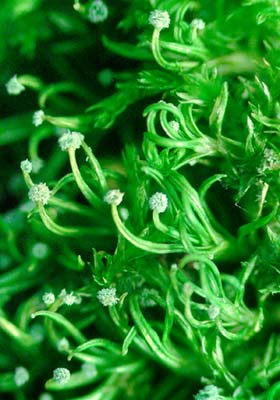
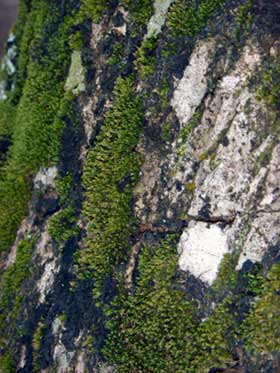
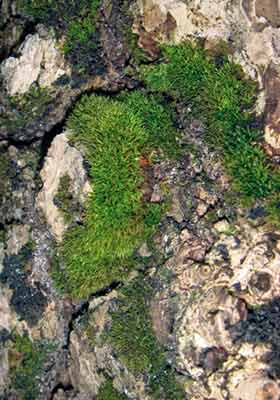
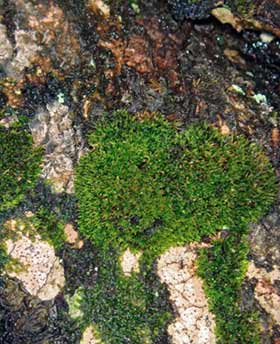
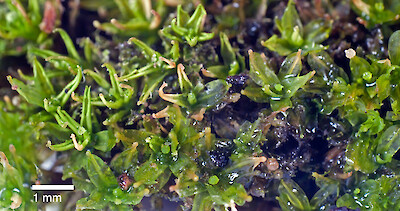
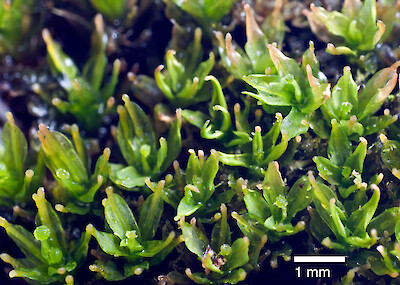
Corticolous at the base of trees. Plants forming dense, soft, extensive tufted mats, dull green above brown below (drying golden yellow). Stems simple, erect, c.10-30 mm tall, sparingly radiculose at the base. Leaves 3.00-3.80 x 0.75 mm, crisped and curled when dry, erect-spreading when moist; lamina ovate-lanceolate, sometimes abnormally so, slightly constricted above the short, broad, lightly clasping base to a broad lingulate point up to 2 mm long; margin entire, plane or slightly inflexed; nerve strong, not tapering upward, c.90 microns wide, convex and very prominent on the back, excurrent into a thick, blunt, scabrous point bearing numerous cylindrical, septate brood-bodies, normal leaves with the nerve only percurrent, only rarely with brood-bodies; basal leaf cells toward the margins in 6-7 rows, small pellucid, short rectangular at the extreme base, gradually becoming quadrate or transversely elongate upward and merging with the dense areolation of the lamina, which is composed of rounded-quadrate thin-walled cells c.7 microns wide, in one layer, lightly papillose on both sides; cancellinae large, short rectangular; c.25 microns wide, thin-walled and hyaline, forming a sharply differentiated group ending abruptly below the top of the leaf base and occupying c.2/3 of its width. Fruit not seen.
Distribution
Tropical (India, Malaysia, Indonesia, Australia (northern Queensland), Pacific Islands (Hawaiian, Fijian, Tonga Group, Cook Islands, Society Islands, Marquesas, New Caledonia). In New Zealand known from three (January 2006, May and November 2008) gatherings from Chatham and Pitt Islands, two (May 2009 and May 2011) gatherings from Raoul Island and two (October 2009, November 2011) gatherings from Te Paki (North Island)
Habitat
Known in New Zealand from eight gatherings (see Fife & de Lange 2009 and de Lange & Fife (2010) who document five of these). Three of these gatherings come from the Chatham Islands where this moss was found on the bark of Coprosma chathamica, the exposed root plate of Pseudopanax chathamicus, and trunk of Rhopalostylis sapida. On Raoul Island Calymperes was collected in 2009 and then again in 2011 from the bark of Metrosideros kermadecensis. Recently (2009, 2010) Calymperes was discovered in the North Island at Te Paki (Te Huka Bay and Surville Cliffs). At Te Huka Bay it grew threaded through a liverwort (Acrolejeunea securifolia) that was growing on the upper trunk of Metrosideros excelsa. On the Surville Cliffs if grew with Syrrhopodon armatus on the exposed roots of Metrosideros excelsa.
Substrate details
Corticolous. The New Zealand specimens have been collected from the bark of Chatham Island karamu (Coprosma chathamica) and nikau (both Rhopalostylis baueri and R. sapida)
Threats
Unknown - First recognised for New Zealand from a chance gathering made on Rekohu (Chatham I.) in February 2006. It was later (2008) found on Rangiauria (Pitt Island). In both Chatham Islands sites it is vulnerable to habitat loss. A serious threat there. It has since been found at Te Paki (2009, 2010) in two sites and on Raoul Island (2009, 2011). At all these locations it seems to be very uncommon. Probably this species is naturally uncommon as it is at the world limit of its range in the New Zealand Botanical Region (see Fife & de Lange 2009) however due to deterioration of its habitat on the Chatham Islands, and the over all small population sizes it has recently been listed as “Nationally Endangered” (see Glenny et al. 2011).
Detailed taxonomy
Genus
Family
Synonyms
None
Endemic genus
No
Endemic family
No
Ecology
Fruiting
Fruit not seen.
Other information
Previous conservation statuses
This is the first complete assessment of all known species of mosses found in the wild in Aotearoa New Zealand with a total of 560 species being assessed. The conservation status of mosses, published in the NZTCS database, replaces all previous assessments of mosses. Data supporting the 2025 NZTCS assessment of mosses has been published on the NZTCS database at https://nztcs.org.nz/reports/1155.
Source: NZTCS and licensed by DOC for reuse under the Creative Commons Attribution 4.0 International licence.
2014 | Threatened – Nationally Endangered | Qualifiers: RR, SO
2010 | Threatened – Nationally Endangered | Qualifiers: RR, SO
Referencing and citations
References and further reading
de Lange, P.J.; Fife, A.J. 2010: Claymperes tenerum in northern New Zealand. Australasian Bryological Newsletter 58: 8.
Fife, A.; de Lange, P. 2009: Calymperes tenerum Müll.Hal. (Calymperaceae) on the Chatham Islands, New Zealand. Australasian Bryological Newsletter 57: 14–16.
Glenny, D.; Fife, A.J.; Brownsey, P.J.; Renner, M.A.M.; Braggins, J.E.; Beever, J.E.; Hitchmough, R. 2011: Threatened and uncommon bryophytes of New Zealand (2010 Revision). New Zealand Journal of Botany 49: 305-327.
Attribution
Fact sheet and description prepared for NZPCN by P.J. de Lange August 2009.
NZPCN Fact Sheet citation
Please cite as: de Lange, P.J. (Year at time of access): Calymperes tenerum Fact Sheet (content continuously updated). New Zealand Plant Conservation Network. https://www.nzpcn.org.nz/flora/species/calymperes-tenerum/ (Date website was queried)