
Coriaria arborea var. kermadecensis

Poisonous plant
Common names
Kermadec tutu
Biostatus
Native – Endemic taxon
Current conservation status
The conservation status of all known New Zealand vascular plant taxa at the rank of species and below were reassessed in 2022-2023 using the New Zealand Threat Classification System (NZTCS) – more information about this can be found on the NZTCS website. This report includes replaces all previous NZTCS lists for vascular plants. Previous assessments can be found here.
- Conservation status of vascular plants in Aotearoa New Zealand, 2023. 2024. Peter J. de Lange, Jane Gosden, Shannel P. Courtney, Alexander J. Fergus, John W. Barkla, Sarah M. Beadel, Paul D. Champion, Rowan Hindmarsh-Walls, Troy Makan and Pascale Michel Department of Conservation. Source: NZTCS and licensed by DOC for reuse under the Creative Commons Attribution 4.0 International licence.
2023 | At Risk – Naturally Uncommon | Qualifiers: IE, OL
Category
Vascular
Structural class
Trees & Shrubs - Dicotyledons
Simplified description
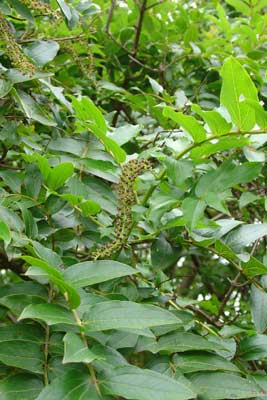
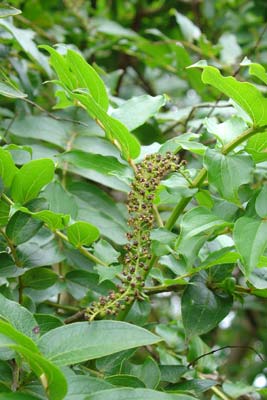
Common robust much branched large shrub inhabiting disturbed areas on the Kermadec Islands. Twigs square in cross-section, bearing pairs of 45-55mm long glossy green oval leaves that do not have a leaf stalk. Flowers in drooping spikes up to 15cm long.
Distribution
Endemic. Kermadec Island group, Raoul Island only
Habitat
Widespread in open seral habitats and disturbed ground.
Threats
Not Threatened. Listed because it is a narrow range endemic abundant within its only known habitat.
Detailed taxonomy
Genus
Family
Synonyms
None
Taxonomic notes
Very doubtfully distinct from C. arborea var. arborea - plants sourced from Raoul Island held in cultivation in New Zealand are virtually indistinguishable from var. arborea (they have a lighter green coloured leaf).
Endemic taxon
Yes
Endemic genus
No
Endemic family
No
Ecology
Flowering
Throughout the year
Fruiting
Throughout the year
Propagation technique
Easily grown fresh fresh seed and suckers. Fast growing but cold sensitive. Plants are a much lighter green than C. arborea R.Linds. var. arborea.
Other information
Poisonous plant
All Coriaria species are poisonous especially the seed inside the black berries. Click on this link for more information about Poisonous native plants.
Etymology
coriaria: From the Latin corium ‘hide’, possibly from the use of some species for tanning leather
arborea: From the Latin arbor ‘tree’, meaning tree-like
kermadecensis: From the Kermadec Islands
NVS code
The National Vegetation Survey (NVS) Databank is a physical archive and electronic databank containing records of over 94,000 vegetation survey plots - including data from over 19,000 permanent plots. NVS maintains a standard set of species code abbreviations that correspond to standard scientific plant names from the Ngä Tipu o Aotearoa - New Zealand Plants database.
CORAVK
Chromosome number
2n = 40
Previous conservation statuses
The conservation status of all known New Zealand vascular plant taxa at the rank of species and below were reassessed in 2022-2023 using the New Zealand Threat Classification System (NZTCS) – more information about this can be found on the NZTCS website. This report includes replaces all previous NZTCS lists for vascular plants. Previous assessments can be found here.
- Conservation status of vascular plants in Aotearoa New Zealand, 2023. 2024. Peter J. de Lange, Jane Gosden, Shannel P. Courtney, Alexander J. Fergus, John W. Barkla, Sarah M. Beadel, Paul D. Champion, Rowan Hindmarsh-Walls, Troy Makan and Pascale Michel Department of Conservation. Source: NZTCS and licensed by DOC for reuse under the Creative Commons Attribution 4.0 International licence.
2017 | At Risk – Naturally Uncommon | Qualifiers: IE, OL
2012 | At Risk – Naturally Uncommon | Qualifiers: IE, OL
2009 | At Risk – Naturally Uncommon | Qualifiers: IE
2004 | Range Restricted