
Libertia edgariae
Common names
Edgar’s iris, Edgar’s mikoikoi
Biostatus
Native – Endemic taxon
Current conservation status
The conservation status of all known New Zealand vascular plant taxa at the rank of species and below were reassessed in 2022-2023 using the New Zealand Threat Classification System (NZTCS) – more information about this can be found on the NZTCS website. This report includes replaces all previous NZTCS lists for vascular plants. Previous assessments can be found here.
- Conservation status of vascular plants in Aotearoa New Zealand, 2023. 2024. Peter J. de Lange, Jane Gosden, Shannel P. Courtney, Alexander J. Fergus, John W. Barkla, Sarah M. Beadel, Paul D. Champion, Rowan Hindmarsh-Walls, Troy Makan and Pascale Michel Department of Conservation. Source: NZTCS and licensed by DOC for reuse under the Creative Commons Attribution 4.0 International licence.
2023 | At Risk – Naturally Uncommon | Qualifiers: DPR, DPS, DPT
Category
Vascular
Structural class
Herbs - Monocots
Flower colours
White, Yellow
Detailed description
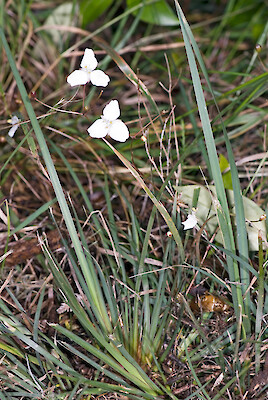
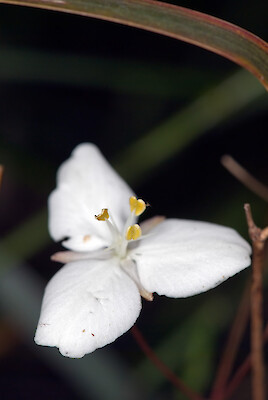
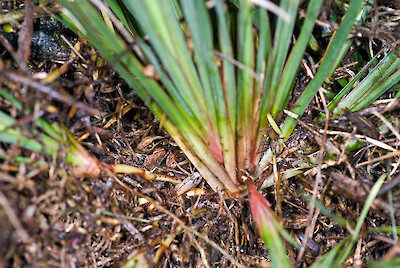
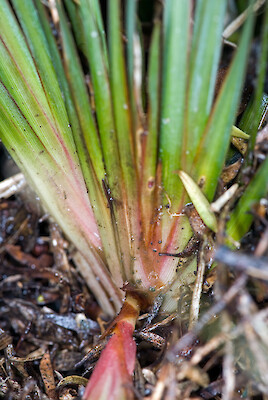
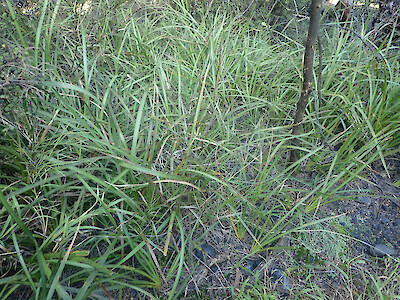
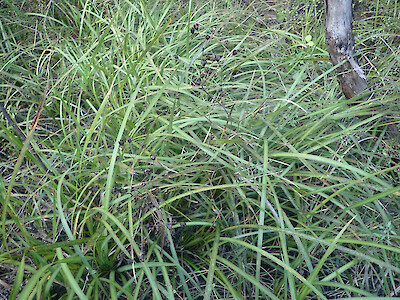
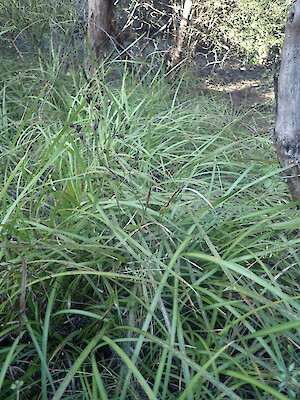
Plants consisting of leafy fans crowded or emerging at intervals from far-spreading horizontal stolons; stolons c. 2 mm diameter, pale yellow in colour. Leaves 120–620 × 1–9 mm, the two surfaces similar; green to pale yellow; nerves many, the median ones sometimes crowded to form a pale midrib; margins only scabrid at tip of leaf; leaf in transverse section convex lens shaped, two rows of vascular bundles present centrally, marginal vascular bundles present, sclerenchyma present on inside of leaf sheath. Peduncles ½ length of total inflorescence, inflorescences of similar length to leaves. Panicle broad, much and widely branched, lower bracts 15–120 mm long, lanceolate, green, upper bracts shorter, brown and membranous, occurring singly, 1–4 flowers per branch. Pedicels slender, glabrous, 10–35 mm long. Perianth in flower bud often pigmented externally, often larger than ovary. Flowers 10–20 mm diameter; tepals all white internally, widely patent; outer tepals < ½ the length of the inner, narrower, elliptical, boat-shaped, with reduced apiculus; inner tepals orbicular, unguiculate, often overlapping outer, cleft present at tip. Staminal filaments shortly connate; anthers 2–3 mm long, bright yellow. Ovary small compared with perianth bud at anthesis; style branches not winged, pointing upwards. Capsule 5–9 mm long, 3–6 mm diameter, barrel-shaped, green, turning black on maturity, dehiscing fully or partially from shorter or longer loculicidal splitting, the longer valves often recurved. Seeds c. 1.0 × 1.5 mm, rounded or sometimes angular, bright tangerine orange.
Similar taxa
This species could be confused with Libertia grandiflora and L. mooreae but differs mainly by its smaller size. It also has falcate leaves, elongated rhizomes, and barrel-shaped capsules, unlike L. grandiflora and L. mooreae. It also differs from L. peregrinans by its taller inflorescences and petal shape.
Distribution
Endemic. New Zealand: North Island (Rimutaka Ranges, Eastbourne Hills extending to south Wellington Coast, also western Wairarapa).
Habitat
Found principally in coastal scrub, on hillsides and old marine terraces in manuka (Leptospermum scoparium) scrub.
Threats
A naturally uncommon, range restricted and usualyl sparsely distributed species under no obvious threat. The majority of this species range occurs within protected land.
Detailed taxonomy
Genus
Family
Synonyms
Specimens were previously determined as stoloniferous forms of L. grandiflora.
Endemic taxon
Yes
Endemic genus
No
Endemic family
No
Ecology
Flowering
September–November
Fruiting
December–May
Life cycle and dispersal
Seeds are possibly dispersed by wind (Thorsen et al., 2009).
Propagation technique
Easily grown from rooted pieces and fresh seed—an attractive plant that deserves to be more widely grown. Because it is highly variable, some selection of forms from the wild for cultivation would be worthwhile.
Other information
Plant of the Month
This plant has been featured as a Plant of the Month – see Trilepidea: NZPCN newsletter for October 2010 for the full story.
Etymology
libertia: Named after Marie-Anne Libert, (1782-1865) born & died in Malmedy, province of Liège, Belgium; botanist and mycologist
NVS code
The National Vegetation Survey (NVS) Databank is a physical archive and electronic databank containing records of over 94,000 vegetation survey plots - including data from over 19,000 permanent plots. NVS maintains a standard set of species code abbreviations that correspond to standard scientific plant names from the Ngä Tipu o Aotearoa - New Zealand Plants database.
LIBEDG
Chromosome number
2n = 114
Previous conservation statuses
The conservation status of all known New Zealand vascular plant taxa at the rank of species and below were reassessed in 2022-2023 using the New Zealand Threat Classification System (NZTCS) – more information about this can be found on the NZTCS website. This report includes replaces all previous NZTCS lists for vascular plants. Previous assessments can be found here.
- Conservation status of vascular plants in Aotearoa New Zealand, 2023. 2024. Peter J. de Lange, Jane Gosden, Shannel P. Courtney, Alexander J. Fergus, John W. Barkla, Sarah M. Beadel, Paul D. Champion, Rowan Hindmarsh-Walls, Troy Makan and Pascale Michel Department of Conservation. Source: NZTCS and licensed by DOC for reuse under the Creative Commons Attribution 4.0 International licence.
2017 | At Risk – Naturally Uncommon | Qualifiers: DP
2012 | Not Threatened
2009 | At Risk – Naturally Uncommon | Qualifiers: Sp
2004 | Range Restricted
Regional conservation statuses
Wellington: 2025 | Regionally At Risk – Regionally Naturally Uncommon | Qualifiers: RE, NStr, TLH
Current regional threat status assessments prepared according to Crisp et al. (2025) are displayed when available. The Wellington conservation status information is sourced from the “Conservation status of indigenous vascular plants in the Wellington region” Enright P et al. 2025 report.
Referencing and citations
References and further reading
Blanchon DJ, Murray BG, Braggins JE. 2002. A taxonomic revision of Libertia (Iridaceae) in New Zealand. New Zealand Journal of Botany 40(3): 437–456. https://doi.org/10.1080/0028825X.2002.9512805.
Thorsen MJ, Dickinson KJM, Seddon PJ. 2009. Seed dispersal systems in the New Zealand flora. Perspectives in Plant Ecology, Evolution and Systematics 11: 285–309. https://doi.org/10.1016/j.ppees.2009.06.001.
Attribution
Description modified from Blanchon et al. (2002).