
Mazus novaezeelandiae subsp. impolitus f. hirtus
Common names
dwarf musk, swamp musk
Biostatus
Native – Endemic taxon
Current conservation status
The conservation status of all known New Zealand vascular plant taxa at the rank of species and below were reassessed in 2022-2023 using the New Zealand Threat Classification System (NZTCS) – more information about this can be found on the NZTCS website. This report includes replaces all previous NZTCS lists for vascular plants. Previous assessments can be found here.
- Conservation status of vascular plants in Aotearoa New Zealand, 2023. 2024. Peter J. de Lange, Jane Gosden, Shannel P. Courtney, Alexander J. Fergus, John W. Barkla, Sarah M. Beadel, Paul D. Champion, Rowan Hindmarsh-Walls, Troy Makan and Pascale Michel Department of Conservation. Source: NZTCS and licensed by DOC for reuse under the Creative Commons Attribution 4.0 International licence.
2023 | Threatened – Nationally Critical | Qualifiers: Sp
Category
Vascular
Structural class
Herbs - Dicotyledons other than Composites
Flower colours
White
Detailed description
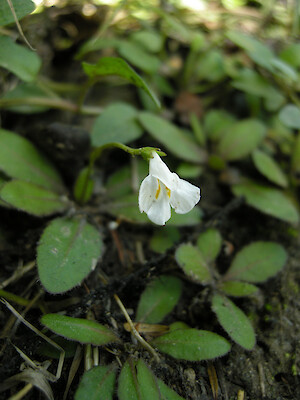
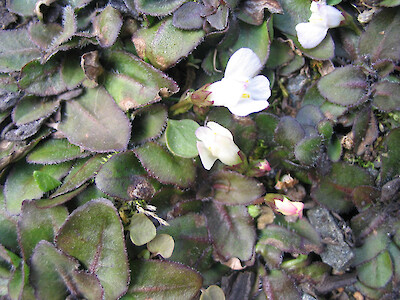
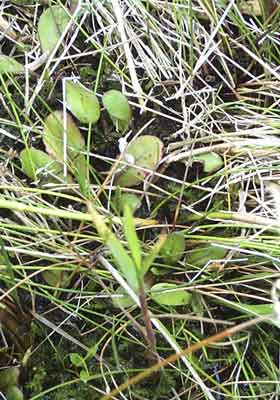
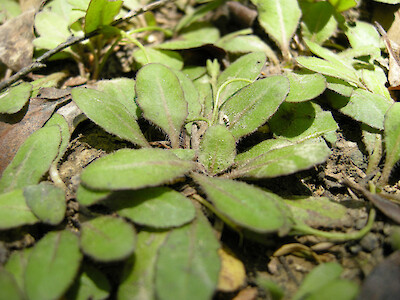
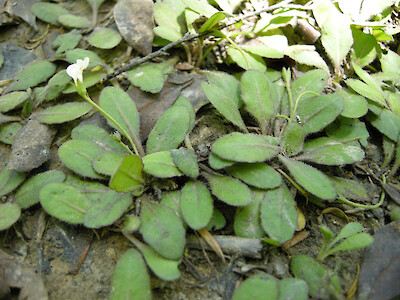
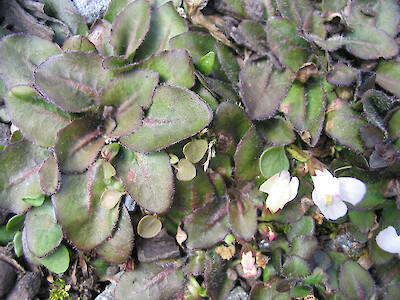
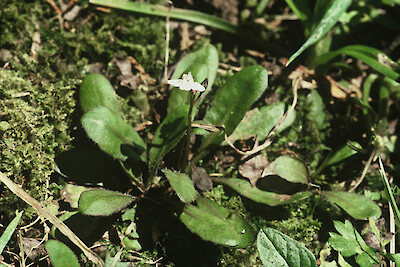
Perennial, creeping herb, forming compact leafy patches. Leaves 10-45 x 4-16 mm, dull, dark green or red-green, elliptic, narrow-elliptic, or narrow-obovate, thin, margin undulate, distinctly hairy, with a prominent brown marginal band. Inflorescences lateral on short branches, 2-8-flowered. Flowers initially pale lilac or lavender fading to white after anthesis. Peduncle 20-60 mm, pale green to brown-green, glabrous. Pedicel 4.5-40 mm, pale green to green. Calyx 3-5 mm, campanulate, green to brown-green, usually hairy, teeth 1.5-2.5 mm, narrow-triangular. Corolla 7-14.5 x 7.8-14 mm, prominently lobed. Tube 3-5 mm, lower lobes 2-6 x 3-5 mm, rounded, spreading or overlapping, middle lobe smaller than lateral lobes. Palate comprising 2 longitudinal ridged. Upper lobes 1-6.5 mm, narrow-triangular, apex subacute. Fruit 6-6.5 x 2.5-3.5 mm, ovoid, green, persistent. Seeds 0.4-0.8 x 0.4-0.5 mm, brown to purple-brown, surface reticulate.
Similar taxa
Because of its flower colour and hairy leaves Mazus pumilio is similar but this species has blue or lilac flowers and a finely toothed leaf margin. This predominantly Australian species is known in New Zealand from only one site in Northland, but is now sold by many garden centres as M. novazeelandiae. It differs from M. novaezeelandiae subsp. novaezeelandiae, and subsp. impolitus by its consistently hairy leaf margins.
Distribution
Endemic. North Island. Formerly recorded from nine sites from western Northland (Te Paki, Kaitaia south to the Hokianga Harbour), the Waikato (near Mercer) and in scattered sites near East Cape. It is now only known with certainty from three sites. One at Awanui near Kaitaia, at Hautai Beach, and Waipapa Stream near East Cape.
Habitat
Lowland swamp forest, and sparsely-vegetated coastal wetlands. Preferring sites free from tall, dense sedges and grasses, often in locations seasonally flooded with water or heavily browsed by cattle (so as to exclude taller vegetation).
Threats
Very susceptible to disturbance, habitat clearance and modification including stock trampling. Although herbarium specimens indicate it was once widespread through northern New Zealand, at present it is known from just two locations, one near Kaitaia and one near East Cape. At both sites it is threatened by competition from taller, faster growing weeds. Only one site, that near Kaitaia, is protected, and here ironically it is now seriously threatened because the forest remnant in which it was found had to be fenced as a condition of its formal protection. Fencing excluded stock (which in the long term would have destroyed the forest), allowing taller, aggressive weeds to take over the open, damp ground in which swamp musk had been common.
Detailed taxonomy
Genus
Family
Synonyms
None.
Endemic taxon
Yes
Endemic genus
No
Endemic family
No
Ecology
Flowering
October - May
Fruiting
January - July
Propagation technique
Easily grown from division of whole plants. Fresh seed germinates easily. Does best when grown on a permanently damp or poorly drained soil in partial shade. It makes an excellent ground cover but is intolerant of competition from taller weeds such as grasses.
Other information
Etymology
mazus: Tear (after protuberance on throat of flower)
novaezeelandiae: Of New Zealand
impolitus: Unpolished, matt
Chromosome number
2n = 38
Previous conservation statuses
The conservation status of all known New Zealand vascular plant taxa at the rank of species and below were reassessed in 2022-2023 using the New Zealand Threat Classification System (NZTCS) – more information about this can be found on the NZTCS website. This report includes replaces all previous NZTCS lists for vascular plants. Previous assessments can be found here.
- Conservation status of vascular plants in Aotearoa New Zealand, 2023. 2024. Peter J. de Lange, Jane Gosden, Shannel P. Courtney, Alexander J. Fergus, John W. Barkla, Sarah M. Beadel, Paul D. Champion, Rowan Hindmarsh-Walls, Troy Makan and Pascale Michel Department of Conservation. Source: NZTCS and licensed by DOC for reuse under the Creative Commons Attribution 4.0 International licence.
2017 | Threatened – Nationally Critical | Qualifiers: Sp
2012 | Threatened – Nationally Critical | Qualifiers: Sp
2009 | Threatened – Nationally Critical | Qualifiers: Sp
2004 | Threatened – Nationally Critical
Regional conservation statuses
Northland: 2026 | Regionally Threatened – Regionally Critical
Current regional threat status assessments prepared according to Crisp et al. (2025) are displayed when available. The Northland conservation status information is sourced from the “Conservation status of indigenous vascular plants in Northland | Taitokerau” Ford et al. 2026 report.
Referencing and citations
References and further reading
Heenan, P. B. 1998: Mazus novaezeelandiae (Scrophulariaceae): taxonomy, distribution, habitats, and conservation. New Zealand Journal of Botany 36(3): 407-416.
Attribution
Fact sheet prepared for NZPCN by P.J. de Lange 1 October 2003. Description adapted from Heenan (1998).