
Nertera scapanioides


Biostatus
Native – Endemic taxon
Current conservation status
The conservation status of all known New Zealand vascular plant taxa at the rank of species and below were reassessed in 2022-2023 using the New Zealand Threat Classification System (NZTCS) – more information about this can be found on the NZTCS website. This report includes replaces all previous NZTCS lists for vascular plants. Previous assessments can be found here.
- Conservation status of vascular plants in Aotearoa New Zealand, 2023. 2024. Peter J. de Lange, Jane Gosden, Shannel P. Courtney, Alexander J. Fergus, John W. Barkla, Sarah M. Beadel, Paul D. Champion, Rowan Hindmarsh-Walls, Troy Makan and Pascale Michel Department of Conservation. Source: NZTCS and licensed by DOC for reuse under the Creative Commons Attribution 4.0 International licence.
2023 | Not Threatened
Category
Vascular
Structural class
Herbs - Dicotyledons other than Composites
Simplified description
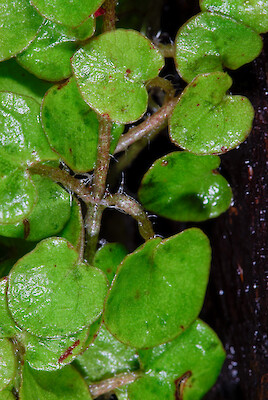
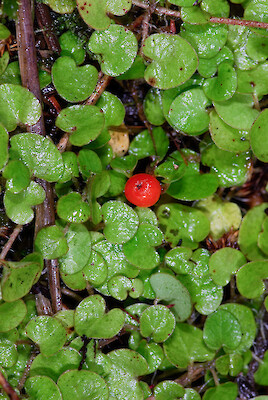
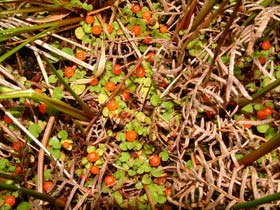
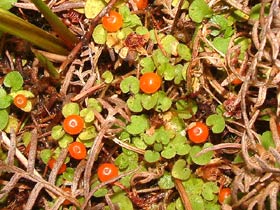
A delicate sprawling perennial herb which forms loose mats of ground cover. The leaves are almost heart shaped and being part of the Coprosma family have stipules on the stem where the leaf stalks attach. The stipules are triangular with a couple of minute hairs nearby. The fruit are bright orange little globes and are often what you will see before the plant itself.
Flower colours
Green, Cream
Detailed description
Creeping perennial herb, forming mats or loose cushions to approximately 5 cm deep, the hairs of the vegetative parts are approximately 0.75 mm long, 5-8 (-13) celled, more or less straight, slender, thin-walled, acicular, contorting somewhat when dry; crimson flecks on stem, petiole and margins of leaf blade; tissues not foetid. Stems terete, 0.4-1.0 mm diameter, glabrous or sparsely hairy (occasionally very hairy, near base of stipules); stipules triangular, fused above petiole base to form a low sheathing collar, lobes dark-glandular at apex, the hairs mostly near base; petioles to approximately 5 mm long, flattened to slightly concave above, pilose along upper margins, the hairs more or less patent; leaf blades to about 6.5 x 7 mm, broad-ovate to almost suborbicular, rounded at apex, cordate at base, glabrous or sometimes with hairs on proximal margins, upper surface with slightly raised midrib and lateral veins, the numerous stomata becoming prominent in dried material and appearing as minute but conspicuous pale tubercles, stomata fewer on lower surface. Flowers solitary, terminal, sessile between a pair of somewhat reduced leaves, bisexual, protogynous. Calyx rim-like, with 2 or 4 minute triangular lobes; corolla funnelform, tube approximately 1 mm long, the lobes 4, about 1 mm long, fully reflexed at anthesis, more or less translucent but crimson mottled externally, margins papillose; filaments approximately 1.6 mm long, entirely free, the anthers 0.4 mm long, introrse; pollen mid-yellow, grains appearing smooth at x400 magnification; styles free to base or slightly fused below, at maturity spreading widely, the exserted (stigmatic) parts approximately 1.5 mm long, somewhat fleshy, slightly flattened dorsiventrally, minutely papillose adaxially and over margins. Fruit more or less globose, approximately 4 mm diameter, orange when ripe; Seeds approximately 2.3 mm long, opening from base up by splitting around the margins for a short way, the lines of weakness not curving inwards over the adaxial face. Embryo about two thirds as long as seed.
Similar taxa
Most similar to Nertera dichondrifolia which has a similar appearance and colour, upon closer examination there are numerous fine short hairs over most of this species compared to the almost hairless N. scapanoides.
When fruiting it may be possible to mistake with Nertera depressa, however this species has smaller leaves which have some olive/brown coloration and also if the leaves are crushed will exude a pungent foul smell as is the case with Coprosma foetidissima.
Distribution
Endemic. Te Ika-a-Māui | North Island, Te Waipounamu | South Island, Rakiura | Stewart Island, Rēkohu | Wharekauri | Chatham Island. Northern North Island South to Southland, less commonly known from Central Plateau in the North to Aurthur’s Pass in the South.
Habitat
Coastal to Montane (0-1200 m.a.s.l.). Often found in peaty wetlands in areas where Sphagnum mosses also occur.
Threats
Wetland destruction via human development and/or degradation by stock grazing.
Detailed taxonomy
Genus
Family
Endemic taxon
Yes
Endemic genus
No
Endemic family
No
Ecology
Flowering
November-January
Fruiting
November-May(-July)
Wetland plant indicator status rating
Information derived from the revised national wetland plant list prepared to assist councils in delineating and monitoring wetlands (Clarkson et al., 2021 Manaaki Whenua – Landcare Research Contract Report LC3975 for Hawke’s Bay Regional Council). The national plant list categorises plants by the extent to which they are found in wetlands and not ‘drylands’. The indicator status ratings are OBL (obligate wetland), FACW (facultative wetland), FAC (facultative), FACU (facultative upland), and UPL (obligate upland). If you have suggestions for the Wetland Indicator Status Rating, please contact: [Enable JavaScript to view protected content]
OBL: Obligate Wetland
Almost always is a hydrophyte, rarely in uplands (non-wetlands).
Other information
Etymology
nertera: Lowly, low growing
scapanioides: Like Scapania, a liverwort
NVS code
The National Vegetation Survey (NVS) Databank is a physical archive and electronic databank containing records of over 94,000 vegetation survey plots - including data from over 19,000 permanent plots. NVS maintains a standard set of species code abbreviations that correspond to standard scientific plant names from the Ngä Tipu o Aotearoa - New Zealand Plants database.
NERSCA
Chromosome number
2n = 44
Previous conservation statuses
The conservation status of all known New Zealand vascular plant taxa at the rank of species and below were reassessed in 2022-2023 using the New Zealand Threat Classification System (NZTCS) – more information about this can be found on the NZTCS website. This report includes replaces all previous NZTCS lists for vascular plants. Previous assessments can be found here.
- Conservation status of vascular plants in Aotearoa New Zealand, 2023. 2024. Peter J. de Lange, Jane Gosden, Shannel P. Courtney, Alexander J. Fergus, John W. Barkla, Sarah M. Beadel, Paul D. Champion, Rowan Hindmarsh-Walls, Troy Makan and Pascale Michel Department of Conservation. Source: NZTCS and licensed by DOC for reuse under the Creative Commons Attribution 4.0 International licence.
2017 | Not Threatened
2012 | Not Threatened
2009 | Not Threatened
2004 | Not Threatened
Regional conservation statuses
Northland: 2026 | Regionally At Risk – Regionally Naturally Uncommon
Current regional threat status assessments prepared according to Crisp et al. (2025) are displayed when available. The Northland conservation status information is sourced from the “Conservation status of indigenous vascular plants in Northland | Taitokerau” Ford et al. 2026 report.
Auckland: 2025 | Regionally At Risk – Regionally Declining | Qualifiers: DPR, DPS, DPT, PF, RR
Current regional threat status assessments prepared according to Crisp et al. (2025) are displayed when available. The Auckland conservation status information is sourced from the “Conservation status of vascular plant species in Tāmaki Makaurau / Auckland” Simpkins E et al. 2025 report.
Otago: 2025 | Regionally At Risk – Regionally Naturally Uncommon | Qualifiers: DPR, DPS, DPT, NS, RR, Sp
Current regional threat status assessments prepared according to Crisp et al. (2025) are displayed when available. The Otago conservation status information is sourced from the “Conservation Status of Indigenous Vascular Plants in Otago, 2025” Jarvie S et al. (2025) report.
Wellington: 2025 | Regionally At Risk – Regionally Naturally Uncommon
Current regional threat status assessments prepared according to Crisp et al. (2025) are displayed when available. The Wellington conservation status information is sourced from the “Conservation status of indigenous vascular plants in the Wellington region” Enright P et al. 2025 report.
Referencing and citations
References and further reading
Gardner RO. 1999. Nertera scapanioides (Rubiaceae) redescribed. New Zealand Natural Sciences. 24: 9 – 19. https://ir.canterbury.ac.nz/server/api/core/bitstreams/f7a6ceea-dfa6-48af-88ae-14b3ca3e0c67/content
Attribution
The majority of this description is from Gardner (1999) CC BY 4.0 https://creativecommons.org/licenses/by/4.0/ Decription adapted by MD Ward for NZPCN, Fact sheet prepared for NZPCN (November 18th 2025).