
Poa aucklandica subsp. rakiura
Common names
Mt Anglem poa
Biostatus
Native – Endemic taxon
Current conservation status
The conservation status of all known New Zealand vascular plant taxa at the rank of species and below were reassessed in 2022-2023 using the New Zealand Threat Classification System (NZTCS) – more information about this can be found on the NZTCS website. This report includes replaces all previous NZTCS lists for vascular plants. Previous assessments can be found here.
- Conservation status of vascular plants in Aotearoa New Zealand, 2023. 2024. Peter J. de Lange, Jane Gosden, Shannel P. Courtney, Alexander J. Fergus, John W. Barkla, Sarah M. Beadel, Paul D. Champion, Rowan Hindmarsh-Walls, Troy Makan and Pascale Michel Department of Conservation. Source: NZTCS and licensed by DOC for reuse under the Creative Commons Attribution 4.0 International licence.
2023 | Threatened – Nationally Critical | Qualifiers: OL
Category
Vascular
Structural class
Grasses
Detailed description
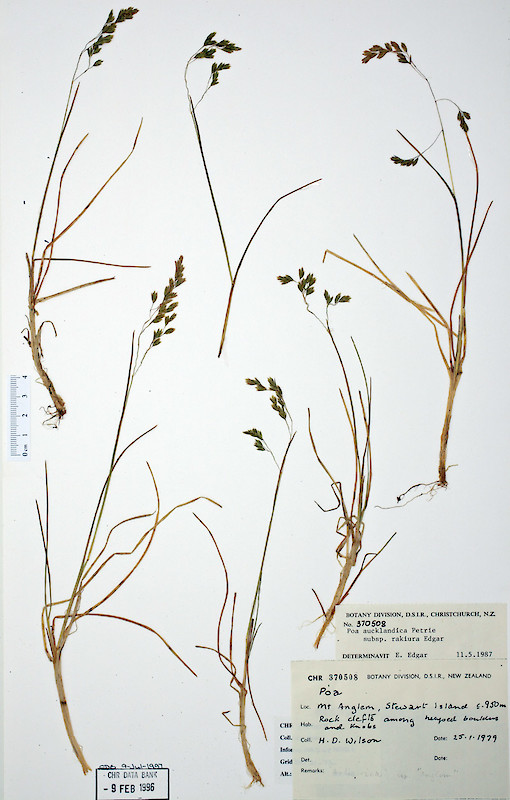
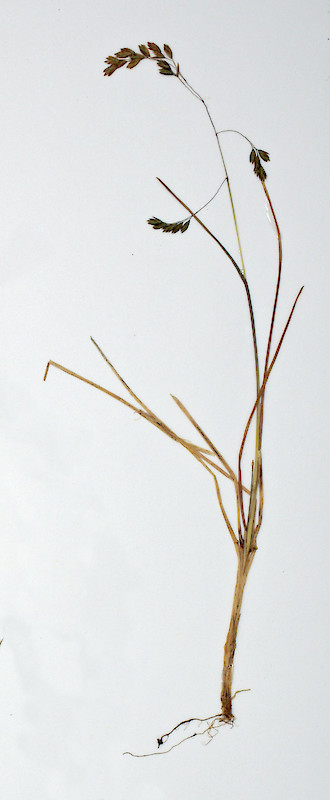
Dull green, slender, laxly tufted, slenderly rhizomatous perennial with narrow, ± erect leaves, ± reaching top of culms; branching extravaginal at plant base, intravaginal above; leaf-blades persistent. Leaf-sheath glabrous or sometimes shortly pubescent-scabrid near margins, very light green or pale brown, membranous, shredding into fibres. Ligule 0.5–2.0 mm, apically glabrous, ± obtuse and slightly erose, abaxially slightly scabrid. Leaf-blade 40–200 × 0.5–1.5 mm, flaccid, soft, flat to folded, underside smooth, upper surface minutely ciliate-scabrid on ribs; margins and midrib entirely smooth or with finely scabrid midrib and margins, tip curved. Culm 150–400 mm tall, slender, internodes usually slightly scabrid below panicle. Panicle 40–75 mm, lax, with few large spikelets borne singly at tips of filiform, finely scabrid branches. Spikelets 5.5–7.5 mm, 3–5-flowered, brownish green or greenish purple. Glumes ± unequal, elliptic, acute; smooth, but occasionally scabrid on midnerve near tip; lower 3.0–4.5 mm, 3-nerved, upper 4–5 mm, 3–(5)-nerved. Lemma 3.5–4.5 mm, oblong-elliptic, obtuse, 5–7-nerved, nerves minutely scabrid with a few short hairs near base of midnerve and outer lateral nerves, internerves glabrous, often scabrid towards tip. Palea 3–4 mm, minutely closely scabrid on keels, smooth elsewhere. Callus with very small tuft of long crinkled hairs. Rachilla c. 1 mm, sparsely scabrid; prolongation to twice as long. Lodicules 0.5–0.7 mm. Anthers 0.5–0.7 mm. Seeds 1.5 × 0.7 mm.
Similar taxa
Allied to Poa aucklandica Petrie subsp. aucklandica and P. aucklandica subsp. campbellensis (Petrie) Edgar. The first subspecies is confined to the Auckland Islands and differs from subsp. rakiura by its smaller tufted habit, with culms up to 300 cf. 400 mm tall in subsp. aucklandica, occasionally finely pubescent-scabrid, rather strictly glabrous leaf-sheath, shorter ligule (up to 1.3 cf. 2.0 mm) and shorter leaves (up to 160 mm cf. 200 mm), larger panicle (up to 80 mm cf. 75 mm), subequal rather than ± unequal glumes and other minor differences in the glume ornamentation, lemma, palea and anther size ranges. Poa aucklandica subsp. campbellensis differs by its restriction to Campbell Island, it is a much smaller plant with closely packed shorter culms (up to 100 cf. 400 mm), longer leaves (up to 50 cf. 200 mm), smaller panicle up to 50 cf. 75 mm, and other minor differences in the glume ornamentation, lemma, palea and anther size ranges.
Distribution
Endemic. New Zealand: Stewart Island (Mt Anglem).
Habitat
Near summit associated with Chionochloa crassiuscula (Kirk) Zotov subsp. crassiuscula grassland on rocks.
Threats
A very localised, naturally uncommon, range restricted endemic known only from a small area near the summit of Mt Anglem. At present there is no evidence of decline but the population needs monitoring to ascertain trends. No obvious threats are evident at its sole known site which is within a Nature Reserve.
Detailed taxonomy
Genus
Family
Synonyms
None (first described in 1986)
Endemic taxon
Yes
Endemic genus
No
Endemic family
No
Ecology
Flowering
Unknown—insufficiently studied and collected.
Fruiting
Unknown—insufficiently studied and collected.
Propagation technique
Unknown.
Other information
Where To Buy
Not Commercially Available
Etymology
poa: Meadow grass
aucklandica: Of the Auckland Islands
rakiura: Named after the Maori name for Stewart Island. Rakiura is derived from raki ‘sky’ and ura ‘glowing’ or ‘blush’. One explanation for the name is because of the beautiful sunsets seen from the Island. Another possible explanation is the name is derived from Te Ura-Te Raki-tamou ‘the blush of Te Raki Tamou, in reference to a story of the shame of a Maori chief who went to the island to court a woman and subsequently found out she had a husband.
Manaaki Whenua Online Interactive Key
Previous conservation statuses
The conservation status of all known New Zealand vascular plant taxa at the rank of species and below were reassessed in 2022-2023 using the New Zealand Threat Classification System (NZTCS) – more information about this can be found on the NZTCS website. This report includes replaces all previous NZTCS lists for vascular plants. Previous assessments can be found here.
- Conservation status of vascular plants in Aotearoa New Zealand, 2023. 2024. Peter J. de Lange, Jane Gosden, Shannel P. Courtney, Alexander J. Fergus, John W. Barkla, Sarah M. Beadel, Paul D. Champion, Rowan Hindmarsh-Walls, Troy Makan and Pascale Michel Department of Conservation. Source: NZTCS and licensed by DOC for reuse under the Creative Commons Attribution 4.0 International licence.
2017 | Threatened – Nationally Critical | Qualifiers: DP, OL
2012 | Threatened – Nationally Critical | Qualifiers: OL
2009 | Threatened – Nationally Critical | Qualifiers: OL
2004 | Range Restricted
Referencing and citations
References and further reading
Edgar E, Connor HE. 2000. Flora of New Zealand. Vol. V. Grasses. Manaaki Whenua Press, Christchurch, NZ. 650 p.
Reed A W. 2002. The Reed Dictionary of New Zealand Place Names. Reed PUblishing. Auckland.
Attribution
Fact sheet prepared for NZPCN by P.J. de Lange (June 2005). Description modified from Edgar and Connor (2000).
Some of this factsheet information is derived from Flora of New Zealand Online and is used under a Creative Commons Attribution 3.0 New Zealand licence.