
Astelia subulata
Biostatus
Native – Endemic taxon
Current conservation status
The conservation status of all known New Zealand vascular plant taxa at the rank of species and below were reassessed in 2022-2023 using the New Zealand Threat Classification System (NZTCS) – more information about this can be found on the NZTCS website. This report includes replaces all previous NZTCS lists for vascular plants. Previous assessments can be found here.
- Conservation status of vascular plants in Aotearoa New Zealand, 2023. 2024. Peter J. de Lange, Jane Gosden, Shannel P. Courtney, Alexander J. Fergus, John W. Barkla, Sarah M. Beadel, Paul D. Champion, Rowan Hindmarsh-Walls, Troy Makan and Pascale Michel Department of Conservation. Source: NZTCS and licensed by DOC for reuse under the Creative Commons Attribution 4.0 International licence.
2023 | At Risk – Naturally Uncommon | Qualifiers: RR, Sp
Category
Vascular
Structural class
Herbs - Monocots
Simplified description
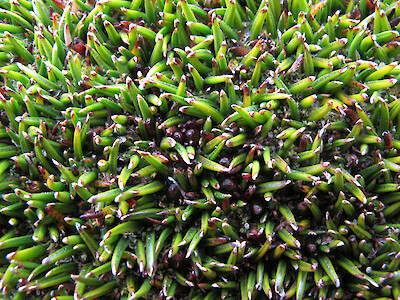
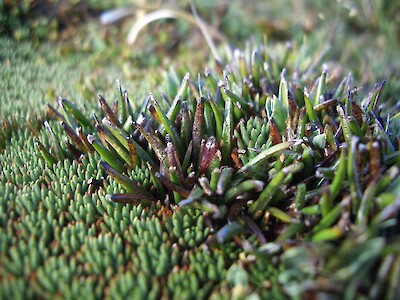
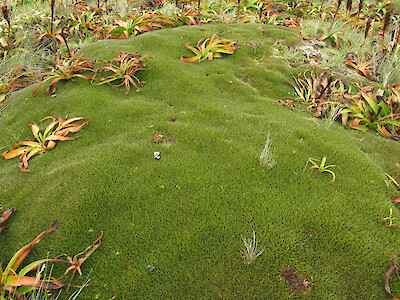
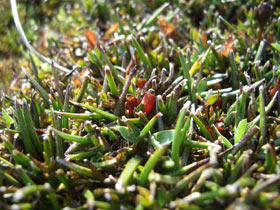
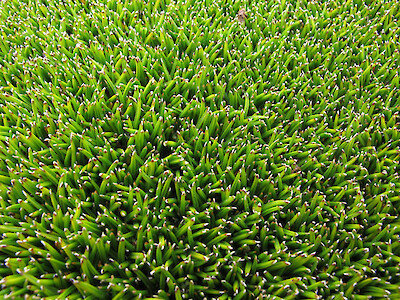
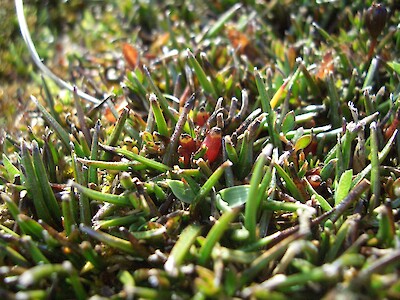
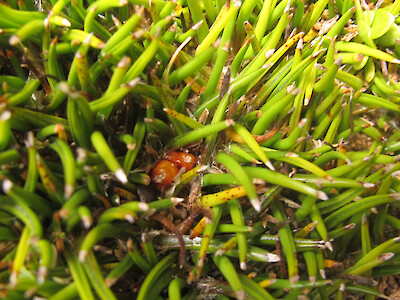
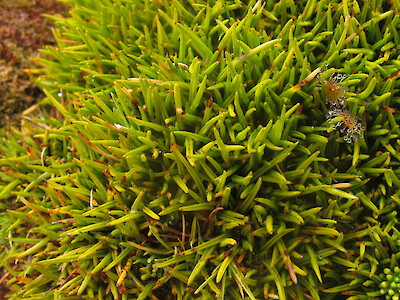
An easily overlooked cushion bog plant among communities of other plants adapted to peat patches, the smallest species of Astelia in New Zealand. The grass-like leaves are shining bright green and numerous, with pointed tips (prickly to the touch), and only up to 25mm in length. The flower spike is modest about same length as leaves with few flowers, fruit are conspicuous fleshy red-orange.
Detailed description
Turf-forming herb, dense extensive patches up to 10 m or more across. Stem, rhizomatous, approximately 1 mm diameter, interwoven below ground, emerging as a stout base for vegetative part above ground. Leaves approximately 10–20 mm long, upright, almost fleshy; sheath membranous, clad abaxially in long pale scales, tapering abruptly into subulate lamina; lamina shallowly channelled, obtuse tip, adaxial channelled surface has obvious strip of caducous scales, abaxial surface glabrous, no nerves visible. Inflorescence erect, approximately the same length as the leaves, panicle represented by only 1–3 flowers; bract single, leaf-like, laterally flattened towards tip, its cup-shaped sheath enclosing basal flower. Flowers with few scales; perianth divided to base; tepals 3-6 mm long, outspread on male flowers, upright on female flowers. Ovary narrowed prolate, unilocular; ovules indefinite. Fruit conspicuously large for the plant (7-)10-13(-23) × 3-5 mm; fleshy, orange, reddish towards narrow tip. Seeds approximately 1.2 × 1 mm, glossy black, compressed pear-shape; stalk hardened into a point.
Similar taxa
This species is similar but much smaller than Astelia linearis var. linearis and Astelia linearis var. novae-zelandiae. Astelia linearis varieties have more scales present giving them an almost grey/silver-tinged appearance.
Distribution
Endemic. Te Waipounamu | South Island, Paparoa Ranges to Ajax Swamp, Catlins; Rakiura | Stewart Island; Motu Ihupuku | Campbell Island; Auckland Islands | Motu maha, Maungahuka.
Habitat
Sub-alpine to low Alpine (700-1500 m.a.s.l.) Peat bogs, cushion bogs.
Detailed taxonomy
Genus
Family
Synonyms
Astelia linearis var. subulata Hook.f.
Endemic taxon
Yes
Endemic genus
No
Endemic family
No
Ecology
Flowering
November - January.
Fruiting
January - April.
Life cycle and dispersal
Fleshy berries are dispersed by frugivory (Thorsen et al., 2009).
Wetland plant indicator status rating
Information derived from the revised national wetland plant list prepared to assist councils in delineating and monitoring wetlands (Clarkson et al., 2021 Manaaki Whenua – Landcare Research Contract Report LC3975 for Hawke’s Bay Regional Council). The national plant list categorises plants by the extent to which they are found in wetlands and not ‘drylands’. The indicator status ratings are OBL (obligate wetland), FACW (facultative wetland), FAC (facultative), FACU (facultative upland), and UPL (obligate upland). If you have suggestions for the Wetland Indicator Status Rating, please contact: [Enable JavaScript to view protected content]
OBL: Obligate Wetland
Almost always is a hydrophyte, rarely in uplands (non-wetlands).
Other information
Etymology
astelia: Stemless
subulata: From the Latin subulam ‘awl’, meaning awl-shaped
NVS code
The National Vegetation Survey (NVS) Databank is a physical archive and electronic databank containing records of over 94,000 vegetation survey plots - including data from over 19,000 permanent plots. NVS maintains a standard set of species code abbreviations that correspond to standard scientific plant names from the Ngä Tipu o Aotearoa - New Zealand Plants database.
ASTSUB
Previous conservation statuses
The conservation status of all known New Zealand vascular plant taxa at the rank of species and below were reassessed in 2022-2023 using the New Zealand Threat Classification System (NZTCS) – more information about this can be found on the NZTCS website. This report includes replaces all previous NZTCS lists for vascular plants. Previous assessments can be found here.
- Conservation status of vascular plants in Aotearoa New Zealand, 2023. 2024. Peter J. de Lange, Jane Gosden, Shannel P. Courtney, Alexander J. Fergus, John W. Barkla, Sarah M. Beadel, Paul D. Champion, Rowan Hindmarsh-Walls, Troy Makan and Pascale Michel Department of Conservation. Source: NZTCS and licensed by DOC for reuse under the Creative Commons Attribution 4.0 International licence.
2017 | At Risk – Naturally Uncommon | Qualifiers: RR, Sp
2012 | Not Threatened
2009 | Not Threatened
2004 | Not Threatened
Regional conservation statuses
Otago: 2025 | Regionally Threatened – Regionally Critical | Qualifiers: DPS, DPT, NS, OL, St
Current regional threat status assessments prepared according to Crisp et al. (2025) are displayed when available. The Otago conservation status information is sourced from the “Conservation Status of Indigenous Vascular Plants in Otago, 2025” Jarvie S et al. (2025) report.
Referencing and citations
References and further reading
Moore LB, Edgar E. 1970. Flora of New Zealand, Volume II. Indigenous Tracheophyta: Monocotyledones except Gramineae. Government Printer, Wellington, NZ. 354 p.
Mark A F. 2021. Above the Treeline: A Nature Guide to Alpine New Zealand, 2nd edition. Potton Burton, Nelson, NZ. 433 p.
Morice IM. 1968. The Smallest Astelia. The Bulletin of the Wellington Botanical Society, Vol.35. pp. 40-41.
Thorsen MJ, Dickinson KJM, Seddon PJ. 2009. Seed dispersal systems in the New Zealand flora. Perspectives in Plant Ecology, Evolution and Systematics 11: 285–309. https://doi.org/10.1016/j.ppees.2009.06.001.
Attribution
Some of this factsheet information is derived from Flora of New Zealand Online and is used under a Creative Commons Attribution 3.0 New Zealand licence.