
Chionochloa rubra subsp. occulta
Common names
red tussock
Biostatus
Native – Endemic taxon
Current conservation status
The conservation status of all known New Zealand vascular plant taxa at the rank of species and below were reassessed in 2022-2023 using the New Zealand Threat Classification System (NZTCS) – more information about this can be found on the NZTCS website. This report includes replaces all previous NZTCS lists for vascular plants. Previous assessments can be found here.
- Conservation status of vascular plants in Aotearoa New Zealand, 2023. 2024. Peter J. de Lange, Jane Gosden, Shannel P. Courtney, Alexander J. Fergus, John W. Barkla, Sarah M. Beadel, Paul D. Champion, Rowan Hindmarsh-Walls, Troy Makan and Pascale Michel Department of Conservation. Source: NZTCS and licensed by DOC for reuse under the Creative Commons Attribution 4.0 International licence.
2023 | Not Threatened
Category
Vascular
Structural class
Grasses
Detailed description
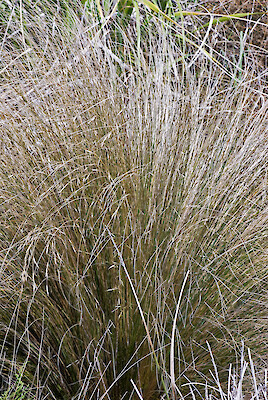
Tall, slender, red tussock with crowded, erect, stiff, rush-like leaves. Leaf-sheath to 300 mm, dark brown, keeled, incurving, fracturing into short segments, inter-ribs with minute and long hairs, margin separating and coiling, apical tuft of hairs to 3 mm. Ligule to 1 mm. Leaf-blade to 1 m long, 1.2 mm diameter, falling with part of sheath; acicular rush-like, splitting longitudinally, keel hollow, abaxially glabrous but infrequently with long hairs near base, prickle-teeth towards apex, adaxially dense wefts of long hairs extending up leaf-blade or short hairs in rows, papillate or prickle-toothed above. Culm to 1.5 m, internodes sometimes long hairy, sheath glabrous. Inflorescence to 45 cm, open on pulvinate branches, glabrous except for long hairs at branch axils and short stiff hairs below spikelets, rarely becoming scabrid above. Spikelets of up to 9 florets. Glumes glabrous, acute, infrequently awned, ≤ adjacent lemma lobes, lower to 12 mm, 1–3–5-nerved, upper to 14 mm, 3–5–7-nerved. Lemma to 6 mm; hairs dense on margin, < sinus; lateral lobes to 6 mm including awn to 2.5 mm; central awn to 13 mm from twisting column to 3 mm. Palea to 8 mm. Callus to 1.5 mm, hairs to 4 mm. Rachilla to 0.75 mm. Lodicules to 1 mm. Anthers to 5 mm. Ovary to 1 mm; stigma-styles to 4 mm. Caryopsis to 3.5 mm.
Similar taxa
Morphologically distinguished from the rest of the Chionochloa rubra Zotov complex by the long weft of hairs on the upper leaf-blade surface which extends well above the ligule.
Distribution
Endemic. New Zealand: South Island (Nelson and West Coast to Cascade Plateau).
Habitat
Upper montane to alpine in scrubland, or as a local dominant in tussock grassland.
Detailed taxonomy
Genus
Family
Synonyms
None (first described in 1991)
Endemic taxon
Yes
Endemic genus
No
Endemic family
No
Ecology
Flowering
October–December
Fruiting
November–April
Propagation technique
Easy from fresh seed and the division of whole plants. However, can be slow growing and dislikes warm, humid climates and drought. Though once established it can take plenty of abuse. The reddish leaves are especially attractive.
Wetland plant indicator status rating
Information derived from the revised national wetland plant list prepared to assist councils in delineating and monitoring wetlands (Clarkson et al., 2021 Manaaki Whenua – Landcare Research Contract Report LC3975 for Hawke’s Bay Regional Council). The national plant list categorises plants by the extent to which they are found in wetlands and not ‘drylands’. The indicator status ratings are OBL (obligate wetland), FACW (facultative wetland), FAC (facultative), FACU (facultative upland), and UPL (obligate upland). If you have suggestions for the Wetland Indicator Status Rating, please contact: [Enable JavaScript to view protected content]
FACW: Facultative Wetland
Usually is a hydrophyte but occasionally found in uplands (non-wetlands).
Other information
Etymology
chionochloa: Snow grass
rubra: Red
Manaaki Whenua Online Interactive Key
NVS code
The National Vegetation Survey (NVS) Databank is a physical archive and electronic databank containing records of over 94,000 vegetation survey plots - including data from over 19,000 permanent plots. NVS maintains a standard set of species code abbreviations that correspond to standard scientific plant names from the Ngä Tipu o Aotearoa - New Zealand Plants database.
CHIRSO
Chromosome number
2n = 42
Previous conservation statuses
The conservation status of all known New Zealand vascular plant taxa at the rank of species and below were reassessed in 2022-2023 using the New Zealand Threat Classification System (NZTCS) – more information about this can be found on the NZTCS website. This report includes replaces all previous NZTCS lists for vascular plants. Previous assessments can be found here.
- Conservation status of vascular plants in Aotearoa New Zealand, 2023. 2024. Peter J. de Lange, Jane Gosden, Shannel P. Courtney, Alexander J. Fergus, John W. Barkla, Sarah M. Beadel, Paul D. Champion, Rowan Hindmarsh-Walls, Troy Makan and Pascale Michel Department of Conservation. Source: NZTCS and licensed by DOC for reuse under the Creative Commons Attribution 4.0 International licence.
2017 | Not Threatened
2012 | Not Threatened
2009 | Not Threatened
2004 | Not Threatened
Referencing and citations
References and further reading
Edgar E, Connor HE. 2000. Flora of New Zealand. Vol. V. Grasses. Christchurch, Manaaki Whenua Press. 650 p.
Attribution
Fact sheet prepared for NZPCN by P.J. de Lange (June 2005). Description modified from Edgar and Connor (2000).
Some of this factsheet information is derived from Flora of New Zealand Online and is used under a Creative Commons Attribution 3.0 New Zealand licence.