
Dracophyllum frondosum
Common names
sprawling inaka, sprawling turpentine scrub
Biostatus
Native – Endemic taxon
Current conservation status
The conservation status of all known New Zealand vascular plant taxa at the rank of species and below were reassessed in 2022-2023 using the New Zealand Threat Classification System (NZTCS) – more information about this can be found on the NZTCS website. This report includes replaces all previous NZTCS lists for vascular plants. Previous assessments can be found here.
- Conservation status of vascular plants in Aotearoa New Zealand, 2023. 2024. Peter J. de Lange, Jane Gosden, Shannel P. Courtney, Alexander J. Fergus, John W. Barkla, Sarah M. Beadel, Paul D. Champion, Rowan Hindmarsh-Walls, Troy Makan and Pascale Michel Department of Conservation. Source: NZTCS and licensed by DOC for reuse under the Creative Commons Attribution 4.0 International licence.
2023 | At Risk – Naturally Uncommon | Qualifiers: Sp, DPS, DPT
Category
Vascular
Structural class
Trees & Shrubs - Dicotyledons
Simplified description
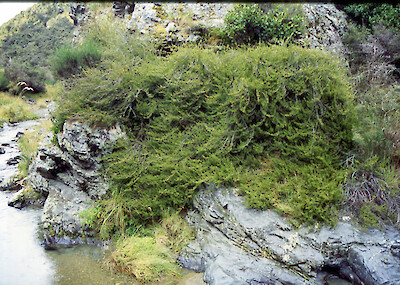
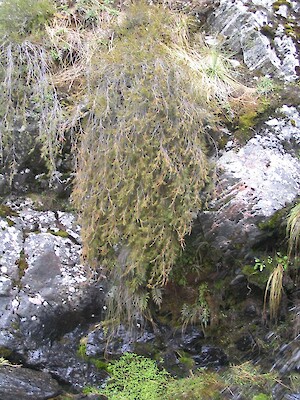
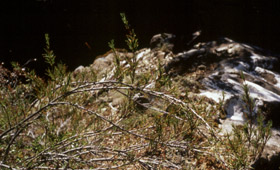
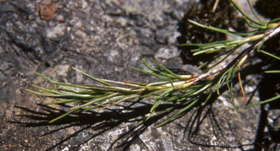
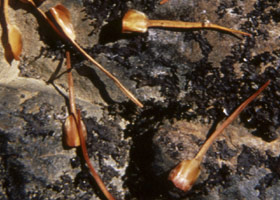
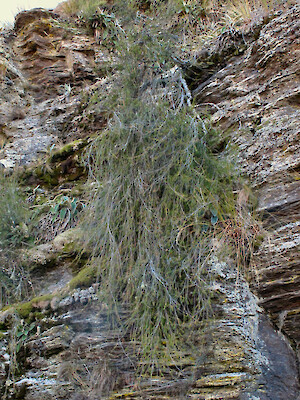
Low-growing grassy shrub with branches that droop down slopes and tufts of narrow wavy leaves at tips of twigs. Leaves 18-34mm long by 0.5-1.5mm wide. Flowers white, tubular, 7-10mm long, solitary at the tips of short side branches.
Flower colours
White
Detailed description
Spreading to decumbent multi–stemmed shrub 0.50–1.0 m tall. Bark on old branches greyish to dark brown, finely fissured, young stems reddish brown. Leaves erect to spreading; lamina sheath, 3.5–7.5 × 2.0–5.0 mm, light green to olive green, margin membranous, shoulders rounded to auricled, ciliate or only the top half ciliate; lamina 18.0–58.0 × 0.5–2.0 mm, light green to olive green, linear, adaxial surface minutely rugose with a tuft of scabrid hairs at base, abaxial surface glabrous; margins serrulate with 60–80 teeth per 10 mm; apex triquetrous and keeled. Inflorescence a terminal, solitary, erect flower on lateral branches, shorter than leaves; flower bract over-topping the flower, foliose, coriaceous, 5.5–11.0 × 0.4–1.2 mm linear; adaxial surface scabrid, abaxial surface glabrous, margin serrulate. Sepals 4.5–9.0 × 1.5–2.0 mm, lanceolate, equaling corolla tube, surfaces glabrous with the top half pubescent on adaxial surface; margins serrulate. Corolla white; corolla tube 5.5–7.0 × 1.5–4.0 mm, cylindrical, widened at mouth, exterior glabrous; corolla lobes reflexed, 1.4–1.5 × 1.0–1.2 mm, ovate–triangular to triangular, shorter than corolla tube, apices inflexed, acute; apical ridge prominent, adaxial surface papillate. Stamens inserted on corolla tube in upper third, filaments 0.3–1.2 mm long; anthers included, oblong, light yellow, 1.0–1.2 mm long. Ovary 2.5–4.5 × 1.2–2.5 mm, cylindrical, apex truncate; nectary scales 1.2–1.5 × 0.5–0.7 mm, rectangular, apices subacute to retuse; style included, 2–4 mm long, glabrous; stigma five–lobed. Fruit sessile, 4.0–4.2 × 2.0–3.0 mm, light brown, broadly obovoid, apex truncate, glabrous. Seed 0.6–0.7 mm long, brown, ovoid, testa slightly reticulate.
Similar taxa
Dracophyllum frondosum is distinguished by the lax, spreading growth habit (often with arching and/or pendulous branches); by the erect–spreading leaves that are 25–50 mm long with ciliate lamina sheaths and a prominent tuft of scabrid hairs at the base on the adaxial surface of the lamina; by the solitary flowers, and flower bracts which are longer than the flowers; by the corolla tube which is equal in length to the sepals; by the densely papillate corolla lobes and by the cylindrical ovary with truncate apex. Dracophyllum frondosum is most closely allied to D. rosmarinifolium with which it sometimes grows and from which it differs in the lax habit and scrambling stems. The flower bract is also longer than the flower and narrower (0.5-1.0 mm compared to 1.0-2.0 mm in D. rosmarinifolium) with the adaxial surface scabrid. The sepal in Dracophyllum frondosum equals the corolla tube and the adaxial surface texture of the sepal is pubescent in the top half and it is also longer (7-10 mm) and wider (2.0-3.0 mm compared to 1.2-2.5 mm in D. rosmarinifolium) than the corolla tube; the corolla lobes are shorter (1.4-1.5 mm compared to 2.0-2.5 mm in D. rosmarinifolium), with longer (1.0-1.2 mm compared to 0.3-0.5 mm in D. rosmarinifolium) filaments. Dracophyllum frondosum also has a longer (2.5-4.5 mm) cylindrical ovary with a truncate apex and a longer (3-4 mm) style.
Distribution
South Marlborough, central and eastern Otago.
Habitat
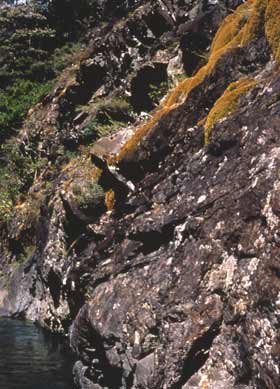
Dracophyllum frondosum is an land lowland to montane plant of rocky gorges and river sides and on cliff faces, especially in the schist country of eastern Otago where it can be locally abundant.
Threats
Endemic. New Zealand: South Island (Nelson lakes Area, eastern Otago).
Detailed taxonomy
Genus
Family
Synonyms
None
Endemic taxon
Yes
Endemic genus
No
Endemic family
No
Ecology
Flowering
December – February
Fruiting
March - August
Propagation technique
Difficult - should not be removed from the wild
Other information
Etymology
dracophyllum: Dragon leaf, from its likeness to the dragon tree of the Canary Islands
NVS code
The National Vegetation Survey (NVS) Databank is a physical archive and electronic databank containing records of over 94,000 vegetation survey plots - including data from over 19,000 permanent plots. NVS maintains a standard set of species code abbreviations that correspond to standard scientific plant names from the Ngä Tipu o Aotearoa - New Zealand Plants database.
DRAFRO
Previous conservation statuses
The conservation status of all known New Zealand vascular plant taxa at the rank of species and below were reassessed in 2022-2023 using the New Zealand Threat Classification System (NZTCS) – more information about this can be found on the NZTCS website. This report includes replaces all previous NZTCS lists for vascular plants. Previous assessments can be found here.
- Conservation status of vascular plants in Aotearoa New Zealand, 2023. 2024. Peter J. de Lange, Jane Gosden, Shannel P. Courtney, Alexander J. Fergus, John W. Barkla, Sarah M. Beadel, Paul D. Champion, Rowan Hindmarsh-Walls, Troy Makan and Pascale Michel Department of Conservation. Source: NZTCS and licensed by DOC for reuse under the Creative Commons Attribution 4.0 International licence.
2017 | At Risk – Naturally Uncommon | Qualifiers: Dp, Sp
2012 | At Risk – Naturally Uncommon | Qualifiers: Sp
2009 | At Risk – Naturally Uncommon | Qualifiers: PD
2004 | Range Restricted
Regional conservation statuses
Otago: 2025 | Regionally Threatened – Regionally Vulnerable | Qualifiers: DPS, DPT, NR, NS, NStr, Sp, St, TL
Current regional threat status assessments prepared according to Crisp et al. (2025) are displayed when available. The Otago conservation status information is sourced from the “Conservation Status of Indigenous Vascular Plants in Otago, 2025” Jarvie S et al. (2025) report.
Referencing and citations
References and further reading
Venter, S. 2009: A taxonomic revision of the genus Dracophyllum Labill. (Ericaceae). Unpublished Phd Thesis, Victoria University of Wellington, Wellington.
Venter, S. 2021: A taxonomic revision of the Australasian genera Dracophyllum and Richea (Richeeae: Styphelioideae: Ericaceae). Australian Systematic Botany 34: 1–205.
Attribution
Fact sheet prepared for NZPCN by P.J. de Lange (6 June 2012). Description adapted from Venter (2009).