
New Zealand Plant Conservation Network
  • Member login
  • Join
Facebook
  • Home
  • Flora
    • Flora species
    • Tag names
    • Vascular
    • Non-vascular
    • Lichens
    • Plant identification
    • Fungi
    • Make your own book
    • Quiz
  • Threats
    • Exotic Plants (Weeds)
    • Pest Animals
    • Other threats
  • Ecosystems
    • Plant communities
    • Ecosystem services
    • Novel ecosystems
  • Publications
    • Documents
    • Newsletter
    • Plant lists
    • Botanical Society journals
    • NZPCN publications
  • Conservation
    • Seedbank
    • Training
    • Restoration
    • Monitoring
    • Habitat protection
    • Funding
    • Botanic gardens
    • Botanic Societies
  • NZPCN
    • News
    • Trilepidea newsletter
    • Events
    • David Given Scholarship
    • Council members
    • Awards
    • Shop
    • Donate
    • Favourite Plant
    • Why join NZPCN?
    • Join
  • Help
    • FAQ
    • Query
    • Glossary
  • Contact us

Search flora

  1. Tracheophyta
    • Tracheophyta
  2. Magnoliopsida
    • Lycopodiopsida
    • Magnoliopsida
    • Pinopsida
    • Polypodiopsida
  3. Ericales
    • Alismatales
    • Apiales
    • Arecales
    • Asparagales
    • Asterales
    • Boraginales
    • Brassicales
    • Canellales
    • Caryophyllales
    • Celastrales
    • Chloranthales
    • Crossosomatales
    • Cucurbitales
    • Dioscoreales
    • Ericales
    • Fabales
    • Fagales
    • Gentianales
    • Geraniales
    • Gunnerales
    • Lamiales
    • Laurales
    • Liliales
    • Malpighiales
    • Malvales
    • Myrtales
    • Nymphaeales
    • Oxalidales
    • Pandanales
    • Paracryphiales
    • Piperales
    • Poales
    • Proteales
    • Ranunculales
    • Rosales
    • Santalales
    • Sapindales
    • Saxifragales
    • Solanales
  4. Ericaceae
    • Ericaceae
    • Primulaceae
    • Sapotaceae
  5. Dracophyllum
    • Acrothamnus
    • Androstoma
    • Archeria
    • Dracophyllum
    • Epacris
    • Gaultheria
    • Leptecophylla
    • Leucopogon
    • Montitega
    • Pentachondra
    • Sprengelia
    • Styphelia
  6. Dracophyllum marmoricola
    • Dracophyllum septentrionale
    • Dracophyllum urvilleanum
    • Dracophyllum arboreum
    • Dracophyllum densum
    • Dracophyllum marmoricola
    • Dracophyllum ophioliticum
    • Dracophyllum patens
    • Dracophyllum trimorphum
    • Dracophyllum frondosum
    • Dracophyllum acerosum
    • Dracophyllum filifolium
    • Dracophyllum fiordense
    • Dracophyllum kirkii
    • Dracophyllum latifolium
    • Dracophyllum lessonianum
    • Dracophyllum menziesii
    • Dracophyllum muscoides
    • Dracophyllum oliveri
    • Dracophyllum palustre
    • Dracophyllum pearsonii
    • Dracophyllum politum
    • Dracophyllum pronum
    • Dracophyllum prostratum
    • Dracophyllum pubescens
    • Dracophyllum recurvum
    • Dracophyllum rosmarinifolium
    • Dracophyllum scoparium
    • Dracophyllum longifolium
    • Dracophyllum sinclairii
    • Dracophyllum strictum
    • Dracophyllum subulatum
    • Dracophyllum townsonii
    • Dracophyllum traversii
    • Dracophyllum elegantissimum
    • Dracophyllum cockayneanum

Dracophyllum marmoricola
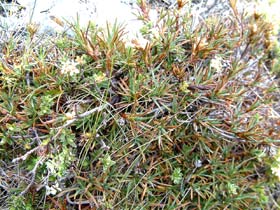
Mt Arthur (January).<br>Photographer: John Smith-Dodsworth, Licence: <a target='_blank' href='https://creativecommons.org/licenses/by-nc/4.0'>CC BY-NC</a>.
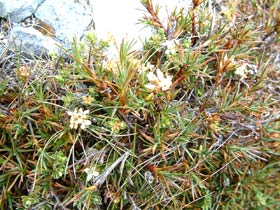
At Mt Arthur (January).<br>Photographer: John Smith-Dodsworth, Licence: <a target='_blank' href='https://creativecommons.org/licenses/by-nc/4.0'>CC BY-NC</a>.
Download PDF Comment on factsheet

NZPCN members can select up to 20 plant species and automatically create a full colour, fully illustrated A4 book describing them (in PDF format).

  • Find out more...
  • Join NZPCN...
Find in plant lists
iNaturalist NZ View observations Biota of NZ Click here to view NZ Flora Click here to view Te Papa View specimens Herbarium View AVH specimens Donate Support NZPCN

Common names

marble Inaka, marble turpentine shrub

Biostatus

Native – Endemic taxon

Current conservation status

The conservation status of all known New Zealand vascular plant taxa at the rank of species and below were reassessed in 2022-2023 using the New Zealand Threat Classification System (NZTCS) – more information about this can be found on the NZTCS website. This report includes replaces all previous NZTCS lists for vascular plants. Previous assessments can be found here.

  • Conservation status of vascular plants in Aotearoa New Zealand, 2023. 2024. Peter J. de Lange, Jane Gosden, Shannel P. Courtney, Alexander J. Fergus, John W. Barkla, Sarah M. Beadel, Paul D. Champion, Rowan Hindmarsh-Walls, Troy Makan and Pascale Michel Department of Conservation. Source: NZTCS and licensed by DOC for reuse under the Creative Commons Attribution 4.0 International licence.

2023 | At Risk – Naturally Uncommon | Qualifiers: RR

Jump to previous conservation statuses

Category

Vascular

Structural class

Trees & Shrubs - Dicotyledons

Simplified description

Low-growing sprawling blue-green shrub with short grass-like leaves crowded at twig tips inhabiting limestone areas in Northwest Nelson. Leaves blue-green, 6-32mm long by 1-2mm wide. Flowers white, tubular, crowded at tip of twigs.

Flower colours

White

Detailed description

Shrublet 2-15 cm tall, multi-stemmed, decumbent to prostrate and sometimes forming compact cushions; bark grey and smooth to finely fissured. Leaves spreading, crowded at the tips of branches, sheathing at base; sheath glaucous, 2.2-6.5 x 3-4 mm, subcoriaceous, shoulder rounded to truncate, margin ciliate; lamina coriaceous, glaucous, linear-triangular to broadly linear-triangular, 5.6-32.0 x 0.75-2.00 mm, slightly concave, surfaces minutely verrucose, margin serrulate, with 12-13 teeth per cm, apex triquetrous. Inflorescence an oblong raceme terminal on branches, dense, 9-24 mm long with 3-8 flowers; inflorescence bracts persistent, longer than flower, coriaceous, light green to glaucous, subulate, 7.5-10.5 x 0.6-1.4 mm at base, verrucose with serrulate margin; flower bract persistent, shorter than flower, coriaceous, broadly ovate, 5-7 x 3.0-4.5 mm, glabrous, margin ciliate, subacute to acute. Flowers sessile. Sepals green to reddish brown, ovate-lanceolate, 4.5-5.5 x 1.5-2.0 mm, equal to shorter than corolla tube, glabrous, ciliate; apex subacute to acute. Corolla white; tube cylindrical, 4.0-6.5 x 2.0-2.5 mm, glabrous; lobes spreading to reflexed, broadly triangular, shorter than corolla tube, 1.5-2.2 x 1.5-1.8 mm, acute to subacute, adaxial surface papillate, abaxial surface glabrous. Stamens epipetalous, 0.4-0.5 mm long; in upper third of corolla tube, anthers light yellow, oblong, 0.6-0.8 mm long, included. Nectary scales separate, rectangular, 0.7-0.8 x 0.4-0.8 mm, apex truncate and emarginate to variously toothed, glabrous; ovary obovate, 1.4-1.5 x 1.3-1.5 mm, apex truncate, glabrous; style enclosed, 1.5 mm long, glabrous; stigma 5-lobed. Capsule sessile, light brown, 2.5-3.5 x 1.8-2.0 mm, obovoid, glabrous, enclosed in persistent sepals; style persistent; seed light brown, ovoid, 1 mm long, surface slightly reticulate.

Similar taxa

Similar to Dracophyllum recurvum but differs in the leaves being minutely rugose to verrucose, not recurved at the apices, flower bracts shorter than flower, sepals glabrous, and apex of ovary truncate. It differs from Dracophyllum kirkii in the narrower verrucose leaves with triquetrous apices and the racemose inflorescence.

Distribution

Endemic. New Zealand: South Island, restricted to North-West Nelson (Kahurangi National Park)

Habitat

Subalpine to alpine (1310-1790 m a.s.l.). Confined to marble exposures where it grows on dark sandy loam in open and exposed sites or in rock crevices in low cliffs in alpine tussock-herbfield.

Threats

Not Threatened. Listed because it is a narrow-range, marble endemic confined to few mountain ranges within Kahurangi National Park.

Detailed taxonomy

Genus

Dracophyllum

Family

Ericaceae

Authority

Dracophyllum marmoricola S.Venter

Synonyms

None (described in 2002)

Endemic taxon

Yes

Endemic genus

No

Endemic family

No

Ecology

Flowering

December - March

Fruiting

April - May

Life cycle and dispersal

Minute seeds are wind dispersed (Thorsen et al., 2009).

Propagation technique

Difficult. Should not be removed from the wild

Other information

Where To Buy

Not commercially available.

Etymology

dracophyllum: Dragon leaf, from its likeness to the dragon tree of the Canary Islands

marmoricola: From the Latin marmor ‘marble’ and cola ‘colour’, meaning marble-coloured

NVS code

The National Vegetation Survey (NVS) Databank is a physical archive and electronic databank containing records of over 94,000 vegetation survey plots - including data from over 19,000 permanent plots. NVS maintains a standard set of species code abbreviations that correspond to standard scientific plant names from the Ngä Tipu o Aotearoa - New Zealand Plants database.

DRAMAR

Previous conservation statuses

The conservation status of all known New Zealand vascular plant taxa at the rank of species and below were reassessed in 2022-2023 using the New Zealand Threat Classification System (NZTCS) – more information about this can be found on the NZTCS website. This report includes replaces all previous NZTCS lists for vascular plants. Previous assessments can be found here.

  • Conservation status of vascular plants in Aotearoa New Zealand, 2023. 2024. Peter J. de Lange, Jane Gosden, Shannel P. Courtney, Alexander J. Fergus, John W. Barkla, Sarah M. Beadel, Paul D. Champion, Rowan Hindmarsh-Walls, Troy Makan and Pascale Michel Department of Conservation. Source: NZTCS and licensed by DOC for reuse under the Creative Commons Attribution 4.0 International licence.

2017 | At Risk – Naturally Uncommon | Qualifiers: RR

2012 | At Risk – Naturally Uncommon | Qualifiers: RR

2009 | At Risk – Naturally Uncommon

2004 | Range Restricted

Jump to current conservation status

Referencing and citations

References and further reading

Venter, S. 2002: Dracophyllum marmoricola and Dracophyllum ophioliticum (Ericaceae), two new species from north-west Nelson, New Zealand. New Zealand Journal of Botany 40: 39-47

Thorsen, M. J.; Dickinson, K. J. M.; Seddon, P. J. 2009. Seed dispersal systems in the New Zealand flora. Perspectives in Plant Ecology, Evolution and Systematics 11: 285-309

Attribution

Fact sheet prepared for NZPCN by P.J. de Lange (4 January 2004). Description adapted from Venter (2002)

NZPCN Fact Sheet citation

Please cite as: de Lange, P.J. (Year at time of access): Dracophyllum marmoricola Fact Sheet (content continuously updated). New Zealand Plant Conservation Network. https://www.nzpcn.org.nz/flora/species/dracophyllum-marmoricola/ (Date website was queried)

▲ Back to top
  • Home
  • Flora
  • Threats
  • Ecosystems
  • Publications
  • Conservation
  • NZPCN
  • Help
  • Contact us

© 2026 New Zealand Plant Conservation Network • Website by RS

Coastlands Plant Nursery Wildlands

Website sponsor

  • Home
  • Flora
    • Flora species
    • Tag names
    • Vascular
      • Ferns
        • King fern
        • True ferns
        • Adder's tongue ferns
        • Fork ferns and whisk ferns
        • Horsetails
      • Conifers
        • Celery pines
        • Kauri
        • Podocarps
          • Podocarpus
          • Dacrydium
          • Prumnopitys
          • Dacrycarpus
          • Halocarpus
          • Lepidothamnus
          • Manoao
        • Cypress
      • Flowering plants
        • Parasites
          • Leafy mistletoes
          • Pygmy mistletoes
            • Korthalsella flowers
            • Korthalsella hosts
            • Dispersal of Korthalsella
            • Associates of Korthalsella
          • Root parasites
          • Saprophytes
        • Epiphytes
          • NZ
            • Typical
            • Occasional
            • Hemi-epiphytes
            • Ephemeral
            • NZ list
        • Monocots
          • Orchids
            • Structure
          • Grasses
        • Dicots
          • Hebes
          • Kowhai
          • Coprosma
          • Beech
          • Rata
        • Carnivorous
        • Deciduous plants
        • Aquatic plants
      • Poisonous natives
      • Threatened plant lists
      • What's a vascular plant?
      • Club mosses
    • Non-vascular
      • Bryophytes
        • Liverworts
        • Mosses
        • Hornworts
      • Algae
        • Seaweeds
    • Lichens
    • Plant identification
      • Written descriptions
      • Experts
      • Plant keys
        • Key to parasitic plant genera
      • Collecting plants
        • Should I collect
        • Choosing a specimen
        • Field notes
        • Fresh plant material
        • Pressing and drying
        • Mounting specimens
        • Labelling specimens
    • Fungi
    • Make your own book
    • Quiz
  • Threats
    • Exotic Plants (Weeds)
      • Unwanted organisms
      • DOC weeds
      • Plant me instead
      • Pest Plant Accord
    • Pest Animals
      • Mammals
        • Mustelids
        • Rodents
        • Ungulates
        • Possums
      • Fish
      • Insects
    • Other threats
      • Natural events
        • Insects
      • Human induced
        • Habitat loss
        • Collection
        • Climate change
  • Ecosystems
    • Plant communities
      • Dunes
        • Volcanic
        • Coastal
          • Threats
          • Common species
          • Research on dunes
          • Pingao research
          • What you can do
      • Wetlands
        • Estuaries
          • Common estuarine species
          • Research on estuaries
        • Ephemeral
        • Restiad peat bogs
      • Forests
        • Kauri-podocarp-broadleaved
        • Podocarp broadleaved
        • Beech
      • Scrub/shrublands
        • Geothermal
          • Distribution of geothermal vegetation
          • Geothermal plants
          • Geothermal vegetation types
          • Threats to geothermal vegetation
        • Frost flat/hollow
        • Manuka fens
        • Gumlands
      • Grasslands
        • Tussock grasslands
      • Bare ground
        • Braided rivers
        • Alpine
        • Cliff
        • Scree and boulderfields
        • Shingle beaches
      • Herbfields
        • Saltpan
    • Ecosystem services
    • Novel ecosystems
  • Publications
    • Documents
    • Newsletter
    • Plant lists
      • Search plant lists
      • Plant lists by political region/district
      • Plant lists by ecological region/district
      • National plant lists
      • How to prepare a plant list
    • Botanical Society journals
    • NZPCN publications
  • Conservation
    • Seedbank
      • Project 1 - Pohutukawa, Rata and Myrtaceae
      • Project 2 - Alpine flora and the Forget-Me-Nots
      • Project 3 - Kowhai and its relatives
      • Project 4 - Podocarps and trees of the forest
    • Training
      • Module 1: Plant life
      • Module 2: Covenants
      • Module 3: Propagation
      • Module 4: Wetlands
      • Pilot course 2006
    • Restoration
      • Gardening
        • Being weed wise
        • Garden plants
          • Trees and shrubs
          • Broad-leaved herbs
          • Grass-like herbs
          • Climbers
          • Ferns
        • Attracting wildlife
        • Planting for lizards
          • Rules
      • Species recovery
        • Plant translocations
      • Ecological restoration
        • Case studies
          • Tavora Reserve
          • Waiwhakareke
      • Revegetation
      • Eco-sourcing
      • Find a restoration group
    • Monitoring
      • Number count
        • Number count method
        • Pros and cons of number counts
        • Data analysis and interpretation
      • Presence/absence surveys
        • Presence/absence survey methods
        • Pros and cons of presence/absence surveys
        • Data analysis and interpretation
      • Mapping spatial extent
        • Spatial extent mapping methods
        • Pros and cons of spatial extent mapping
        • Data analysis and interpretation
      • Photo points
        • Photo point guidelines
    • Habitat protection
      • Legal protection
        • Nga Whenua Rahui
        • QEII covenants
        • DOC Covenants
      • Animal pest control
      • Weed control
      • Fencing
    • Funding
    • Botanic gardens
    • Botanic Societies
  • NZPCN
    • News
    • Trilepidea newsletter
    • Events
      • 2026 NZPCN conference
        • 2026 Conference field trips
        • 2026 Conference workshops
        • 2026 conference sponsors
        • 2026 Conference keynote speakers
      • 2024 AGM
      • Conference 2024
        • 2024 conference overview
        • Conference 2024 workshops
        • Conference 2024 Field Trips
        • 2024 conference sponsors
        • Conference 2024 accommodation options
        • 2024 Conference Programme
      • Conference 2022
        • Conference programme summary
        • 2022 conference workshops
        • 2022 conference field trips
        • Code of conduct
        • COVID-19 information
        • 2022 conference sponsors
        • Abstract and poster submission
        • 2022 Conference venue and accommodation
        • Conference Workshop: Restoration Pathways
        • 2022 conference postponement
      • Conference 2019
      • Conference 2017
      • Conference 2015
        • Speakers
        • Workshops
        • Field trips
        • Charity auction
      • Conference 2013
        • Speakers
        • Timetable
      • 2023 Restoration Pathways Workshop
      • 2023 AGM
    • David Given Scholarship
      • David Given Scholarship Recipients
    • Council members
      • NZPCN council member profiles
      • Council 2023
      • Council 2022
      • Council 2021
      • Council 2020
      • Council 2019
      • Council 2018
      • Council 2017
      • Council 2016
      • Council 2015
      • Council 2014
      • Council 2024
      • Council 2013
      • Council 2012
      • Council 2011
      • Council 2010
      • Council 2009
      • Council 2008
      • Council 2007
      • Council 2006
      • Council 2005
      • Council 2004
      • Council 2003
    • Awards
      • NZPCN Awards
        • 2024 Plant Conservation Awards
        • 2022
        • 2019
        • 2018
        • 2017
        • 2016
        • 2015
        • 2014
        • 2013
        • 2012
        • 2011
        • 2010
        • 2009
        • 2008
        • 2007
        • 2006
        • 2005
    • Shop
    • Donate
    • Favourite Plant
    • Why join NZPCN?
    • Join
  • Help
    • FAQ
      • Joining the Network
      • The Network
      • Network website
      • New Zealand plants
      • The law
      • Your discoveries
    • Query
    • Glossary
  • Contact us
  • Facebook