
Gingidia haematitica
Biostatus
Native – Endemic taxon
Current conservation status
The conservation status of all known New Zealand vascular plant taxa at the rank of species and below were reassessed in 2022-2023 using the New Zealand Threat Classification System (NZTCS) – more information about this can be found on the NZTCS website. This report includes replaces all previous NZTCS lists for vascular plants. Previous assessments can be found here.
- Conservation status of vascular plants in Aotearoa New Zealand, 2023. 2024. Peter J. de Lange, Jane Gosden, Shannel P. Courtney, Alexander J. Fergus, John W. Barkla, Sarah M. Beadel, Paul D. Champion, Rowan Hindmarsh-Walls, Troy Makan and Pascale Michel Department of Conservation. Source: NZTCS and licensed by DOC for reuse under the Creative Commons Attribution 4.0 International licence.
2023 | Threatened – Nationally Endangered | Qualifiers: CD, OL, St
Category
Vascular
Structural class
Herbs - Dicotyledons other than Composites
Simplified description
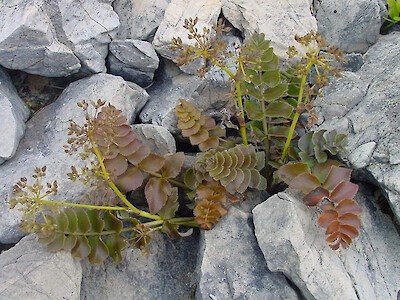
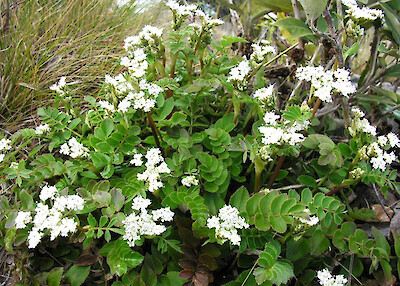
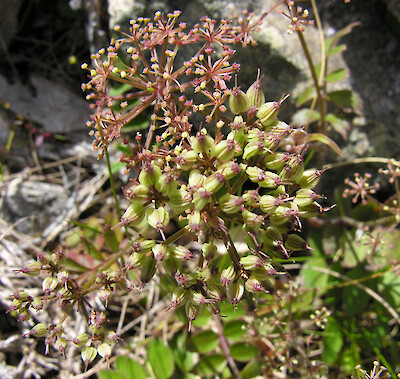
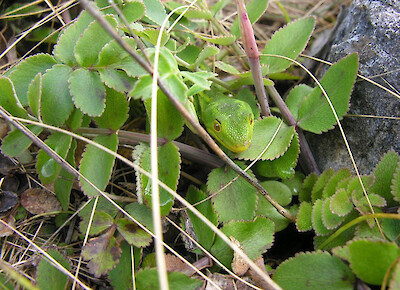
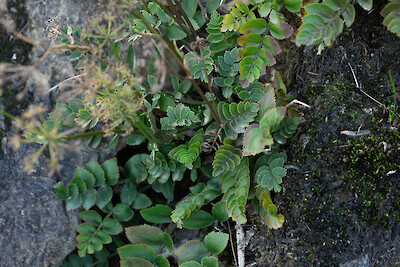
A herbaceous perennial with glabrous, pinnate leaves that are bright green, blue-green or sometimes bronze-green in more exposed conditions. The leaflets are typically in seven to eight pairs with shallow rounded teeth on the margins of each leaflet. The species has white flowers and is gynodioecious. Both male and female flowers are borne in umbels atop stems that are slightly taller than the leaves. The seeds are brown with five ribs
Flower colours
White
Detailed description
Stout to somewhat spreading perennial herbs occasionally forming small colonies; bases often clothed by dead leaf remnants. Petioles 70-115 × 1.5-4 mm, circular in cross-section with shallow channel evident; sheaths 18-22 × 2.5-3 mm. Leaves once pinnate, 3-5 per rosette, leathery, up to 200 mm long; leaflets 7-8 pairs, sessile, simple, ovate to ovate-rhomboid, slightly overlapping, each 7-35 × 5-25 mm, reducing in size distally, margin crenate, base obtuse-truncate without teeth, green to blue-green to bronze-green paler below; Inflorescences 200-550 mm long with larger terminal umbel and up to 3 lateral umbels; compound umbels 1-3 per inflorescence; simple umbels 10-18 per compound umbel; bracts free or partly fused, elliptic; flowers 8-18 per simple umbel; styles 1.0-1.7 mm long in female flowers, 1.7-2.0 mm in hermaphrodite flowers. Mericarps 5-6 mm long, longer than broad, pale orange, orange-brown to brown, vittae dark brown; 5 ribs, with 2 more or less same sized opposing wings.
Similar taxa
G. haematitica is most similar to G. montana and their distributions overlap, G. haematitica is distinguished by its more compact habit, smaller leaves (up to 200 mm) compared to G. montana (up to 800 mm) and brown-red veins on the petioles and leaflets, compared to the those of G. montana which are pale or translucent. Other similar species include G. amphistoma and G. grisea but these two species are only found further south, therefore, do not co-occur with G. haematitica in the wild.
Distribution
Endemic. South Island: North-West Nelson, Mt Burnett Range.
Habitat
Montane (500-600 m.a.sl.). Shaded crevices, and open areas amongst the dolomite and marble bluffs and outcrops.
Threats
Having a limited range which is still subjected to the mining of dolomite, nearby.
Detailed taxonomy
Genus
Family
Synonyms
None first described in 2013 - treated as Gingidia aff. montana (a) (CHR 510570; Mt Burnett) in de Lange et al. (2013)
Endemic taxon
Yes
Endemic genus
No
Endemic family
No
Ecology
Flowering
November-January.
Fruiting
January-March.
Other information
Plant of the Month
This plant has been featured as a Plant of the Month – see Trilepidea: NZPCN newsletter for July 2020 for the full story.
Etymology
gingidia: A Syrian carrot
haematitica: haematitica from the Greek word for blood, αἷμα (haima), it refers to the brown-red veins of the leaflets, midrib and petiole.
Previous conservation status
The conservation status of all known New Zealand vascular plant taxa at the rank of species and below were reassessed in 2022-2023 using the New Zealand Threat Classification System (NZTCS) – more information about this can be found on the NZTCS website. This report includes replaces all previous NZTCS lists for vascular plants. Previous assessments can be found here.
- Conservation status of vascular plants in Aotearoa New Zealand, 2023. 2024. Peter J. de Lange, Jane Gosden, Shannel P. Courtney, Alexander J. Fergus, John W. Barkla, Sarah M. Beadel, Paul D. Champion, Rowan Hindmarsh-Walls, Troy Makan and Pascale Michel Department of Conservation. Source: NZTCS and licensed by DOC for reuse under the Creative Commons Attribution 4.0 International licence.
2017 | Threatened – Nationally Critical | Qualifiers: CD, OL, St
Referencing and citations
References and further reading
de Lange PJ, Rolfe JR, Champion PD, Courtney SP, Heenan PB, Barkla JW, Cameron EK, Norton DA, Hitchmough RA. 2013. Conservation status of New Zealand indigenous vascular plants, 2012. New Zealand Threat Classification Series 3. Department of Conservation, Wellington, NZ. 70 p. https://www.doc.govt.nz/globalassets/documents/science-and-technical/nztcs3entire.pdf.
Heenan PB, Telford IRH, Bruhl JJ. Three new species of Gingidia (Apiaceae: Apioideae) from Australia and New Zealand. Australian Systematic Botany 26(3): 196-209.
Hindmarsh-Walls R. 2020. Plant of the Month – Gingidia Haematitica. TRILEPIDEA Newsletter of the New Zealand Plant Conservation Network. 200: page 4.
Attribution
Fact sheet prepared for NZPCN by MD Ward (October 1st 2025).