
Leptospermum hoipolloi f. hoipolloi




Common names
kahikatoa / mānuka
Biostatus
Native – Endemic taxon
Current conservation status
The conservation status of all known New Zealand vascular plant taxa at the rank of species and below were reassessed in 2022-2023 using the New Zealand Threat Classification System (NZTCS) – more information about this can be found on the NZTCS website. This report includes replaces all previous NZTCS lists for vascular plants. Previous assessments can be found here.
- Conservation status of vascular plants in Aotearoa New Zealand, 2023. 2024. Peter J. de Lange, Jane Gosden, Shannel P. Courtney, Alexander J. Fergus, John W. Barkla, Sarah M. Beadel, Paul D. Champion, Rowan Hindmarsh-Walls, Troy Makan and Pascale Michel Department of Conservation. Source: NZTCS and licensed by DOC for reuse under the Creative Commons Attribution 4.0 International licence.
2017 | Threatened – Nationally Vulnerable | Qualifiers: De, DPS, DPT
Category
Vascular
Structural class
Trees & Shrubs - Dicotyledons
Simplified description
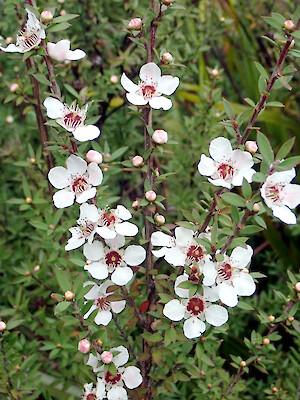
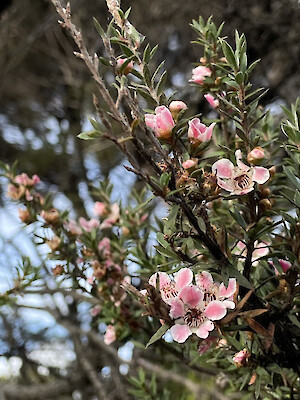
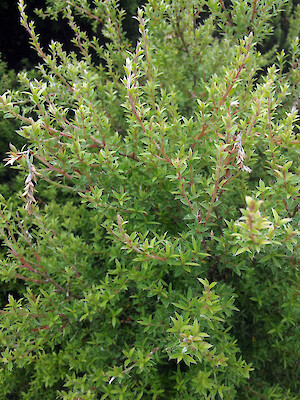
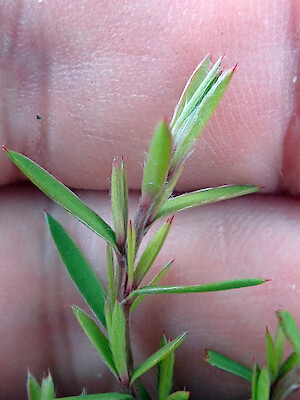
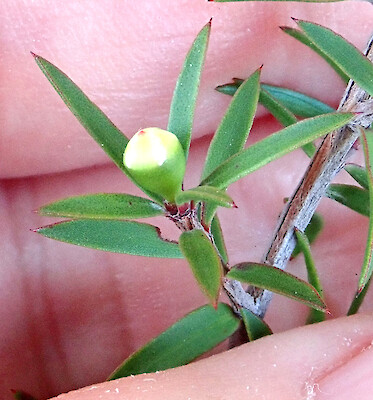
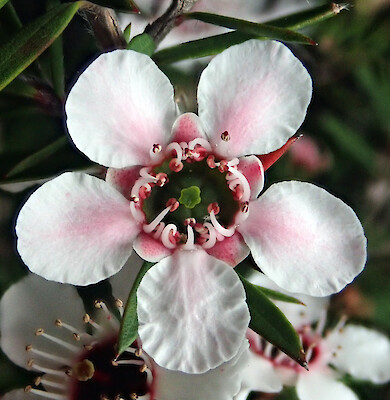
Distinguished from Leptospermum scoparium s. str. with which it often grows by the sericeous, narrower and longer (up to 30 × 6 mm) lanceolate to elliptic lanceolate leaves, larger (up to 30 mm in diameter) flowers (these white, pink-tinged, pink-streaked or red); pink, red, amber or brown (sometimes yellow-green) style up to 4.5 mm long at anthesis, elongating to 5.2 mm after anthesis; stigma flat, pink, red, dark amber-brown, up to 1.3 mm in diameter at anthesis, expanding to 1.6 mm following anthesis; capsules up to 15.1 × 14.1 mm (unopened) and 16.6 × 18.0 mm (opened).
Flower colours
White, Red/Pink
Detailed description
Growth habit — trees or shrubs (1-)3(-10) m tall, sometimes much reduced in extreme acid wetlands, then attaining heights of 100 mm or less. Trunk — usually unbranched at base, up to 0.3 m d.b.h., usually devoid of branches in lower third to half. Bark — usually loosely attached, chartaceous to semi-coriaceous, flaking readily, shards irregular, often with sinuous margins, adaxially charcoal grey or grey, abaxially reddish. Branches — 3 or more, erect, semi-erect or widely spreading, young stems copiously covered in (0.20-0.35-)0.40(-0.52) mm long, white, straight to slightly flexuous, sericeous, antrorse-appressed hairs, usually but not always glabrescent with age. Vegetative bud scales — 3-8, mostly shedding soon after vegetative growth commences, rarely with a few persistent, (0.4-)0.8-1.0(-1.2) × (0.3-)0.6-0.7(-1.0) mm, amber to red-brown, scarious, oblong to ovoid, inner surface smooth, glossy, outer with frayed, lacerate margins or entire, basal portion densely invested in white antrorse-appressed to suberect sericeous hairs up to 0.1 mm long. Leaves — crowded along branchlets, spicy-scented when crushed, divergent to spreading, 5.0-)9.6-17.5(-22.0) × (2.2-)2.8(-3.1) mm, dull to semi-glossy green, dark green, sometimes glaucescent; lamina lanceolate, elliptic lanceolate, flat to weakly concave, shortly acute or sometimes acuminate, rarely cuspidate, acumen if present up to 1.2 mm long, bases cuneate to attentuate, margins minutely denticulate; surfaces on young growth sericeous near base and along midrib, and along leaf margin, maturing ± glabrescent with hairs ± persisting on basal portion of leaf and along portions of leaf margin (especially toward base); oil glands numerous, more evident when dry. Perules — 4-6, shedding at bud burst, (0.4-)0.6-0.8(-1.2) × (0.4-)0.6-0.8(-1.0) mm, glabrous, hyaline, amber to pale red-brown, scarious, orbicular, margins usually entire or sometimes frayed, inner surface smooth, glossy. Inflorescence — monadic on short axillary brachyblasts or on long, 300 mm long or more, terminal shoots. Prophylls — caducous, 2, 0.1-0.2 mm long, oblong, midrib scarcely developed, green to red-green when fresh, tan when dry, abaxial surface densely invested in white sericeous hairs. Pedicels — sessile or subsessile, 0.1-0.4 mm long at anthesis, sometimes elongating to 3.6 mm after anthesis, terete, sparsely invested with antrorse-appressed, sericeous white hairs. Flower buds — clavate, tholiform with calyx lobes not meeting; living flowers when fully expanded (18-)20(-24) mm in diameter. Hypanthium — (4.5-)6.4(-8.0) wide, by (2.3-)3.3(-4.2) mm, yellow-green, green, or pale honey-brown, obconic, obconic-funnelform, terminating in a slightly thicker rim bearing five calyx lobes; surface smooth (wrinkling in dry specimens) finely glandular punctate, glabrous. Calyx lobes 5, spreading, 2.6-2.8 × 2.6-2.8 mm, caducous, broadly deltoid to ovate, with rounded apices, glabrous or very rarely with margins sparsely ciliate, oil glands colourless. Receptacle initially pale pink (sometimes pale green / yellow green), colour usually intensifying to dark red at anthesis. Petals — 5(-6), spreading, 6.7-7.3(-8.3) × 5.2-7.4 mm, white, pink-tinged, pink or very rarely red, orbicular, apex obtuse to rotund, margins finely crimped, oil glands not evident. Stamens — (18-)28(-36-40), arranged in 1(-2) whorls adnate to receptacular rim, filaments white, pink- or more rarely green-tinged (usually near base), or completely pink or carmine. Antipetalous stamens 3-4, antisepalous 4(-6). Outermost antipetalous stamens erect or weakly incurved, sometimes petalloid, on filaments (1.0-)2.3-2.8 mm long, occasional inner whorl of 2 stamens present, these erect or incurved, 1.0-1.3 mm long, positioned at base of the outermost antipetalous pair. Antisepalous stamens usually shorter than antipetalous, on filaments 1.0-1.8 mm long, incurved, erect or in mixtures of both. Anthers dorsifixed 0.3-0.5 × 0.12-0.16 mm, ovoid, latrorse, pale pink, red or dark red. Pollen white to cream. Anther connective gland 0.26 mm long, amber or pale pink, narrowly obovoid. Ovary — 5(-7)-locular, each loculus with 80 or more ovules, set in 8 rows on each placental lobe. Style (2.6-)3.8-4.5 mm long at anthesis, elongating to 5.2 mm after anthesis, pink, red, amber or brown (very rarely yellow green); stigma (0.60-)0.70-1.3 mm in diameter at anthesis, expanding to 1.6 mm following anthesis, flat, pink, red, dark amber brown, at anthesis, finely papillate rugulose. Fruits — persistent, woody, (8.3-)10.3(-14.4) × (8.2-)12.2 mm (unopened), (9.2-)12.3(-16.6) × (9.3-)15.4 mm (opened), pale brown grey to grey, broadly obconic, turbinate, (sometimes hemispherical / globose), centre often with persistent style remnant, valves 5(-7), exserted as a dome, indented at centre, ± symmetrical with base. Valves opening on dead branches or following fire. Seeds — 2.4-2.6(-2.8) × 0.22-0.26 mm, linear, linear-cuneiform, curved, flexuous to sigmoid, laterally compressed or terete, 2-4-angled, apex truncate or acute, testa dull or glossy, orange-brown, glabrous, longitudinally striate.
Similar taxa
Throughout its range Leptospermum hoipolloi f. hoipolloi is sympatric with L. scoparium s. str. From that species L. hoipolloi is easily distinguished by the consistently longer, narrower, lanceolate leaves, whereas L. scoparium s. str. has broadly ovate, oval to orbicular, or broadly elliptic, ovate-elliptic leaves that are sharply acuminate. The mature leaves of L. hoipolloi f. hoipolloi are glabrescent though they usually retain some indumentum on their margins (especially toward the base); however, in L. scoparium s. str. the mature leaves tend to be completely glabrous; hairs if present are usually on the basal adaxial surface and then only sparsely so. Leptospermum hoipolloi f. hoipolloi has slightly larger flowers than L. scoparium (up to 24 mm diameter c.f. up to 20 mm in L. scoparium). As a rule, L. scoparium has white petals; however, pink-tinged and completely red petals are also known in L. scoparium so these are not diagnostic. Morphologically Leptospermum hoipolloi f. hoipolloi (and f. incanum) differs from L. repo by its more heavily branched growth habit and wider (2.2−3.1 mm c.f. 0.3−2.0 mm wide) lanceolate, elliptic-lanceolate, sharply acute, often distinctly acuminate leaves. When fully expanded, these are set at 60−80° rather than 85−90° to the branch axis, and due to their width, often obscure the branchlet internodes, such that the branchlets appear to be “leafier” than they really are. This contrasts with finer, more divergent leaves of L. repo, whose positioning exposes the branchlets internodes, imparting the impression that this species has fewer leaves than it does. The mature leaves of Leptospermum hoipolloi f. hoipolloi are also more consistently hairy, along the leaf margins, midrib and particularly near the leaf base. The leaves of L. repo are glabrous or nearly so. The flowers of Leptospermum hoipolloi f. hoipolloi are usually larger than those of L. repo (up to 24 mm diameter, as compared to 15 mm in L. repo), and whilst usually white, may also be pink-tinged, pink (the pink colour being more common in the northern part of the species range) or red. Another difference is that the stamen filaments of Leptospermum hoipolloi f. hoipolloi though usually white, may be pink- or more rarely green-tinged (usually near base), or completely pink or carmine. The stigma and style of L. hoipolloi f. hoipolloi mature pink, red, amber, or brown (very rarely yellow green) rather than uniformly green in L. repo In the northern part of its range L. hoipolloi f. hoipolloi is found growing syntopically with f. incanum with no apparent ecological differentiation. Morphologically both taxa are similar except that the young emergent and maturing foliage of L. hoipolloi f. incanum is densely invested in long silvery grey appressed hairs, which in extreme examples impart a greyish appearance to the plant. On coastal headlands, rock outcrops and open ground in Northland and the eastern Waikato Leptospermum hoipolloi f. hoipolloi is sympatric with, and commonly grows syntopically with L. hoipolloi f. procumbens. The key distinction between these two taxa is that Leptospermum hoipolloi f. procumbens has a decumbent growth habit with sprawling, prostrate stems (these often layering), pendulous branchlets, and distinctly silver hairy leaves. Leptospermum tairawhitiense differs from L. hoipolloi (all formae) by having short (3.0−9.0 × 1.0−2.1 mm c.f. 5.0−15.0 × 0.3−2.0 mm (in L. repo), 5.0−30.0 × 2.2−6.0 mm (in L. hoipolloi), narrowly elliptic to lanceolate, adaxially dull green to dark green, red-tinged, ±glaucescent (new growth yellow-green, red-tinged, glaucescent) leaves that arise at 70°−90° from the branchlet axis. Leptospermum tairawhitiense also has the smallest flower size range, 8−14 mm diameter, and the flowers are usually subcampanulate, rather than spreading at anthesis. Leptospermum tairawhitiense, unusually for the New Zealand members of the genus, often but not always produces root suckers, in places forming clonal patches on the flood prone river beds, alluvial terraces and slip scars this species favours.
In coastal areas in North-West Nelson, notably at the base Farewell Spit and on the coastline west and south of there, plants of Leptospermum with a decumbent habit (see Schmid et al. 2023) are locally common growing in association with erect L. scoparium s.s. These plants may be referred to L. hoipolloi, perhaps as L. hoipolloi f. procumbens but that require further study of their behaviour in cultivation.
Distribution
Endemic: New Zealand where it is indigenous to North Island and the north-western part of the South Island, growing from the coast to subalpine (0−900 m a.s.l.)
Habitat
Leptospermum hoipolloi f. hoipolloi may be found on a range of substrates including igneous, ultramafic, sedimentary rocks, mobile sand, alluvium, peat and soils derived from these. The species is most commonly found in coastal to lowland / montane areas, especially in regenerating shrubland and gumland.
Threats
Leptospermum hoipolloi f. hoipolloi was assessed by de Lange et al. (2024) as ‘Not Threatened’ on the basis that at the time of that threat listing (November 2022) there was no evidence that myrtle rust disease caused by the invasive rust Austropuccinia psidii was threatening wild populations yet (it has been found on garden plants). Until this disease is confirmed as having an impact on wild populations of Leptospermum hoipolloi f. hoipolloi is regarded as too common over its natural range and believed secure.
Detailed taxonomy
Genus
Family
Synonyms
None - first published in 2023.
Taxonomic notes
There is an alternative taxonomy for Leptospermum in Aotearoa New Zealand based on analysis of the genetic structure of L. scoparium across its range. Chagné et al. (2023) used single nucleotide polymorphism (SNP) array for genotyping specimens of L. scoparium in natural stands around Tasmania and Aotearoa New Zealand. These analyses revealed a genetically distinct Tasmanian L. scoparium grouping, and eight geographic groups within Aotearoa New Zealand. The eight groups were distinguished with genotypic variation that exhibited a general north to south landscape scale pattern with additional regional genetic clusters. The authors summarised that there was little support for taxonomic revision and subdividing L. scoparium within Aotearoa New Zealand based on their results. In comparing recent Leptospermum treatments with the Chagné et al. (2023) analysis, L. repo (de Lange & Schmid 2021) maps as the group ‘L. repo’ in Chagné et al. (2023), L. tairawhitiense (de Lange et al. 2023) maps as the group ‘East Cape North Island’ in Chagné et al. (2023), additionally there is geographic alignment between L. hoipolloi f. incanum (Schmid et al. 2023) and the group ‘northern North Island subcluster #2’ in Chagné et al. (2023), and between L. hoipolloi f. procumbens and the group ‘northern North Island subcluster #1’ in Chagné et al. (2023). The third forma in L. hoipolloi f. hoipolloi maps across five of the Chagné et al. (2023) groups - however, the vouchers used for that study were not made available to the authors of Schmid et al. (2023) for study, and notably throughout the range as mapped by Chagné et al. (2023) a both Leptospermum scoparium and L. hoipolloi are often found growing together. Further study is needed.
Endemic taxon
Yes
Endemic genus
No
Endemic family
No
Ecology
Flowering
Throughout the year but often peaking in late winter / early spring.
Fruiting
Present throughout the year.
Other information
Etymology
leptospermum: Slender seed
hoipolloi: The epithet “hoipolloi” is from the Greek term for ‘the many’ (derived from two Greek words ‘hoi’ [definite article, ói in Greek] and ‘polloi’: οἱπολλοί) in English is usually taken to refer to ‘the masses; common people’ or even ‘rabble’. It is used in a form of academic joke alluding to the abundance and disregard for a very common species that is now economically so important when it was once considered a weed.
Regional conservation statuses
Northland: 2026 | Regionally Not Threatened
Current regional threat status assessments prepared according to Crisp et al. (2025) are displayed when available. The Northland conservation status information is sourced from the “Conservation status of indigenous vascular plants in Northland | Taitokerau” Ford et al. 2026 report.
Auckland: 2025 | Regionally Not Threatened | Qualifiers: DPR
Current regional threat status assessments prepared according to Crisp et al. (2025) are displayed when available. The Auckland conservation status information is sourced from the “Conservation status of vascular plant species in Tāmaki Makaurau / Auckland” Simpkins E et al. 2025 report.
Referencing and citations
References and further reading
Chagné D., Montanari S., Kirk C., Mitchell C., Heenan P., Koot E. 2023. Single nucleotide polymorphism analysis in Leptospermum scoparium (Myrtaceae) supports two highly differentiated endemic species in Aotearoa New Zealand and Australia. Tree Genetics & Genomes, 19: 31.
de Lange, P.J., Schmid L.M.H. 2021. Leptospermum repo (Myrtaceae), a new species from northern Aotearoa / New Zealand peat bog habitats, segregated from Leptospermum scoparium s. l. Ukrainian Botanical Journal, 78(4): 247–265. https://doi.org/10.15407/ukrbotj80.03.173
de Lange P.J., Atkins G., Renner M.A.M., Fisher L.K.M., Marshall A.J., Schmid L.M.H. 2023. Leptospermum tairawhitiense (Myrtaceae), a new species from Aotearoa / New Zealand, segregated from Leptospermum scoparium s. l. Ukrainian Botanical Journal, 80(5): 386−398. https://doi.org/10.15407/ukrbotj80.05.386
de Lange, P.J., Gosden, J., Courtney, S.P., Fergus, A.J., Barkla, J.W., Beadel, S.M., Champion, P.D., Hindmarsh-Walls, R., Makan, T., Michel, P. 2024. Conservation status of vascular plants in Aotearoa New Zealand, 2023. (43). Wellington: New Zealand Department of Conservation. https://www.doc.govt.nz/globalassets/documents/science-and-technical/nztcs43entire.pdf.
Attribution
Fact sheet prepared for NZPCN by P.J. de Lange 30 August 2024. Description from Schmid et al (2023)
NZPCN Fact Sheet citation
Please cite as: de Lange, P.J. (Year at time of access): Leptospermum hoipolloi f. hoipolloi Fact Sheet (content continuously updated). New Zealand Plant Conservation Network. https://www.nzpcn.org.nz/flora/species/leptospermum-hoipolloi-f-hoipolloi/ (Date website was queried)