
Leptospermum tairawhitiense
Common names
Tairawhiti Kahikatoa
Biostatus
Native – Endemic taxon
Current conservation status
The conservation status of all known New Zealand vascular plant taxa at the rank of species and below were reassessed in 2022-2023 using the New Zealand Threat Classification System (NZTCS) – more information about this can be found on the NZTCS website. This report includes replaces all previous NZTCS lists for vascular plants. Previous assessments can be found here.
- Conservation status of vascular plants in Aotearoa New Zealand, 2023. 2024. Peter J. de Lange, Jane Gosden, Shannel P. Courtney, Alexander J. Fergus, John W. Barkla, Sarah M. Beadel, Paul D. Champion, Rowan Hindmarsh-Walls, Troy Makan and Pascale Michel Department of Conservation. Source: NZTCS and licensed by DOC for reuse under the Creative Commons Attribution 4.0 International licence.
2023 | At Risk – Naturally Uncommon | Qualifiers: DPS, DPT
Category
Vascular
Structural class
Trees & Shrubs - Dicotyledons
Simplified description
Distinguished from Leptospermum scoparium, L. hoipolloi, and L. repo by the shortly and densely branching growth habit; the often suckering growth habit; leaves arising at (70−)85−90° from the stem; leaves that are narrow-lanceolate, elliptic-lanceolate, rarely narrowly ovate (3.0−)4.8−6.2(−9.0) × (1.0−)1.3(−2.1) mm, coloured dull green to dark green, red-tinged, ± glaucescent (new growth yellow-green, red-tinged, glaucescent); flowers subcampanulate, 8−14 mm in diameter, with 5(−8) white petals, 5.0−7.0 × 4.6−6.4 mm and 20−32 stamens with white or pink filaments; capsules up to 6.8 × 5.5 mm (unopened), 7.2 × 4.6 mm (opened).
Flower colours
White
Detailed description
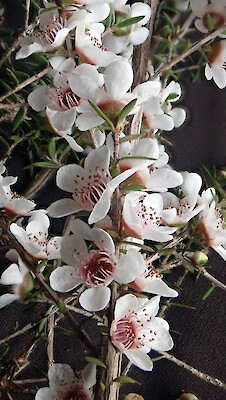
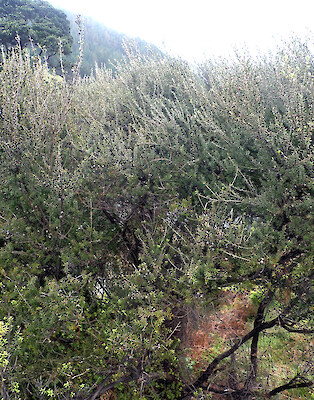
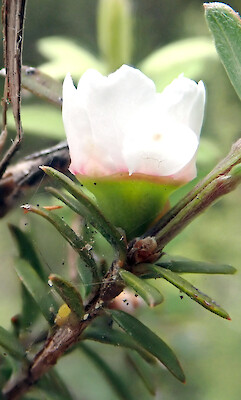
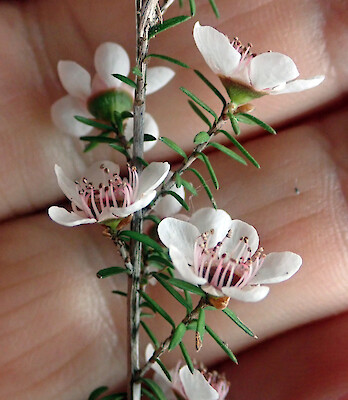
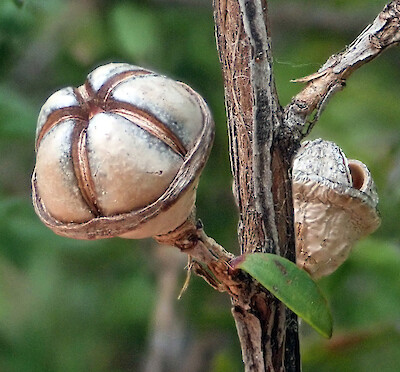
Growth habit — erect shrubs up to 4 m tall, bases sometimes suckering, and when so forming thickets up to 2 m wide. Trunk — slender, usually unbranched at base, up to 0.2 m d.b.h., branched or not from base. Bark — usually loosely attached, chartaceous to semi-coriaceous, flaking readily, shards irregular, often with sinuous margins, adaxially charcoal grey or grey, abaxially reddish. Branches — 3 or more, erect, semi-erect or widely spreading, with numerous branchlets, young stems glabrescent, initially copiously covered in (0.10−0.22−)0.25(−0.40) mm long, white, straight to slightly flexuous, sericeous, antrorse-appressed, caducous hairs. Vegetative bud scales — 3−8, mostly shedding soon after vegetative growth commences, rarely persistent (0.4−)0.6−0.8(−1.0) × (0.3−)0.6−0.7(−1.0) mm, amber to red-brown, scarious, oblong to ovoid, inner surface smooth, glossy, outer often entire, sometimes with frayed, lacerate margins, glabrescent. Leaves — crowded along branchlets, spicy-scented when crushed, divergent to spreading (arising at angles of (70−)85−90° from axis, in mature plants), semi-glossy yellow-green to dull dark green, usually red-tinged in seedlings, maturing, dull green to dark green, red-tinged, ±glaucescent (new growth, or if plants stressed, yellow-green, red-tinged, glaucescent); lamina (3.0−)4.8−6.2(−9.0) × (1.0−)1.3(−2.1) mm, narrow-lanceolate, elliptic-lanceolate, rarely narrowly ovate, flat to weakly concave, acute or sometimes acuminate, usually cuspidate, acumen if present up to 0.2−0.4 mm long, bases cuneate to attentuate, margins minutely denticulate; surfaces on young growth sericeous hairy either near base and along midrib, and along leaf margin, maturing glabrescent or with adaxial and abaxial surfaces sparsely covered with hairs, these (if present) either persisting on mature leaves or ± persisting on basal portion of leaf and along portions of leaf margin (especially toward base); oil glands numerous, more evident when dry. Perules — 4−6, shedding at bud burst, (0.3−)0.4−0.8(−1.1) × (0.4−)0.6−0.8(−1.0) mm, glabrous, hyaline, amber to pale red-brown, scarious, orbicular, margins usually entire or sometimes frayed, inner surface smooth, glossy. Inflorescence — monadic on short axillary brachyblasts or on long, 400 mm long or more, terminal shoots. Prophylls — caducous, 2, 0.1−0.2 mm long, oblong, midrib scarcely developed, green to red-green when fresh, tan when dry, abaxial surface densely invested in white sericeous hairs. Pedicels — sessile or subsessile, 0.1−0.2 mm long at anthesis, sometimes elongating to 1.3 mm after anthesis, terete, sparsely invested with antrorse-appressed, sericeous white hairs. Flower buds — clavate, tholiform, spheroidal, with calyx lobes not meeting. Flowers — living flowers subcampanulate, when fully expanded (8−)10(−14) mm in diameter. Hypanthium — green, obconic, obconic-funnelform, (2.5−)3.9−4.2(−4.8) wide, by (2.2−)3.3(−4.0) mm, terminating in a thicker rim bearing five calyx lobes; surface smooth, finely glandular punctate, glabrous. Calyx lobes — 5, erect to sub-erect, 0.8−1.2 × 0.9−1.4 mm, green, broadly deltoid, subacute. Sepals — sub-erect to ± spreading, caducous, 3.0−4.5 × 3.6−4.8 mm, white, green-white, or pink-tinged, tabular-obtuse, sometimes subacute, apices often weakly cucullate, oil glands evident, colourless. Receptacle initially pink, colour intensifying to dark red at anthesis. Petals — 5(−8)5.0−6.6(−7.0) × 4.6−6.4 mm, white, orbicular, apex obtuse, rotund, sometimes subtruncate, margins entire or finely crimped, oil glands not evident. Stamens — (20−)28(−32), arranged in 1(−2) whorls adnate to receptacular rim, filaments white or pink. Antisepalous stamens (2−)3(−4), antipetalous (2−)4−5(−6). Antisepalous stamens on filaments 1.0−1.8 mm long, incurved, erect or in mixtures of both. Antipetalous stamens erect or weakly incurved, sometimes petalloid, on filaments (3.0−)4.6−6.0 mm long, occasional inner whorl of 2 stamens present, these erect or incurved, 2.0−3.3 mm long, positioned at base of the outermost antipetalous pair. Anthers dorsifixed 0.3−0.5 × 0.12−0.16 mm, ovoid, latrorse, pink or dark red. Pollen white to cream. Anther connective gland c. 0.19 mm long, amber, or pale pink, narrowly obovoid. Ovary — 5(−7)-locular, each loculus with 70 or more ovules, set in 8 rows on each placental lobe. Style (2.6−)3.8−4.5 mm long at anthesis, elongating to 5.2 mm after anthesis, green, pink, darkening to red, at anthesis; stigma (0.40−)0.50−0.8 mm in diameter at anthesis, expanding to 1.0 mm following anthesis, flat, initially green, or pink, darkening red at anthesis, finely papillate rugulose. Fruits — persistent, woody, (4.5−)5.6(−6.8) × (3.6−)5.5 mm (unopened), (4.8−)5.8(−7.2) × (3.8−)4.6 mm (opened), pale grey, broadly obcoic or hemispherical / globose, centre often with persistent style remnant, valves 5(−7), exserted as a dome, indented at centre, ± symmetrical with base. Valves opening on dead branches or following fire. Seeds — 2.2−2.4(−2.8) × 0.19−0.22 mm, linear, linear-cuneiform, curved, flexuous to sigmoid, laterally compressed, or terete, 2−4-angled, apex truncate or acute, testa dull or glossy, orange-brown, glabrous, longitudinally striate.
Similar taxa
Leptospermum tairawhitiense forms its own clade (see Koot et al., 2022) and is further distinguished by its unique chemistry (Douglas et al., 2004). Plants are easily separated from other North Island Leptospermum by their short (3.0−9.0 × 1.0−2.1 mm c.f. 5.0−15.0 × 0.3−2.0 mm (in L. repo), 5.0−30.0 × 2.2−6.0 mm (in L. hoipolloi), narrowly elliptic to lanceolate, adaxially dull green to dark green, red-tinged, ±glaucescent (new growth yellow-green, red-tinged, glaucescent) leaves that arise at 70°−90° from the branchlet axis. Leptospermum tairawhitiense has the smallest flower size range, 8−14 mm diameter. the flowers of L. tairawhitiense are usually subcampanulate, rather than spreading at anthesis. Leptospermum tairawhitiense, unusually for the New Zealand members of the genus, often but not always produces root suckers, in places forming clonal patches on the flood prone river beds, alluvial terraces and slip scars this species favours. Root suckering has also been reported in Leptospermum scoparium s. l. by Burrell (1965), though this seems to be very unusual in that species. Throughout its range, Leptospermum tairawhitiense is widely sympatric and even syntopic with L. hoipolloi and L. scoparium s. str. Key differences between L. tairawhitiense and L. hoipolloi are noted above. As far as it is known, Leptospermum repo and L. tairawhitiense are wholly allopatric. Some specimens of L. tairawhitiense have leaf shapes and dimensions comparable to those in L. repo. However, morphologically they are readily separated, have different ecological preferences, chemistry, and belong to separate clades (Koot et al., 2022). Leptospermum scoparium s. str., as circumscribed and illustrated by de Lange & Schmid (2021), morphologically differs from L. tairawhitiense by the broadly ovate, oval to orbicular, or broadly elliptic, ovate-elliptic leaves that are sharply acuminate ranging from 3−20 × 3.0−15 mm, rather than narrowly elliptic to lanceolate, and ranging from 3.0−9.0 × 1.0−2.1 mm. Chemically, L. scoparium s. l. does not have the elevated triketone levels reported by Douglas et al. (2004) and, as currently circumscribed, belongs to different clusters: (CSNI (Central and Southern North Island), NESI (North East South Island), SWSI (South West South Island) (Koot et al., 2022). While the status of those plants referred to L. scoparium s. l. within those clusters still needs examination, their relationship, morphologically, chemically, and genetically, to L. tairawhitiense is unequivocal: they are distinct from that species. Possibly, L. tairawhitiense has originated via peripatric speciation from an isolated ancestral population. Genetic data obtained to date suggest limited ongoing genetic contact with other New Zealand Leptospermum species (Chagné et al., 2023), but this is not incompatible with the existence and maintenance of a distinct evolutionary identity for these East Coast plants (de Queiroz et al., 1998).
Distribution
Endemic to Aotearoa / New Zealand where it is endemic to the Tairāwhiti / East Cape, occurring in a narrow band from Hawai along the coastline, river valleys, river beds and lower foothills of the Raukūmara Range, increasing in abundance from Pōtaka east and thence south along the eastern portion of Tairāwhiti / East Cape to just south of Ūawa (Tolaga Bay).
Habitat
Leptospermum tairawhitiense is a species of river flats, in places prone to frequent flooding, coastal shrublands and occasionally in reverting pasture on hill slopes. In these habitats it mostly associates with Kunzea robusta, Coriaria arborea var. arborea and Coprosma robusta. On alluvium along flood prone rivers, it is often the sole woody shrub present, or the dominant one.
Detailed taxonomy
Genus
Family
Taxonomic notes
There is an alternative taxonomy for Leptospermum in Aotearoa New Zealand based on analysis of the genetic structure of L. scoparium across its range. Chagné et al. (2023) used single nucleotide polymorphism (SNP) array for genotyping specimens of L. scoparium in natural stands around Tasmania and Aotearoa New Zealand. These analyses revealed a genetically distinct Tasmanian L. scoparium grouping, and eight geographic groups within Aotearoa New Zealand. The eight groups were distinguished with genotypic variation that exhibited a general north to south landscape scale pattern with additional regional genetic clusters. The authors summarised that there was little support for taxonomic revision and subdividing L. scoparium within Aotearoa New Zealand based on their results. In comparing recent Leptospermum treatments with the Chagné et al. (2023) analysis, L. repo (de Lange & Schmid 2021) maps as the group ‘L. repo’ in Chagné et al. (2023), L. tairawhitiense (de Lange et al. 2023) maps as the group ‘East Cape North Island’ in Chagné et al. (2023), additionally there is geographic alignment between L. hoipolloi f. incanum (Schmid et al. 2023) and the group ‘northern North Island subcluster #2’ in Chagné et al. (2023), and between L. hoipolloi f. procumbens and the group ‘northern North Island subcluster #1’ in Chagné et al. (2023). The third forma in L. hoipolloi f. hoipolloi maps across five of the Chagné et al. (2023) groups.
Regarding Leptospermum tairawhitiense (which was described after Chagné et al. (2023) was published), de Lange et al. (2023) stated “the fact that L. tairawhitiense forms a discrete genetic cluster, the presence of morphological character differences, some of which are unique to L. tairawhitiense, ecological differences and geographic range restriction, in combination with the sympatric and even syntopic occurrence with other Leptospermum species, may all be explained by L. tairawhitiense having and maintaining a separate evolutionary identity from other Leptospermum. Possibly, L. tairawhitiense has originated via peripatric speciation from an isolated ancestral population. Genetic data obtained to date suggest limited ongoing genetic contact with other New Zealand Leptospermum species (Chagné et al., 2023), but this is not incompatible with the existence and maintenance of a distinct evolutionary identity for these East Coast plants (de Queiroz et al., 1998).’ The species is also accepted by Biota of New Zealand (Flora - see https://biotanz.landcareresearch.co.nz/scientific-names/5a3a74a3-f0fb-459a-b645-40cc356db091)
Endemic taxon
Yes
Endemic genus
No
Endemic family
No
Ecology
Flowering
October-December (peaking in early November)
Fruiting
Throughout year
Propagation technique
Easily grown from fresh seed. Leptospermum tairawhitiense is an attractive species on account of its small often reddish or glaucescent leaves and seemingly large, white subcampanulate flowers with dark red centres and often pink stamen filaments.
Other information
Etymology
leptospermum: Slender seed
tairawhitiense: Derived from ‘te tai rāwhiti’ meaning the ‘coast of the sun- rise’ which is the te reo Māori name for the East Cape region of Te Ika a Māui / North Island, of Aotearoa / New Zealand
Chromosome number
2n = 22
Referencing and citations
References and further reading
Burrell J. 1965. Ecology of Leptospermum scoparium. New Zealand Journal of Botany 3: 3−16. https://doi.org/10.1080/00288 25X.1965.10428708
Chagné D., Montanari S., Kirk C., Mitchell C., Heenan P., Koot E. 2023. Single nucleotide polymorphism analysis in Leptospermum scoparium (Myrtaceae) supports two highly differentiated endemic species in Aotearoa New Zealand and Australia. Tree Genetics & Genomes, 19: 31.
de Lange P.J., Atkins G., Renner M.A.M., Fisher L.K.M., Marshall A.J., Schmid L.M.H. 2023. Leptospermum tairawhitiense (Myrtaceae), a new species from Aotearoa / New Zealand, segregated from Leptospermum scoparium s. l. Ukrainian Botanical Journal, 80(5): 386−398. https://doi.org/10.15407/ukrbotj80.05.386
de Lange, P.J., Schmid L.M.H. 2021. Leptospermum repo (Myrtaceae), a new species from northern Aotearoa / New Zealand peat bog habitats, segregated from Leptospermum scoparium s. l. Ukrainian Botanical Journal, 78(4): 247–265.
de Queiroz K., Howard D.J., Berlocher S.H. 1998. The general lineage concept of species, species criteria, and the process of speciation: A conceptual unification and terminological recommendations. In: Endless forms: Species and speciation. New York: Oxford University Press, pp. 57–75.
Douglas M.H., van Klink J.W., Smallfield B.M., Perry N.B., Anderson R.E., Johnstone P., Weavers R.T. 2004. Essential oils from New Zealand mānuka: triketone and other chemotypes of Leptospermum scoparium. Phytochemistry, 65(9): 1255–1264.
Koot E., Arnst E., Taane M., Goldsmith K., Dormont E., Hancox T., Delaporte K., Thrimawithana A., Reihana K., González-Martínez S.C., Goldsmith V., Houliston G., Chagné D. 2022. Genome-wide patterns of genetic diversity, population structure and demographic history in mānuka (Leptospermum scoparium) grown on indigenous Māori land. Horticultural Research, 9: 1–17
Attribution
Fact sheet prepared for NZPCN by P.J. de Lange 30 August 2024. Description from de Lange et al (2023)
NZPCN Fact Sheet citation
Please cite as: de Lange, P.J. (Year at time of access): Leptospermum tairawhitiense Fact Sheet (content continuously updated). New Zealand Plant Conservation Network. https://www.nzpcn.org.nz/flora/species/leptospermum-tairawhitiense/ (Date website was queried)